Climate change claims more victims; Vietnam elects new president

This week in Asean:
- Vietnam: Elects new president, parliament chair after high-level exits
- Indonesia: Keeps interest rate steady after April’s hike
- Thailand: Q1 growth slowed, prompting rate cuts
- Malaysia: Privatisation bid for Malaysia Airports may face opposition
Dear BT reader,
The tragic incident aboard Singapore Airlines Flight SQ 321 is a painful reminder of how humans are powerless in the face of climate forces.
While the turbulence that rocked the Boeing 777-300ER aircraft seems to be a rare and entirely unpredictable occurrence, industry watchers pointed out that it is becoming more common and severe due to climate change, which may hurt travellers’ confidence in the long run.
Climate change is causing damage across industries: a new report found that nearly one in 10 assets belonging to real estate investment trusts (Reits) across the Asia-Pacific region will be at high risk from extreme weather by 2050, with those in Singapore among the most vulnerable.
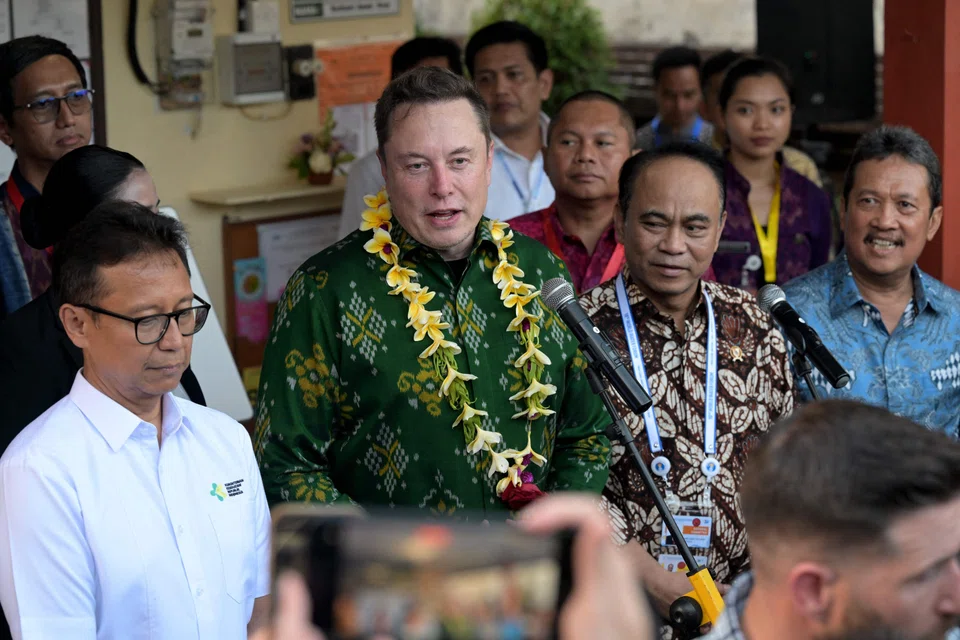
We previously looked at how El Nino-induced drought is taking a toll on Indonesia. This week, SpaceX and Tesla chief Elon Musk visited Bali in conjunction with the 10th World Water Forum. Noting plummeting cost of batteries, Musk highlighted the potential for storing solar energy to power desalination processes, thereby improving water security.
During his visit, Musk also launched SpaceX’s Starlink Internet services in Indonesia as the country seeks to boost connectivity to its most remote areas.
While the tech billionaire is mulling more investments, experts warn that Indonesia risks losing its appeal to environmentally focused investors due to its near-term reliance on coal.
The country’s coal demand is expected to grow with President-elect Prabowo Subianto’s focus on energy self-sufficiency, economic growth and nickel processing, despite efforts to transition to renewable energy. The increase in demand is likely to be met with the rise in coal production, forecasted to hit 970.1 million tonnes by 2030.
While Prabowo’s administration maintains commitments to achieve net-zero by 2060, the challenge of balancing coal dependency with green ambitions remains significant. Read our ESG correspondent Sharanya Pillai’s deep dive on how the new government’s policy direction matters to global investors.
The week has also seen Vietnam achieving a bit of clarity amid its shaken-up political scene with the election of its newest president and parliament chair. Since 2022, a total of six top officials have been purged from the Politburo, the country’s highest decision-making body, amid the ruling party’s anti-graft crackdown.
The fluid political backdrop was thought to carry the risk of undermining one of Vietnam’s key selling points – its political stability. Yet, results show that investors are still flocking to Vietnam despite the political upheaval: between January and April, disbursed foreign direct investment rose 7.4 per cent from a year earlier to US$6.3 billion.
Economists have previously cited the country’s stable economic policies as a saving grace for investors amid leadership turmoil. More stability is expected from here on out.
I hope you have enjoyed this week’s reads. Be sure to scroll down for more stories, and we will see you next Friday!
Trending
On Thursday (May 23) morning, China launched immediate military drills around Taiwan, taking the island by surprise. The sudden act was largely seen as a “punishment” in response to the inauguration speech of Taiwan’s new President Lai Ching-te, who took office on Monday and is regarded by China as a dangerous “separatist”.
While no actual attack is expected, the relationship between China and Taiwan appears to be deteriorating and continues to be a source of instability affecting the Asia-Pacific region.
Asean in Brief
- Big tech players splash the cash to court S-E Asia’s young and fast digitalising population Tech giants have been courting South-east Asia in recent weeks, with high-profile visits from senior executives with promises of eye-watering investment amounts. Read more
- Nearly one in 10 Reit assets in Apac at high risk from climate change, extreme weather: report Close to one in 10 assets belonging to real estate investment trusts across Asia-Pacific will be at high risk from the effects of climate change and extreme weather by 2050. Read more
- Thailand’s economic growth slows even as it beats estimate Thailand’s economic growth slowed in the first quarter, heaping further pressure on the central bank to answer the government’s call for lower borrowing costs to aid recovery. Read more
- Political shake up: Vietnam elects new president, parliament chair after high-level exits Vietnam’s National Assembly elected top security official To Lam as the new president on Wednesday (May 22), filling the second-highest political post after his predecessor resigned amid an anti-corruption campaign. Read more
- Oil-rich Sarawak wants greater investments in renewable energy The Malaysian state of Sarawak, a major supplier of fossil fuels for much of the past century, is making a rapid shift to renewable energy and hopes to become a regional provider of hydropower in the near future, said the state’s premier at an energy conference in Thailand. Read more
- Malaysia Airports shareholder expresses doubt on takeover bid Northcape Capital said a bid by major shareholders to take Malaysia Airports Holdings private may face opposition due to the low valuation offered. Read more
- Malaysia’s exports jump 9.1% in April, but remain below economists’ forecast Malaysia’s exports grew 9.1 per cent year on year in April to RM114.7 billion (S$33 billion) after two consecutive months of contraction, said the Department of Statistics Malaysia on Monday (May 20). Read more
- Indonesia exports of ‘white gold’ soar on China’s hefty appetite for bird’s nests Indonesia’s prominence as a significant exporter of edible bird’s nests is poised for further growth with surging demand from China. Read more
- Bank Indonesia keeps rate steady after surprise hike in April The recent stability of the rupiah has provided Indonesia’s central bank with the leeway to maintain its benchmark interest rate on Wednesday (May 22), following an unexpected hike last month. Read more
TRENDING NOW
Grab CEO’s wife Chloe Tong on life with Anthony Tan and finding her purpose
What role can Japan play in Asean’s future?
He built the Vingroup empire. Now South-east Asia’s richest man is handing some key roles to his sons
Asean’s challenge is to become resilient against global geopolitics: former Indonesia trade minister