Issue 221: COP31 goes big on carbon markets; South-east Asia enhances Asean Power Grid agreement
This week in ESG: Coalition to Grow Carbon Markets launches policy playbook; Asean leaders in MOU on regional power grid

Carbon markets
Policy, aggregation lead carbon approaches at COP31
Public-sector support and market aggregation have emerged as two major areas of focus for carbon markets at the annual United Nations climate conference in Turkey.
South-east Asia, with its rich and abundant ecosystems, stands to gain if governments are able to catalyse improved confidence and scale in carbon markets.
The hosts of the climate meeting, known as COP31, had identified carbon markets as a priority issue to better channel capital towards activities that positively impact climate change.
Over the past week, 17 governments endorsed a “policy playbook” that describes eight levers that policymakers can use to enable carbon credit markets at “speed and scale”. The playbook is authored by the Coalition to Grow Carbon Markets, a group of 18 governments – including Canada, Indonesia, the Philippines, Singapore and Britain – working to unlock corporate demand for high-integrity carbon credits.
The playbook has a noticeably practical bent, with the policy levers going beyond broad principles to policy actions for countries to implement. The eight levers themselves serve three policy objectives:
- Support corporate purchases of high-integrity carbon credits;
- Build buyer confidence and mitigate risk; and
- Support the development of effective carbon credit markets.
Singapore has also been active on the carbon markets front at COP31.
A Singapore-World Bank partnership known as the Singapore Carbon Markets for Development Programme has released a three-year work plan aimed at helping developing countries to build infrastructure and capabilities to take part in carbon markets.
Singapore authorised the first project aligned with international rules that govern cross-border trading of carbon credits, a clean-water initiative in Rwanda. Preliminary carbon credit deals have also been secured with Kenya and Colombia.
The policy playbook, the cross-border carbon deals and government-driven carbon market initiatives reflect growing government involvement in carbon markets as countries and industries pursue decarbonisation targets, and could provide important tailwinds if supportive policies are put in place.
Another piece of the carbon market puzzle is scale, and aggregation appears to be a favoured solution of the moment.
A Singapore-initiated public-private group called the Action for a Resilient Climate (ARC) coalition – which aims to raise corporate demand for carbon credits – plans to launch its first tender in 2027 to buy a million tonnes of credits.
The policy playbook explains the logic of aggregation. The hypothesis is that pooling demand reduces due diligence costs, supports market building and proofs of concept, and improves the financeability of projects through long-term offtake agreements. Buyers benefit because they can spread risk, improve access and standardise risk management.
Aggregation is being applied on the supply side as well, with project aggregation among the approaches being explored by the Singapore-World Bank programme.
The focus on carbon markets bodes well for South-east Asia, as does the fact that Indonesia, the Philippines and Singapore are part of The Coalition to Grow Carbon Markets. The region continues to face a sizable climate investment gap, which thriving carbon markets can help to close. One estimate by Singapore bank DBS places the region’s cumulative climate investment requirement at US$5.2 trillion from 2025 to 2035 across mitigation, adaptation and resilience areas.
EY notes that South-east Asia accounts for about 30 per cent of the world’s nature-based solutions potential, and has the world’s largest “blue carbon” storage capacity largely due to mangrove areas. Blue carbon projects, in particular, also offer substantial biodiversity benefits. The consultancy estimates that nature-based solutions projects have delivered internal rates of return between 2 and 12 per cent.
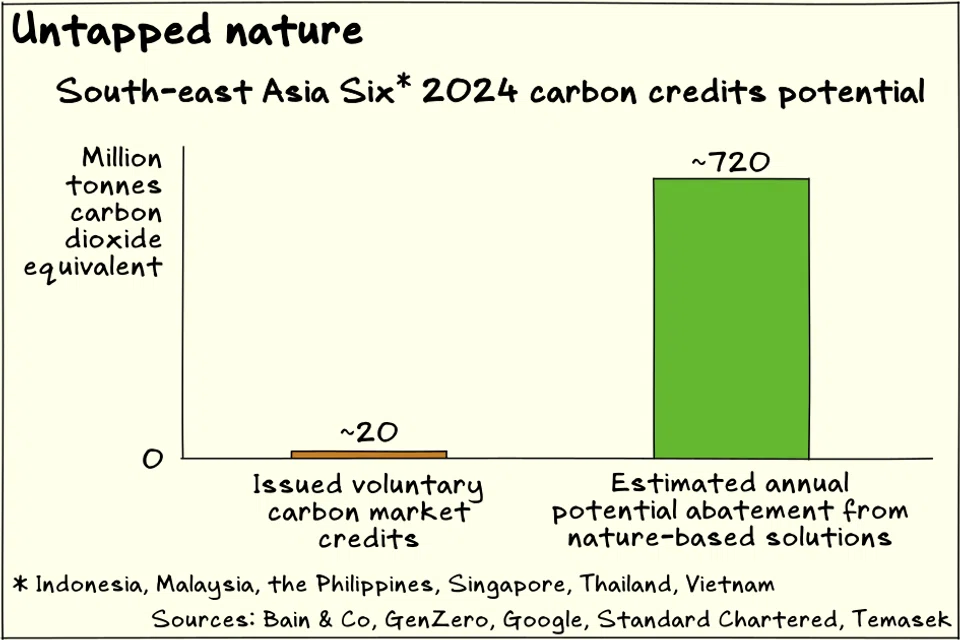
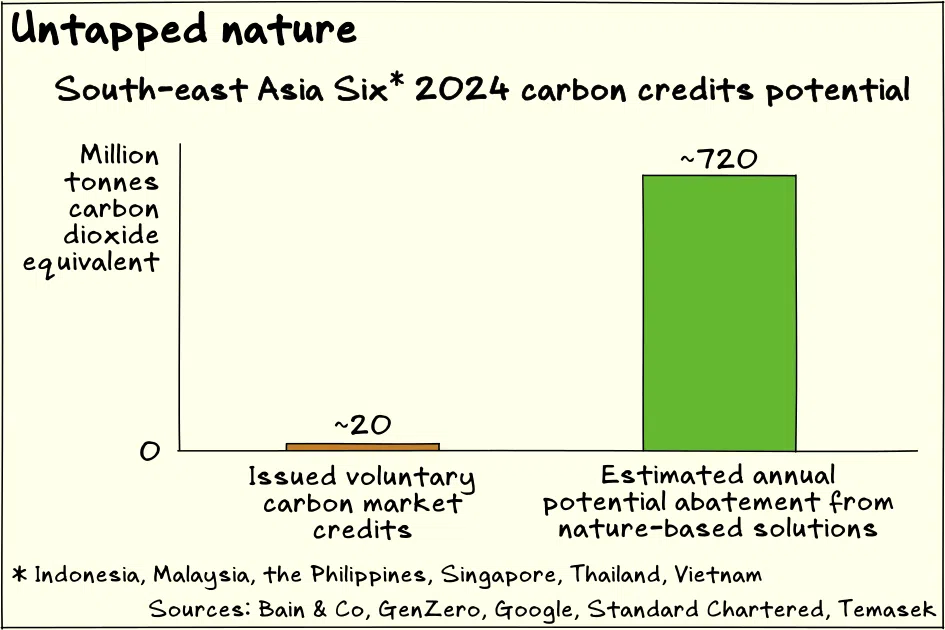
A 2025 green-economy report by Bain & Co, GenZero, Google, Standard Chartered and Temasek estimates that South-east Asia’s six largest economies issued about 20 million tonnes of carbon dioxide equivalent credits in 2024, far short of the roughly 720 million tonnes of annual credits from nature-based solutions in those countries.
Singapore, in particular, could potentially reap many benefits. Being an urban, natural resource-limited country, Singapore needs to rely on carbon credits as it progresses towards its climate goals. Furthermore, Singapore has a strategic ambition to be a sustainable finance hub, and thriving carbon markets would be important validation for those plans.
Energy transition
Asean Power Grid is more than a bunch of bilateral deals
South-east Asian leaders have signed an enhanced memorandum of understanding (MOU) on the Asean Power Grid (APG), a regionwide electricity network that was first conceived in 1997 but has made little progress in the 30 years since.
Asean covers 11 countries with very different energy profiles across a vast expanse of land and water, hence difficulty in building a regional power network amid such complexity should not be surprising.
In recent years, Singapore’s pursuit of low-carbon energy imports from its neighbours has fuelled optimism that such imports can spark faster progress on the APG. However, there is a limit to how much Singapore’s energy import projects can advance the APG, because there are fundamental differences between the mostly bilateral, one-way import deals that Singapore is trying to set up and the multilateral, two-way interconnections embodied in the APG’s vision of supporting regional energy resilience.
Some of that complexity is explained in the International Energy Agency’s study into financing the APG. A key observation in the report is that most of the investments in cross-border power projects in South-east Asia have been for one-way power exports, but such investments are insufficient to meet the needs of bi-directional, grid-to-grid projects required by the APG.
Among the APG’s goals are to allow South-east Asian countries to harness complementary energy resources. The Association of Southeast Asian Nations’ announcement about the latest MOU states that the APG can help to “diversify electricity supplies, improve power system resilience and support renewable energy integration”.
A fee framework that governs how much Singapore will pay for electricity from Indonesia is very different from a two-way agreement that would allow Indonesia to buy electricity from Singapore, much less rules that determine how 11 different countries can trade electricity among themselves. There are also questions involving how capital and operating expenditures related to infrastructure and running the networks should be split, with such decisions taking on a substantially different level of complexity in a multilateral arrangement versus a bilateral one.
The point is that while bilateral deals can help to move progress on the APG forward in certain areas, Asean cannot escape the need to establish a common set of fundamental arrangements across the region as a whole. It will certainly be complicated and challenging, but the struggle will almost certainly be worth it when considering the benefits that a deal could unlock.
Other ESG reads
- COP31: Singapore to contribute US$500,000 in climate finance to the Pacific islands
- PM Wong pitches deeper Asean ties on digital payments, energy and haze
- Malaysia loosens rare earths curbs for France amid upgrade of ties to strategic partnership
- China’s fossil fuel power tips towards annual drop on green boom
- Why Singapore should stop trying to recycle everything