

The Hyundai that South Koreans can’t buy – and what it can teach the car industry
The Elexio, launching in Singapore on Sep 10, shows how legacy automakers are catering to Beijing
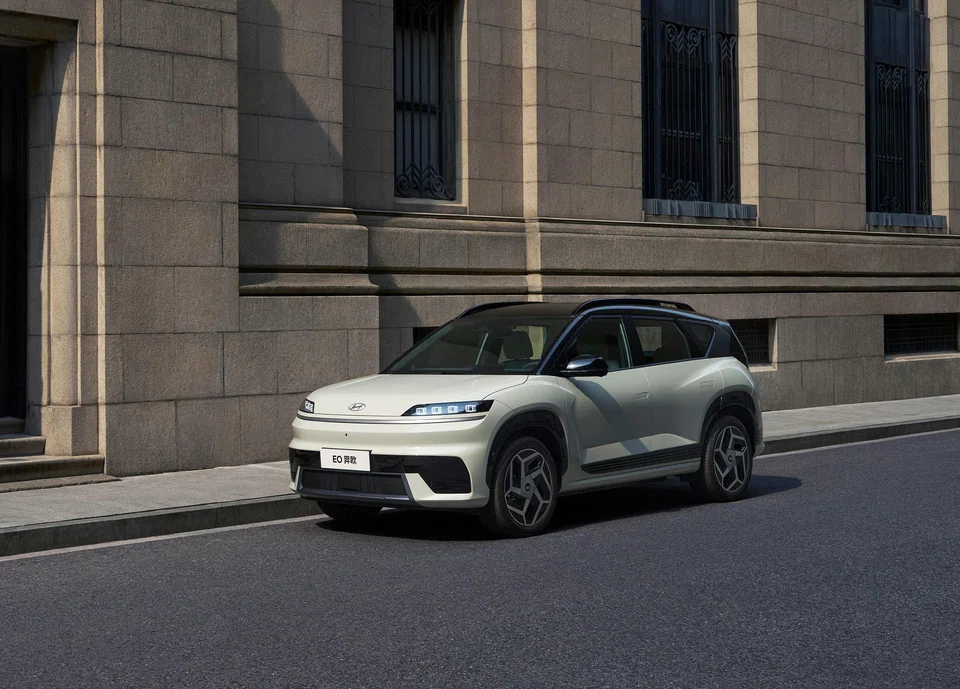
[SINGAPORE] Hyundai – the South Korean automaker – will launch a car in Singapore on Thursday (Sep 10) that it does not sell anywhere except for China and Australia.
It does not hawk the Elexio in South Korea, and there are lessons the industry could draw from its absence at home.
The Elexio is built on an electric-vehicle architecture that represents the pride of Hyundai’s engineering. Its Electric-Global Modular Platform underpins a host of award-winning cars, each one named Ioniq.
That makes the Elexio technologically South Korean.
Yet, it is assembled in China, ostensibly for Chinese buyers. Unlike the Ioniq cars, which cater to Western tastes, the Elexio ditches physical switches in favour of a sprawling touch screen.
A Snapdragon 8295 chip, ubiquitous in Chinese cars, powers its entertainment system. It even uses batteries from BYD.
Heavily Sinicised, it must do no less than get Hyundai back on its feet in China. From a sales peak of 1.14 million units in 2016, the automaker sold just 125,726 cars there in 2025.
The Elexio kicks off a 20-model product onslaught intended to drive sales in China to 500,000 by 2031.
The need to cater to Chinese tastes
Hyundai’s approach requires humility.
Legacy players have long expected the Chinese to accept whatever they sell the rest of the world, but that is no longer working, even for the most fabled brands.
Porsche, for example, having nothing specific for China’s consumers, has had deliveries there fall for four years running, to less than half of 2021’s volume.
Nor has size conferred protection. Volkswagen led in China for 25 years, but lost its crown to BYD in 2024 and slid to third behind Geely in 2025. Its China boss admitted the shift in buyers’ tastes has been “beyond imagination”.
While Hyundai adds Chinese flavour to its own technology, others do the opposite. Mazda and Toyota, for example, borrow the technical platforms of their assembly partners – respectively, Changan and GAC – and apply their own designs to them.
The resulting cars are essentially Chinese, but look Japanese.
This route is paved with even more humble pie, for in the past, Mazda and Toyota would have taught Changan and GAC nearly everything they know about assembling cars in the first place.
Some legacy car companies may have enough heritage and desirability to rise above this game altogether. Ferrari’s Luce, its maiden electric car, is bested by far cheaper Chinese cars in terms of range and acceleration.
Yet, relentless online mockery aside, it has been a triumph, selling out its first year’s production within two months.
Range Rover’s first EV, unveiled on Sep 2, panders not to the Chinese buyer’s taste for touch screens, but instead to its own design heritage and stateliness.
Despite looking almost exactly like the combustion model it is based on – or more likely, because of it – it collected 80,000 expressions of interest from potential buyers by August, more than 40 per cent of the brand’s annual sales.
Few car companies enjoy that sort of cachet, but mainstream players such as Hyundai, Mazda and Toyota may now have a plausible way to fend off Chinese domination.
They must either adapt their own platforms to Chinese tastes, or dress Chinese technology in their own branding.
It may be too early to determine which approach, if either, will ultimately succeed. But Porsche, Volkswagen, Hyundai and many others should at least know by now what will not.
TRENDING NOW

MAS allocates S$1.45 billion to five asset managers in third EQDP batch: Chee Hong Tat
‘My grandfather’s legacy’: Sherman Kwek lays out three-year plan for CDL to drive returns
‘How many will survive?’: Bubble fears arise as China’s humanoid robotics face reality check
CDL to hire dedicated CEO for fund management as it steps up push into private funds

