S-Reits' data centres, logistics properties may see their values improve: IREUS
Valuations of retail, office and hospitality properties are likely to see more volatility, analysis adds

Singapore
MORE volatility may be in store for valuations of retail, office and hospitality properties, while data centres and logistics assets will likely see their values improve in tandem with the growing need for digital solutions and supply-chain resilience.
That is according to the Institute of Real Estate and Urban Studies (IREUS) at the National University of Singapore. It analysed all properties held by Singapore-listed real estate investment trusts (S-Reits), based on their annual reports.
IREUS deputy director Lee Nai Jia said: "Valuations will remain fluid as consumers, firms and workers recalibrate their lives in response to pandemic measures. The Delta variant may also trigger new waves of infections in countries that have otherwise brought Covid-19 under control."
For S-Reits with fiscal years ending Mar 31 or Jun 30, valuations of their logistics properties and warehouses across all geographies increased by 3.4 per cent from end-FY20 to end-FY21, although the pace of growth for data centres slowed to 0.9 per cent.
Retail and office assets, meanwhile, posted declines in values. "This suggests the downtrend is likely to persist for the whole of calendar year 2021," Dr Lee said.
In tracking the values, IREUS referred to figures stated in the currencies of the countries of origin, except for a few S-Reits that reported valuations only in Singapore dollars.
To compare the differences in values between end-FY19 and end-FY20, the research institute focused on S-Reits with financial years ending Aug 31, Sep 30 or Dec 31. Logistics and data centres emerged as the top performers; the biggest increase was the 9.1 per cent jump for logistics assets and warehouses, followed by 6.9 per cent for light industrial properties and 5.4 per cent for data centres.
Unsurprisingly, on the other end of the spectrum was the hospitality sector as travel evaporated. Hotels' and serviced apartments' valuations slid the most, by 8.3 per cent during FY20 due to border controls.
In the same period, office values eased by just 1.5 per cent, "alluding to the resilience of the workplace", Dr Lee said. But retail assets saw a 4.7 per cent drop, while office buildings with retail components slipped 3.7 per cent. The retail scene will continue to face challenges, with stricter measures and higher Covid-19 numbers tempering footfall and demand. Nonetheless, there are bright spots, such as the grocery and furniture segments, and suburban malls servicing large residential catchment areas are also expected to hold their values well, Dr Lee said.
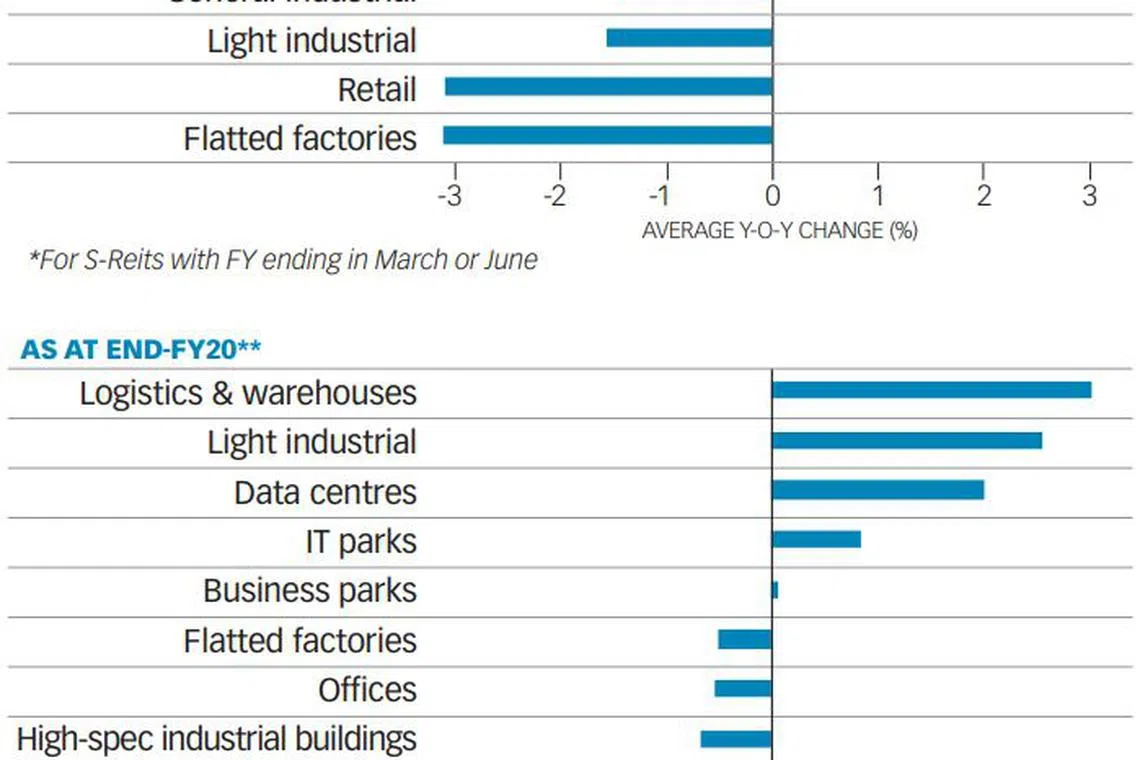
By geography, retail properties in Singapore posted a 1.2 per cent dip in values by end-FY20, milder than the 10 per cent to 17.2 per cent declines in Indonesia and Italy. However, retail valuations in Singapore continued to sag this year, falling by 3.1 per cent at end-FY21 for S-Reits with financial year-ends in March or June.
Also in the commercial sector, values of Singapore office properties inched down by 1 per cent as at end-FY20. They held up better than their counterparts in France (-12 per cent), China (-9 per cent) and Spain (-5 per cent), supported by demand from Chinese technology firms and limited upcoming supply, Dr Lee said.
However, he noted the lingering uncertainty as to how demand for office spaces will pan out; it remains to be seen whether companies will pivot to hybrid working permanently.
Meanwhile, industrial real estate and data-centre values are expected to appreciate, riding on strong demand and tight supply.
In Singapore, valuations of data centres rose by a modest 2 per cent as at end-FY20, more slowly than in Europe, which clocked increases of at least 3.3 per cent. Ireland posted the biggest jump of 38.4 per cent.
"Interestingly, given the temporary pause on the release of state land for data centres and the development of data centres, prices in Singapore should have increased more," Dr Lee said. A possible reason for the smaller-than-expected growth is that prices were "already on the high side" in the Republic, he noted. And in Europe, demand for enterprise and co-location data centres had surged - likely more so than in Singapore.
Logistics assets in Singapore saw their values fall 2.9 per cent by the end of FY20, from a year ago. In contrast, those in the Netherlands, Germany and Australia recorded double-digit growth.
The shorter land tenure of warehouses in Singapore could have contributed to the lower values, whereas freehold warehouses are common abroad. "The drop in value as a 30-year lease shortens by a year is significant, compared to freehold sites," Dr Lee noted. Older properties unequipped to handle vaccine storage or medical supplies may have also weighed on overall logistics valuations here, even as demand for newer purpose-built and cold-storage facilities was robust, he added.
As for the hospitality industry, the hardest hit within S-Reit portfolios were hotels in the Maldives and the US; their valuations slid 14.4 per cent and 14 per cent, respectively, in FY20.
Hotels in Singapore appeared to withstand the crisis better than most others overseas, with a 4.2 per cent drop as at end-FY20. The SingapoRediscovers voucher scheme boosted staycation demand, and many hotels in the city-state were used as quarantine or stay-home notice facilities.
The most resilient hotel values were seen in Japan, losing just 2.5 per cent in FY20, helped by the country's Go To Travel campaign.
"Hotels in countries that supported their hospitality industries through incentives to encourage domestic demand, had a relatively softer landing," Dr Lee said. "Moving forward, hospitality values will depend on how each country can establish green lanes (for travel), as well as the strength of domestic demand."
READ MORE: