He built the Vingroup empire. Now South-east Asia’s richest man is handing some key roles to his sons
Vingroup founder Pham Nhat Vuong is accelerating succession plans while retaining a central role
Inside Asia’s family empires: How they are transforming to seize the next stage of growth
A 1,000 per cent surge in Vingroup’s shares has transformed the fortunes of founder Pham Nhat Vuong. Now, the Vietnamese billionaire is handing the management of two key businesses to the next generation within a sprawling empire that spans property, transport, automotive, infrastructure, technology and services.
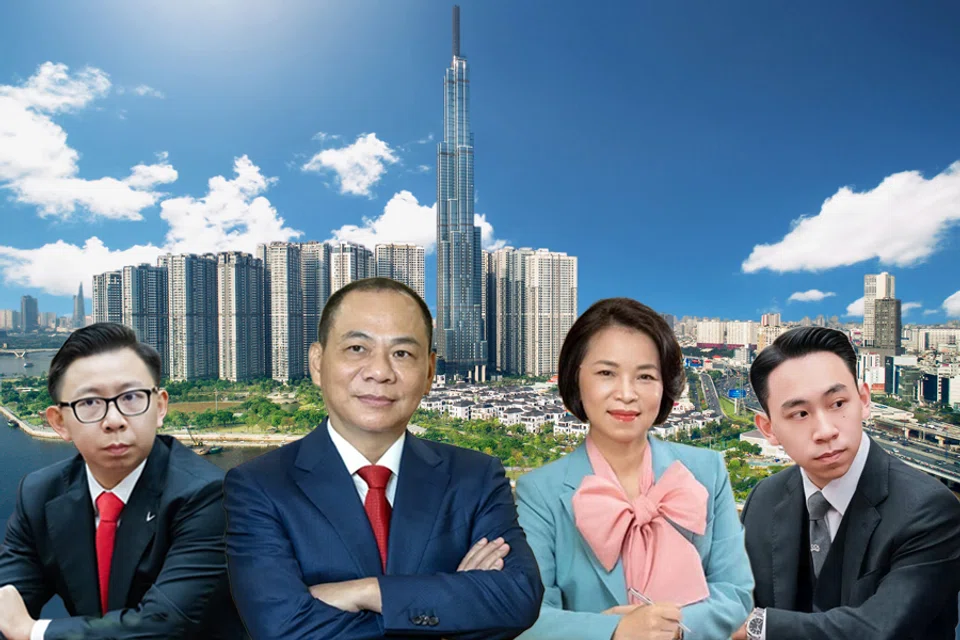
Vuong’s eldest son, Pham Nhat Quan Anh, 33, was named global chief executive of Vingroup’s electric-vehicle (EV) unit VinFast on Sep 12, succeeding his father while retaining the chairmanship he assumed in May.
His younger brother, Pham Nhat Minh Hoang, 26, was also appointed chief executive of global and Vietnam operations for Green and Smart Mobility (GSM), the VinFast-linked electric taxi and ride-hailing company.
The appointments bring succession at one of South-east Asia’s largest family controlled corporate empires into sharp focus, amid a stunning rally in shares of its listed entities, even as Vuong remains firmly at the centre.
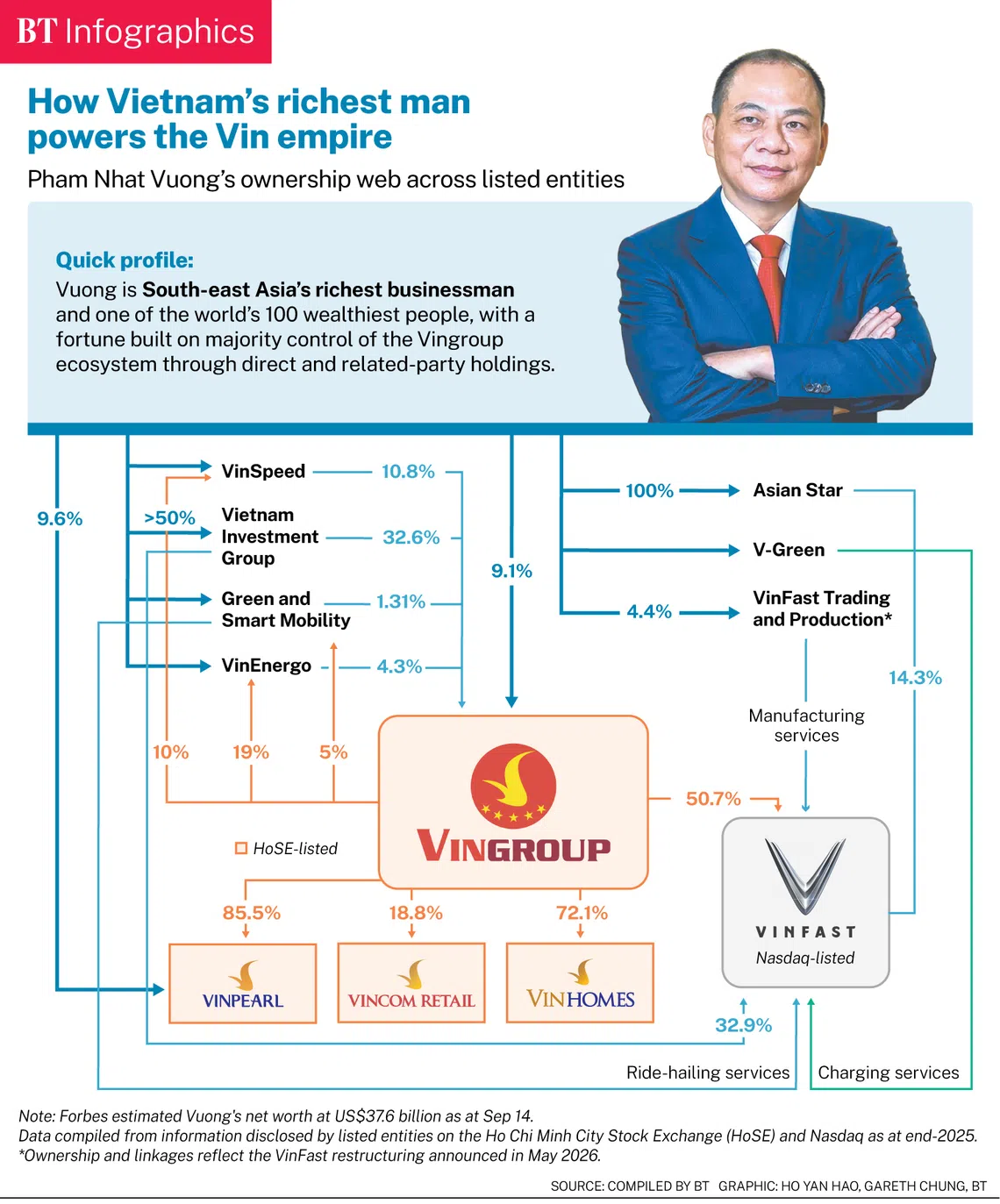
As at the end of June, Vuong, 58, directly owned 9.7 per cent of the company; his wife, Pham Thu Huong, held 4.4 per cent; and his sister-in-law, Pham Thuy Hang, had a stake of roughly 3 per cent.
Together with his majority-owned companies – including Vietnam Investment Group, high-speed rail (HSR) developer VinSpeed, power generator VinEnergo, and GSM – Vuong, his family and related entities controlled about 65 per cent of Vingroup.
This is based on public ownership data compiled from the group’s disclosures and market information.
Forbes has estimated the Vingroup chairman and founder’s net worth to be US$37.6 billion as at Sep 14 – up from US$4.4 billion at the start of 2025 – making him South-east Asia’s wealthiest person and placing him among the world’s 100 richest businessmen.
But the bigger story is not just Vuong’s fortune on paper. The value surge in Vietnam’s largest private conglomerate has enriched a wider family-and-affiliate network, while turning the group into one of the clearest stock-market proxies for the nation’s growth narrative.
From instant noodles to national champ
Vuong began with property development in Vietnam in the early 2000s, after building his fortune in Ukraine through an instant-noodle business.
Since then, Vingroup has grown into a sprawling conglomerate spanning residential and commercial real estate, hospitality, healthcare and education across the South-east Asian country.
The firm’s economic influence has also deepened with bolder bets on EVs, power generation, HSR development, robotics and steelmaking – sectors closely aligned with Vietnam’s ambition to join the ranks of high-income economies within the next two decades.
That also came despite the group taking on “significant debt” to enter sectors where it had “little to no experience”, noted VinaCapital economists Michael Kokalari and Thai Thi Viet Trinh earlier this year.
With Vingroup’s assets approaching 10 per cent of Vietnam’s gross domestic product, the group is widely viewed as one of the clearest beneficiaries of Hanoi’s push to develop “national champions” – the private-sector engine for Vietnam’s next development cycle.
“The company is likely to be the principal project developer of a significant share of major infrastructure projects in the coming years,” the economists said.
These include VinSpeed’s Ben Thanh-Can Gio metro line in Ho Chi Minh City, which broke ground in December 2025, and its Hanoi-Quang Ninh HSR project in northern Vietnam, which began construction in April 2026.
Vingroup shares have traded at an average price-to-earnings ratio of more than 100 times since the beginning of this year, compared with about 14 times for the broader market.
Between the start of 2025 and its recent peak, it also climbed over 12 times – briefly making it the largest stock in frontier markets and one of Asia’s most expensive large-cap counters.
Shares as ecosystem capital
The rally has given the founder-linked ecosystem a larger pool of valuable listed shares that can be pledged for loans, injected as capital into other companies, sold or transferred, or used to signal financial strength.
This means maintaining the stock’s rising momentum has become more important, with major shareholders having a stronger economic incentive to sustain investor confidence in its valuation, said Quan Trong Thanh, head of research at Maybank Investment Bank Vietnam.
In 2025 alone, Vingroup shares jumped 711 per cent “on the back of a very low free float and trading volumes”, VinaCapital pointed out.
The rally lifted Vingroup’s weighting in the VN-Index to 16 per cent, and pushed Vingroup-family stocks to nearly a quarter of the benchmark.
What stands out is how the conglomerate’s shares have been used in recent years to capitalise new ventures across the ecosystem linked to Vuong.
In 2025, he transferred blocks of Vingroup shares – then trading several times higher than at the start of the year – as capital contributions to newly established and higher-risk ventures including VinSpeed and VinEnergo.
“This structure can be understood as the founder and his related parties funding the business first using their family assets,” said Thanh. “Once it takes shape and starts to gain value, Vingroup has the option to buy it back or raise its ownership.”
On Jun 8, Vingroup’s board approved a framework agreement giving the conglomerate the right – but not the obligation – to acquire certain stakes from Vuong and related parties in several Vietnam and Hong Kong-incorporated entities linked to his mobility firm GSM and energy company VinEnergo.
GSM and VinEnergo were established largely through Vuong’s capital contributions in the form of Vingroup shares, and have since built leading positions in their respective industries through actual business scale.
The development was also a more concrete signal of these ventures’ international initial public offering ambitions, as the transactions, if exercised, should be completed before their listings and within 36 months of signing, according to the announcement.
Vietcap analyst Thuc Than said the framework could give Vingroup acquisition rights rather than requiring immediate capital deployment, enabling “flexibility” to increase its economic interest in those businesses.
Meanwhile, Maybank’s Thanh views the arrangement as beneficial for all three sides.
He said: “Vingroup gains access to potential assets; the initial backers can monetise their investment; and shareholders may benefit if the businesses prove to have real value.”
Mostly a one-man show
While Vingroup still relies heavily on its traditional engine of real estate, Dao Minh Chau, deputy head of research at brokerage SSI, said in a May report the group’s profit also remains dependent on chairman support.
SSI forecasts Vingroup’s 2026 net profit after minority interest to come in at 30.8 trillion dong (US$1.2 billion), helped partly by a 22 trillion dong support package for VinFast from chairman Vuong.
From 2023 to the end of the first quarter of 2026, Vuong funnelled about US$2 billion of his personal wealth into the EV maker.
Excluding that support, SSI estimates Vingroup’s net profit this year to be 14.5 trillion dong, compared with a loss of 7.3 trillion dong in 2025.
Another form of founder-backed funding was the recent restructuring to separate some manufacturing assets from VinFast’s core sales, R&D and intellectual-property operations.
VinFast transferred its entire stake – including roughly US$7 billion of debt – in VinFast Trading and Production to a buyer group led by Future Investment Research and Development, or Tuong Lai, in a deal valued at over US$500 million.
The founder was central to making the deal possible.
Based on VinFast’s proxy statement to shareholders on May 12, Tuong Lai, then named Novatech, was actually carved out from VinFast’s Vietnam-based manufacturing entity.
It was first bought by Vuong for US$1.6 billion before being sold to the latest investor group that has a history of collaborating with him.
The statement said: “The primary purpose of (Vuong’s) acquisition of Tuong Lai was to support (VinFast) and provide additional capital resources to facilitate VinFast’s development.”
That support echoed an earlier arrangement in 2022, when VinFast exited internal combustion-engine (ICE) vehicle production by transferring its ICE assets to Vietnam Investment Group – another entity majority-owned by Vuong – which also committed to reinvest any net proceeds from a future third-party disposal back into VinFast Vietnam.
SSI’s Chau said VinFast’s latest move to shift towards a light-asset model is expected to reduce capital-expenditure pressure, limit the impact on consolidated profit and improve the leverage of the parent company, Vingroup.
But “together with (VinFast’s) ongoing operating losses, support from the chairman is likely to remain necessary”, Chau added.
A handover begins
Despite the founder’s dominant influence, the growing presence of Vuong’s three children across management roles and ownership structures within the business empire points to a planned succession.
Since joining VinFast in 2019, his eldest son, Quan Anh – the new CEO of the EV maker, has held a series of senior operational roles, overseeing areas including vehicle development, manufacturing, global sales and after-sales services.
Quan Anh also concurrently serves as the CEO of VinMetal Trading and Production, a high-quality steel manufacturer within the Vingroup ecosystem.
His younger brother, Hoang, previously served as VinFast’s global marketing director. He was also CEO of Green Future, Vingroup’s EV rental and mobility arm, which later merged with GSM, where he now serves as chief executive.
The brothers, sometimes alongside their wives, have also appeared as minority shareholders in a string of new Vingroup-linked ventures spanning infrastructure, energy and technology, including VinSpeed, VinEnergo, VinRobotics and VinMetal, as well as cultural endeavours such as V-Film, V-Culture Talents and V-Spirit.
Vuong’s youngest child, Pham Nhat Minh Anh, is also a founding shareholder of the event management firm V-Spirit.
Still, Maybank’s Thanh pointed out that the group’s key new businesses – from EVs to energy and robotics – may need another seven to 10 years to become more self-sustaining.
“It may take until 2035 to 2040 for these businesses to mature and for the next generation to have enough time to learn and prove themselves,” he said.
“Vuong remains the key man and the flag bearer of Vingroup,” he added. “Investors’ confidence depends on him still being there and still leading.” THE BUSINESS TIMES