

Iran finds control over Hormuz strait slipping away but US far from becoming victorious
As a naval blockade crushes its economy, Iran bets the US will not stay in the region for years to come
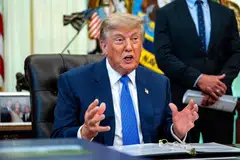
[LONDON] With his characteristic preference for boasting, US President Donald Trump announced what he called “the most crushing economic operation ever taken” against Iran, vowing on Aug 20 that the Islamic republic would suffer “economic warfare and isolation on an unprecedented scale” and threatening any state whose “financial institutions, businesses, airports or government entities” offered Iran “any type of lifeline” with “tremendous economic consequences”.
Teheran’s official response was to yawn.
The Fars news agency run by Iran’s Islamic Revolutionary Guard Corps (IRGC) dismissed the Trump threats as “delusional”, noting that all previous US administrations for over two decades predicted the Islamic republic’s imminent financial collapse.
Still, Trump’s underlying claim – that Iran is now being squeezed as never before – is essentially true. What is crushing the Iranian economy is not the sanctions list, but the physical blockade of Iranian ports and the loss of Iran’s ability to convert oil into money at any price.
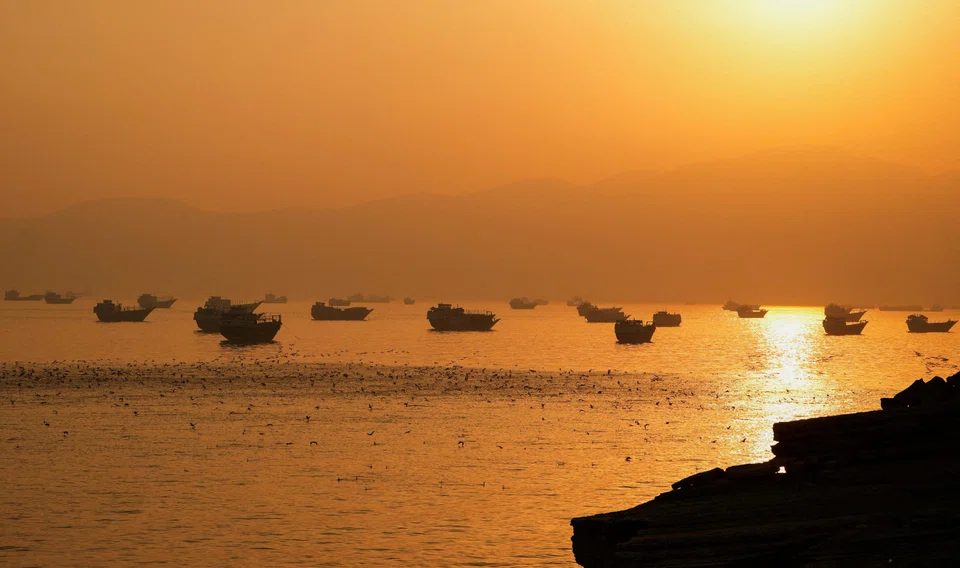
More significantly, the US navy is slowly but decisively gaining the upper hand in the Strait of Hormuz, as larger quantities of oil exported by the Gulf’s Arab nations pass through the waterway, in defiance of the Iranian military.
Longstanding US sanctions on Iranian oil have never stopped Iranian oil; they merely forced Iran to accept a discount on its energy sales.
Before the war, Iran was exporting something in the region of 1.7 million to 1.8 million barrels of crude oil a day, mostly to small (nicknamed “teapot”) Chinese refineries, usually at around a 10 to 15 per cent discount on world prices.
The naval blockade imposed by the US navy on April 13 has stopped this trade, and the effects on the Iranian economy have been dramatic, depriving the country of around US$170 million (or S$216 million) of revenue daily.
It remains unclear what Trump’s newly threatened sanctions mean.

Five Chinese oil refiners are already on the US sanctions list for purchasing Iranian oil, and in May, the Chinese government ordered its commercial entities to ignore the US ban.
So, if the US is serious about hitting those who may be trading with Iran, another major showdown between Washington and Beijing is in the offing.
It is likely that the White House would be keen to avoid such a clash, particularly since Chinese President Xi Jinping is expected in the US in September.
What remains much more plausible is that the US will target instead global financial houses that help Iran repatriate funds and enable other financial transactions on behalf of the Islamic republic.
On Aug 19, hours before Trump’s announcement, the United Arab Emirates (UAE) suspended all trade and financial transactions with Iran until further notice.
This is a big blow to Iran, since the UAE supplied more than 30 per cent of Iran’s imports – roughly US$21 billion a year – and absorbed nearly 13 per cent of its exports, some US$7 billion.
Yet probably the most ominous development for Iran is evidence that the US navy is increasingly in control of the Hormuz strait and is therefore able to ensure the flow of oil from Arab producers, while still restricting the movement of Iranian oil.
For the past six months of the Gulf war, the accepted wisdom was that Iran held the keys to Hormuz. And Trump’s frequent pronouncements on the matter have only tended to discredit the US claim to protect the strait.
“We own it,” Trump told journalists on Aug 11; “total control over the Hormuz strait”, he claimed, days after posting a map labelling the international waterway as new American territory.
The more the US President made such extravagant claims, the less he was believed.
But away from this noise barrage, the reality is that the US navy has developed a sophisticated method of batching large oil tankers and guiding them through Hormuz in the dead of night, under US protection.
These are not formal naval convoys, escorted by US military vessels, as was done in previous naval conflicts. Still, the result is that Arab oil is flowing again through the strait in meaningful quantities, by avoiding the Iranian coastline, and sailing instead close to the opposite shores of Oman.
According to an Aug 18 report by Kpler, a global data and analytics company, more than 80 per cent of seaborne transits in the Gulf over the past fortnight used the Omani route – the UN-authorised southern channel that Iran objects to and cannot police – rather than the Iranian territorial-waters lane through which Teheran intends to levy its tolls.
Homayoun Falakshahi, who leads Kepler’s oil analysis team, says that “Iran has at least partially lost control of the strait”.
The Arab monarchies of the Gulf are also getting better at bypassing Hormuz altogether.
Aramco, Saudi Arabia’s energy giant, has resumed exports through ship-to-ship transfers off the UAE coast. And the UAE is accelerating its Fujairah pipeline expansion, which bypasses the strait.
How much Arab oil is exported remains debatable, if only because American officials such as US Energy Secretary Chris Wright have every incentive to talk up the numbers.
But the general figure accepted by energy analysts is that anything between eight million and 10 million barrels of oil now pass through Hormuz each night, roughly half of what used to be normal traffic.
That is not enough to alleviate long-term shortages, but perhaps enough to tame any further major increases in oil prices.
And every barrel that leaves the Gulf permanently reduces the value of Iran’s claim to control the waterway.
Still, the fact remains that global oil prices continue to be at least 20 per cent higher than they were at the start of the war.
And although some oil supplies are now flowing again, very little has been done to facilitate exports of liquefied natural gas, of which Qatar is by far the biggest local producer.
Trump has pivoted back to economic sanctions because the alternatives are non-existent.
Diplomatic talks are dead, an agreed ceasefire agreement between Iran and the US expired on Aug 17 without either side troubling to renegotiate it, American munitions stocks are depleted, no US military strikes have landed on Iranian soil since Aug 1, and the funds for continuing the war remain disputed in a US Congress that is not even in session.
The financial squeeze on Iran will keep tightening.
Still, the Iranians are gambling that the US will not have the will to stay in the region for years to come and that, the moment the US navy departs, Iran will regain control of Hormuz. THE STRAITS TIMES
Decoding Asia newsletter: your guide to navigating Asia in a new global order. Sign up here to get Decoding Asia newsletter. Delivered to your inbox. Free.
Share with us your feedback on BT's products and services
TRENDING NOW
OCBC customers face difficulties accessing online, mobile banking services

SGX CEO Loh Boon Chye to step down; succession planning under way

Waymo founder predicts ‘landslide’ robotaxi adoption in Singapore, driven by high car costs

Vietnam’s northern provinces, not Hanoi or Ho Chi Minh City, are powering near 10% GDP growth

