

Size matters: OCBC’s Bank of Singapore doubles down on ultra-wealthy – and the bankers chasing them
CEO Jason Moo says the lender is starting to see large amount of flows into the region
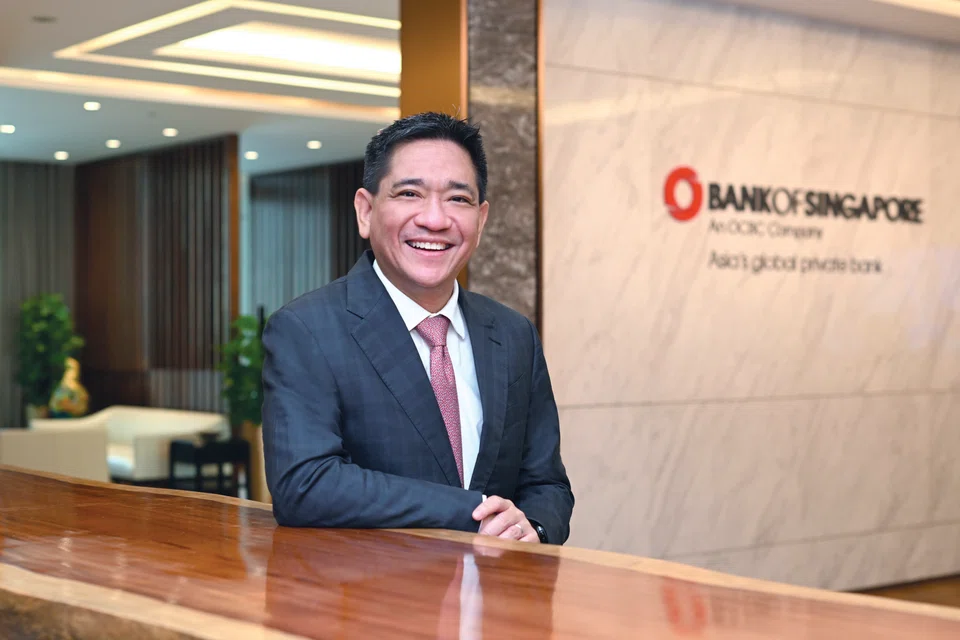
[SINGAPORE] If it takes the same effort to serve a US$100 million client as a US$10 million one, then why not go bigger?
That blunt calculation is shaping the next phase of growth at Bank of Singapore (BOS), where chief executive officer Jason Moo is sharpening the private bank’s focus on ultra-high-net-worth (UHNW) clients – even as rivals across Asia compete for the same wealthy families.
The push is backed by aggressive hiring, bespoke investment capabilities and closer integration with parent OCBC’s broader “whole-of-wealth” ecosystem, as BOS seeks to position itself as a “house bank” for Asia’s richest clients.
“The amount of effort it takes to cover a US$100 million client is the same (as that for) a US$10 million client,” Moo said in an exclusive interview with The Business Times. “So, I might as well have the (bigger) amount in the bank.”
For Moo, a veteran investment banker who spent years working with the same type of UHNW clients that he now wants BOS to court more aggressively, the opportunity is clear.
“The sheer size of the clients that we’re starting to see… whether from North Asia, South-east Asia or outside the region, we’re starting to see very large amounts (of flow)... come into the region,” he said.
Scaling up for the ultra-rich
Much of the bank’s UHNW focus remains centred on North Asia and South-east Asia, which Moo said continue to generate some of the region’s largest pools of wealth.
He added that many of the world’s largest private banks have already shown how lucrative the segment can be. “Our global competitors, a lot of them cover this space well, and if you’ve seen their growth in the last five years, it’s really been driven by this space.”
BOS now aims to grow the proportion of assets under management (AUM) contributed by UHNW clients by 30 per cent by 2028.
SEE ALSO



The private bank does not disclose AUM figures, but its assets grew by more than 20 per cent year on year in 2025. At the group level, OCBC’s wealth management AUM stood at S$342 billion as at end-March, up 12 per cent from a year earlier.
To support its 2028 ambition, BOS resumed hiring “pretty aggressively” in 2026, after spending much of last year integrating a record wave of recruits.
Moo said BOS had earlier targeted 500 relationship managers by the end of 2025 – a milestone that has already been “achieved and passed”.
“The bulk of that hiring was really (in) 2024,” he said, describing it as “the (biggest) number of people we’ve ever hired”.
But after bringing in so many bankers within a short span, the firm needed time to “digest” the expansion and ensure the new hires were properly integrated.

The talent chase
Competition for talent, however, remains intense, as global and regional wealth managers push deeper into Asia’s wealth boom.
Singapore’s three local banks are also scaling up their wealth businesses, with DBS, OCBC and UOB all signalling plans to hire more wealth talent, including relationship managers.
“The pool of talent is actually not that small,” said Moo. “But the pool of talent when you want the people you really want becomes quite well-reduced from that.”
For BOS, a key recruitment tool has been a revamped compensation framework rolled out earlier this year. Moo said the new structure gives relationship managers greater transparency over how they are rewarded.
The framework was designed partly to address longstanding frustrations in private banking over opaque pay structures, where bankers may have limited clarity on how bonuses are ultimately decided.
“People think: ‘Okay, I might do really well, but then at the end of the year, I roll a dice on whether the manager likes me or doesn’t like me, and I don’t know what I’m going to get,’” said Moo.
By contrast, the new structure aims to provide a clearer link between performance and pay. Put simply, “if you achieve X, you get Y – no argument”, Moo said.
He added that the framework has already lifted interest from prospective hires, as “our pipeline of people who have now indicated interest has shot up tremendously”.
One wealth machine
Beyond hiring, BOS is also changing how it serves wealthy clients.
A major part of that effort sits within OCBC’s broader “Next Frontier” strategy, unveiled by group chief executive Tan Teck Long in February.
The strategy seeks to bring together BOS, OCBC’s consumer banking business and insurer Great Eastern under a more integrated “whole-of-wealth” approach, aimed at making the wider OCBC group easier for wealthy clients to navigate.
To set the tone from the top, a wealth management committee has been formed. It is chaired by Tan, and includes Moo, OCBC head of global consumer financial services Sunny Quek, and Great Eastern chief executive Greg Hingston.
Moo said that the committee has met five times since the start of the year, though the actual rhythm can feel more intensive.
“We only meet officially once a month, but there’s a lot of meetings that go around in making that one meeting happen and be fruitful,” he quipped. “I feel like I have two or three meetings just to prepare for that one meeting.”
Through the committee, joint key performance indicators will be set for the first time in two areas: wealth income and bancassurance revenue.
With the joint targets, “my success is going to be dependent a lot on how Sunny executes his business, and how Greg executes his business”, and it is a “huge change in mentality”, noted Moo.
Yet, the broader integration strategy is already beginning to reshape client relationships, in what he called a “perfect example” of the type of deals the new committee is trying to cultivate.
“I want to be the client’s house bank. I don’t think I’ll ever be a UHNW client’s only bank… but being a house bank is my goal in each of the UHNW relationships.”
Jason Moo, CEO, Bank of Singapore
He pointed to a recently hired BOS relationship manager who brought over a UHNW client in the real estate and construction space.
That relationship later allowed OCBC’s wholesale banking division to participate in an S$800 million club deal to finance the client’s residential development project.
It also opened the door for potential insurance mandates through Great Eastern.
Said Moo: “The client goes: ‘Oh, this is a new phenomenon for me, because I don’t have to go to everybody (else) – I can just go to one part of OCBC.’ This is a perfect example.”
Early gains from the wealth push are already flowing through in OCBC’s earnings.
For the three months ended Mar 31, the bank reported a 23 per cent rise in non-interest income to S$1.61 billion, helping offset a 5 per cent fall in net interest income.
Meanwhile, net profit grew 5 per cent to S$1.97 billion, beating consensus estimates.
Within non-interest income, wealth fees grew 34 per cent year on year to S$422 million.
Sharper tools
To deepen its appeal among ultra-rich clients, the private bank has also been investing in bespoke investment and advisory capabilities.
In February, BOS hired Bernard Heng as head of customised solutions, to lead a dedicated UHNW solutions effort on customised investments and specialised wealth offerings.
At the same time, the bank has been building what Moo described as a differentiated investment platform.
Part of that effort includes a “CIO Lab” service, where clients can voluntarily open up their entire global portfolio for analysis.
“If a UHNW client is willing to open up to us… we can run the entire risk for you – down to your public (and) your private holdings, your local currency considerations, everything,” he said.
The process can take up to a month and produce reports running more than 70 pages long. “It’s like your financial health check-up,” he added.
The lender’s portfolio construction also aims to protect clients’ assets when markets move against them. Weekly reports show that BOS’ portfolios tend to outperform benchmarks during downturns, said Moo.
“I don’t need to really outperform on the upside, but I really want to protect on the downside, and that’s what our asset allocation is meant to do.”
Markets still matter
But even as BOS presses ahead with its wealth push, Moo cautioned that private banking earnings remain closely tied to markets and investor sentiment.
With volatility stemming from the ongoing Middle East conflict, it is “hard to predict” where things will land by year-end, he said.
“If markets continue to be choppy and volatile – and more importantly, with no clear view on where we’re going to go – it’s hard to be able to predict that transaction revenue will continue... in the same direction,” he added.
Still, he believes the bank is entering its next phase of growth from a far stronger base than before, with greater scale, broader capabilities and a more integrated strategy across the wider OCBC group.
“I want to be the client’s house bank,” Moo said. “I don’t think I’ll ever be an UHNW client’s only bank… but being a house bank is my goal in each of the UHNW relationships.”
Decoding Asia newsletter: your guide to navigating Asia in a new global order. Sign up here to get Decoding Asia newsletter. Delivered to your inbox. Free.
Copyright SPH Media. All rights reserved.
TRENDING NOW

DBS, OCBC, UOB rout lops billions off STI as inflation, rate concerns spook investors

Grab CEO’s wife Chloe Tong on life with Anthony Tan and finding her purpose

OCBC sheds S$8 billion in value as shares close nearly 6% down; analysts cautious on banks

Deal between tycoon friends sparks scrutiny of Philippine power sector

