

Acquisitions to take centre stage as industrial S-Reits seek further growth

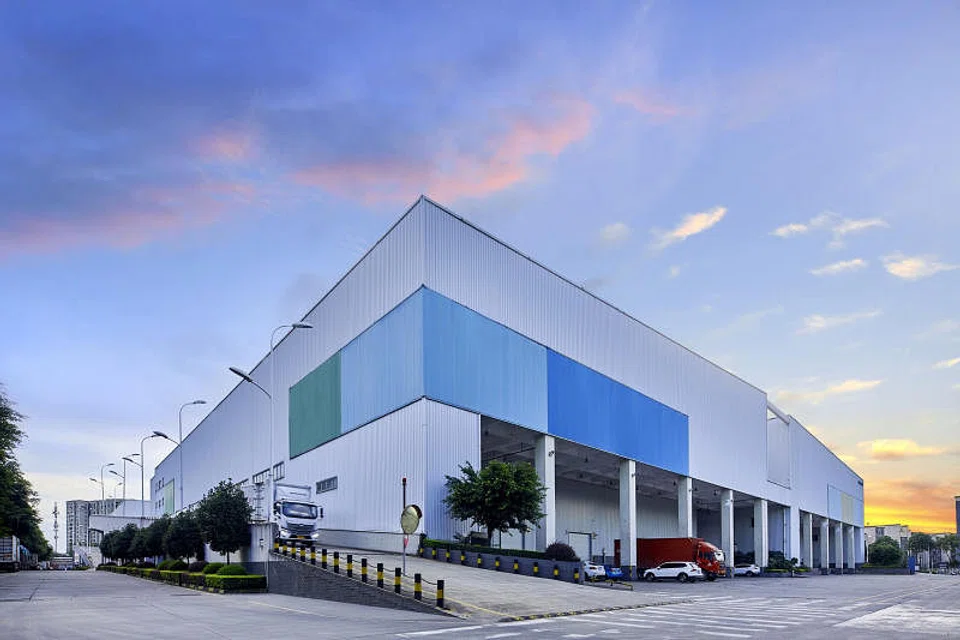
INDUSTRIAL-FOCUSED Singapore-listed real estate investment trusts (S-Reits) have performed better than most of their peers in other sub-segments amid the Covid-19 pandemic.
With a combined market capitalisation of S$33.8 billion, prices of the 8 pure-play industrial S-Reits -- Aims Apac Reit O5RU, ARA Logos Logistics Trust K2LU, Ascendas Reit A17U, EC World Reit BWCU, ESR-Reit J91U, Mapletree Industrial Trust ME8U, Mapletree Logistics Trust M44U, and Sabana Reit M1GU -- have gained 14.9 per cent on average in the year to date.
In comparison, the benchmark Straits Times Index has grown 11.6 per cent while the iEdge S-Reit Index has edged up 1.6 per cent year-to-date.
But pundits believe there could still be room for industrial S-Reits to grow.
"Investors have often baulked at the industrial S-Reits' tight yields of close to 5.7 per cent -- or 4.5 per cent for large caps -- but we believe that this premium is justified," said DBS analysts Dale Lai and Derek Tan in a recent report.
"With the sector's earnings resilience proven during the Covid-19 recession and with economies re-opening, we believe that sector remains on a firm footing to deliver decent growth of more than 3 per cent compound annual growth rate (CAGR) over FY21to 23 (Forecast)," they added.
The way Lai and Tan see it, structural growth trends for "new economy" assets such as logistics, data centres and business parks could deliver a "potent mix" of growth and capital upside.
Even Reits that were traditionally not focused on industrial real estate are now gravitating towards it.
CapitaLand China Trust (CLCT) AU8U , a diversified S-Reit which had in September last year expanded its investment mandate beyond the retail sector, provides a striking case in point.
CLCT on Oct 12 proposed its maiden acquisition of 4 logistics assets, which will push the Reit's new economy assets to 21.4 per cent of its assets under management.
This comes after CLCT in the first half of this year completed the acquisition of 5 business park properties.
Following its mandate expansion, the Reit has a 5-year acquisition growth roadmap for 30 per cent of its portfolio to constitute new economy assets, as part of CLCT's strategic direction to capture growth trends.
Nicholas Wilson, Colliers' director and head of research for Asia capital markets, noted that there has been a "significant divergence" between the performance of Asia-Pacific industrial and retail Reits over the past 3 years.
"Across the region, prices of industrial Reits have climbed 77 per cent, whereas in a stark contrast, retail REITs have posted negative returns over the same period," he said.
Wilson added that, on a weighted market capitalisation basis, industrial Reits across Asia-Pacific are now trading at a 35 per cent premium to underlying valuations, while retail Reits in the region are trading at a 10 per cent discount.
"This implies that investors appear to be happy paying market premiums to gain investment exposure to the Asia-Pacific industrial real estate sector, while even 'on sale', the Asia-Pacific retail Reits struggle to find takers," he said.
Some industrial assets are poised to perform better than others though.
Phillip Securities Research analyst Natalie Ong noted that the outlook for S-Reits' data centres, hi-spec and business parks assets remains favourable, supported by a growing technology sector and low supply under construction. Warehouse assets, too, are a beneficiary of higher demand from logistics players on the back of e-commerce growth, she added.
On the other hand, Ong said the leasing of light industrial factory space may be muted as global demand is still on the mend, while the outlook for factory assets remains challenging due to considerable new supply.
Phillip has an "overweight" rating on the industrial S-Reit sub-sector.
"We believe the industrial sub-sector will be resilient," Ong said in a recent report. "Industrial Reits have been the most active in acquisitions, owing to early recovery in their share prices. We think industrial Reits will continue to lead the pack in acquisitions and redevelopment or asset enhancement initiatives for the rest of 2021."
DBS also noted that industrial S-Reits have been actively growing their portfolios in recent years. However, the research house's analysts added that the sponsor's role in shaping an acquisition pipeline will be "crucial" as industrial S-Reits continue to pivot to new economy assets.
"With competition from funds, returns are increasingly looking compressed and as such, sponsor's pipeline and ability to kick-start greenfield or brownfield developments will be an edge going forward," Lai and Tan said.
Among the industrial S-Reits, DBS continues to favour Ascendas Reit and Mapletree Logistics Trust, as well as diversified S-Reit Frasers Logistics and Commercial Trust BUOU , which invests in both prime logistics and commercial properties.
"Their continued access to pipelines ... can potentially grow their assets under management by 13 to 40 per cent, while redevelopments to rejuvenate some of their ageing assets will offer added upside to net asset values," the analysts said.
"In our estimation, large-cap Reits have a potential pipeline of more than S$7.8 billion they could tap on in the near future (while) mid-cap Reits have a significantly smaller potential pipeline of close to S$2.6 billion in realisable pipeline they could tap on. In our opinion, this is likely the key reason for the premium valuations of the large-cap industrial Reits," they added.
READ MORE
- ESR-Reit, Ara Logos propose merger with pricing favouring ESR-Reit unitholders
- S-Reits' data centres, logistics properties may see their values improve: IREUS
- Industrial S-Reits' return on assets most resilient: IREUS
TRENDING NOW

South-east Asia has lost Nvidia’s best salesman
UN says Singapore’s Penguin International broke Libya arms embargo; company disputes panel’s findings
Is Singapore still South-east Asia’s headquarters haven?
CapitaLand, Far East, Sing Holdings team up for S$1.82 billion bid for Jurong Lake District site

