Index providers react to Trump executive order, drop companies with links to China's military
Pushing Chinese companies off US exchanges may enliven China's capital market, weigh on the US dollar

THIS week, S&P Dow Jones Indices and FTSE Russell will begin excluding from their index products a slew of Chinese companies that outgoing US President Donald Trump has accused of having ties to China's military.
Another key index provider, MSCI, is expected to similarly adjust its index products after the New Year.
On Nov 12, President Trump signed an executive order that prohibits US investors from buying securities issued by companies his administration deems to be supporting China's military and intelligence activities.
"Those companies, though remaining ostensibly private and civilian, directly support the PRC's military, intelligence, and security apparatuses and aid in their development and modernisation," the executive order stated.
"At the same time, those companies raise capital by selling securities to US investors that trade on public exchanges both here and abroad, lobbying US index providers and funds to include these securities in market offerings, and engaging in other acts to ensure access to US capital," it added.
The executive order identified 31 companies as being such "Communist Chinese military companies". Not all of these companies are publicly listed, though; and not all of the ones that are listed are necessarily components of an index.
On Dec 4, FTSE Russell said it will exclude eight Chinese companies from its indices prior to the market open on Dec 21.
The companies are: China Communications Construction Co, China Spacesat, China Nuclear Engineering & Construction Corp, Hangzhou Hikvision Digital Technology Co, CRRC Corp, Dawning Information Industry Co, China National Chemical Engineering Group, and China Railway Construction Corp.
On Dec 9, S&P Dow Jones said that it would exclude 10 Chinese companies from its indices prior to the market open on Dec 21.
These include the eight companies to be excluded by FTSE Russell plus China State Construction International Holdings and Semiconductor Manufacturing International Corp.
S&P Dow Jones also said it will remove securities issued by 18 Chinese companies from its fixed income indices before Jan 1.
On Dec 15, MSCI named seven China companies that will be excluded from its indices from the close of business on Jan 5.
All of them are among the companies that FTSE Russsell and S&P Dow Jones are excluding from their indices.
MSCI said it consulted more than 100 US and non-US market participants, and was told that Mr Trump's executive order would "challenge the investability" of the companies in question.
"In particular, non-US market participants noted that the extensive presence of US entities, such as commercial banks, broker-dealers, and custodians, within their chain of financial intermediaries would significantly limit their ability to transact in the impacted securities," MSCI added
Will China companies go home?
While Mr Trump's term in office will end a month from now, it seems unlikely that President-elect Joe Biden will be inclined to overturn or dilute this executive order.
In fact, the Democrats have been just as hawkish as the Republicans towards China.
This was evident in the passing of the Holding Foreign Companies Accountable Act, which Mr Trump signed into law last week.
The bill, which could disqualify many major Chinese companies from being listed on US exchanges, was co-sponsored by Republican Senator John Kennedy and Democrat Senator Chris Van Hollen, and sailed through the US Senate and House of Representatives with strong bipartisan support.
On the face of it, the Holding Foreign Companies Accountable Act is about protecting investors participating in the US market.
Specifically, it prohibits securities of foreign companies from being traded on US exchanges in the event that their audits are not inspected for three consecutive years by the US Public Company Accounting Oversight Board (PCAOB), a body created by the Sarbanes-Oxley Act of 2002.
The PCAOB states on its website that it has been unable to obtain timely access to relevant documents and testimony to carry out its mission, despite having spent significant time and resources negotiating with the authorities in China for enforcement cooperation.
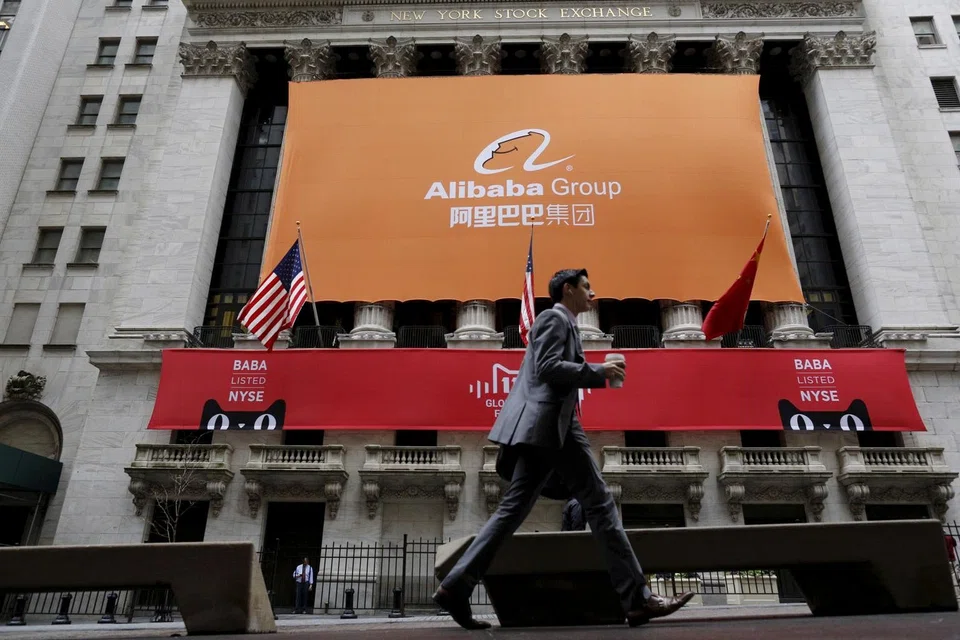
With the new law in place, Chinese companies such as Alibaba Group Holding, Baidu, JD.com, TAL Education Group and Yum China Holdings, which are all components of well-known market indices, might be forced to delist in the US.
Yet, much like Mr Trump's executive order in November, it is hard to not view this stiffening of US securities regulation as being at least partly motivated by a sense among Democrats as well as Republicans that China poses a growing threat to US hegemony.
US campaign may backfire
For investors in Singapore, the stakes might not seem all that high.
No doubt, shares of some Chinese companies with purported links to the country's military and intelligence services might suffer de-ratings as they are excluded from key market indices. Some Chinese companies currently listed in the US might also be forced to return home.
But so what? As non-US investors, we still have the ability to invest in these Chinese stocks, if we are inclined to do so.
One could also argue that if Chinese companies had no choice but to list in their home market, frauds like Luckin Coffee might be less likely to happen because of more informed scrutiny by Chinese investors and regulators.
That could, ironically, improve the perception of Chinese companies among global investors and enliven China's own capital markets.
The US Securities and Exchange Commission said this past week that Luckin Coffee will pay US$180 million to settle charges that it overstated its 2019 revenues and understated a net loss.
Efforts by the US to push Chinese companies out of its capital markets could also lead to further significant weakness in the greenback.
As the primary reserve currency, the US dollar has steered the world's savings into the US capital market. This is the reason many large Chinese companies are listed on US exchanges in the first place.
Yet, Mr Trump has shown little appreciation of the basis of this "exorbitant privilege".
He has spent the last four years purposely exacerbating rather than healing divisions within American society, and antagonising rather than cultivating trading partners whose cooperation is needed to keep the global system functioning.
The US Treasury's recently published December 2020 report on economic and foreign exchange policies of its key trading partners labelled Switzerland and Vietnam as currency manipulators.
The report also added Taiwan, Thailand and India to its "monitoring list".
Other places currently on the list are: China, Japan, Korea, Germany, Italy, Singapore and Malaysia.
While the availability of Covid-19 vaccines could revive economic activity in the US and around the world, the ongoing push for financial decoupling from China could still keep the US dollar under pressure, and perhaps even dilute its vaunted position as the world's reserve currency.