S-Reits' growth lies in foreign asset acquisitions: Aprea
Singapore
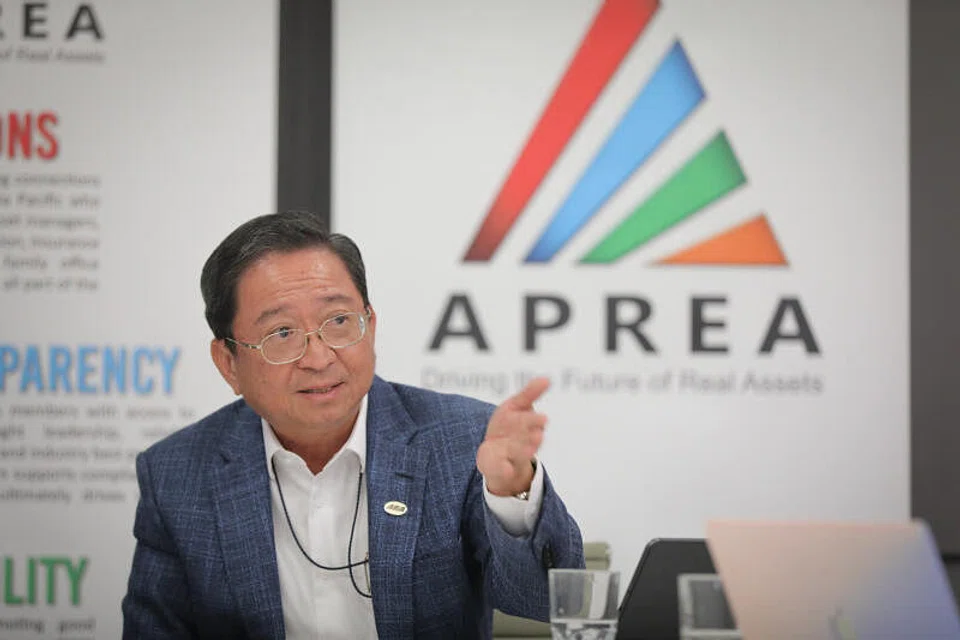
DESPITE the absence of new Singapore real estate investment trust (S-Reit) listings of late, John Lim, chairman of the Asia Pacific Real Assets Association (Aprea), is not worried. He believes that the answer to growing the S-Reit sector is not by amassing more Reits, but by relaxing taxes and regulations to allow the big boys to make overseas acquisitions more easily.
He foresees that with each regional market doubling down to building its own Reit regime, cross-border foreign Reit listings will become less relevant, as investing in them also carries asset, political and foreign exchange risks. Mr Lim, who is also co-founder and deputy chairman of ARA Asset Management, said this at an Aprea briefing to announce the rebranding of the association, whose acronyms used to stand for Asia-Pacific Real Estate Association.
The change to Real Assets was to encompass infrastructure, an emerging asset class which has been securitised and listed in India as trusts, with China trying to do the same. With the pandemic squeezing public budgets and rising debt levels limiting fiscal manoeuvres, Aprea believes that more infrastructure securitisation could follow to meet the funding gap.
Mr Lim said: "We have been telling the (Monetary Authority of Singapore), subject to their reviews, to make the policies, rules and regulations a bit more friendly for local Reits to acquire overseas assets," referring to the largest Reits listed here such as CapitaLand Integrated Commercial Trust (CICT), Ascendas Reit, and Mapletree Logistics Trust. These Reits have already ventured overseas.
He believes that the local market needs more "S$10 billion to S$15 billion Reits", rather than new Reit listings every year. The market cap of Singapore's biggest Reit, CICT, was S$14.2 billion on Tuesday. Mr Lim hopes to see more Reits approach the market cap of Hong Kong's Link Reit at HK$146.5 billion (S$25.3 billion), the largest Reit in the Asia-Pacific. The missing ingredients, in his opinion, are policy adjustment, education and good quality assets.
He said: "If the top 10 Reits in Singapore acquire S$1 billion of assets a year, that's S$10 billion and a 10 per cent growth per year."
Countries in the region have been ramping up their own Reit regimes in recent years. India launched its first Reit in 2019, followed by the Philippines a year later, while the United Arab Emirates launched its first green Reit this year. Meanwhile, the market is anticipating announcement of China's first infrastructure trust this year, and more Reit listings are expected to launch in Thailand and the Philippines this year. Aprea is very involved in working with local regulators to develop these markets.
Sigrid Zialcita, Aprea's CEO, expects that once China's and India's Reit markets mature, the Asia-Pacific will become the global Reit epicentre with a total market cap of more than US$1 trillion by the end of the decade. By comparison, the US Reit market is valued at US$1.25 trillion as at end-March 2021.
Mr Lim said that with countries developing their own asset securitisation framework, there will be less incentive for overseas assets to list in Singapore in future, given cross-border tax and regulation complexities. Rather, it would be better to allow local Reits to buy more assets in mature markets such as London, New York, Seoul, Tokyo and Australia.
"We are already doing it. I am talking about making regulations even more flexible, and having more tax incentives for Reits to be able to go out and acquire assets," he said. Tax structures for property purchases in the US, Dubai and London are currently "complicated".
"There are established structures that enable S-Reits to efficiently purchase overseas assets from a tax perspective, eg the Mapletree Industrial Trust structure in Australia. ARA US Hospitality Trust has a tax structure that utilises the portfolio interest exemption rules to repatriate income from the US. The availability of double tax treaties in various jurisdictions also helps to reduce tax leakage."
Agnes Lo, partner, real estate and asset management, tax, at KPMG Singapore, said most countries would levy domestic corporate income tax on rental profits as well as withholding tax on profit repatriation. Hence, S-Reits' outbound investment structures would typically use a combination of tax-efficient vehicles (eg US Reits) and tax-efficient instruments (eg eurobonds) overseas.
"In recent years, managing overseas tax has become more challenging due to regular tax reforms, increased restrictions imposed on tax deduction and more substantial changes proposed in the international tax landscape," she said.
"S-Reits' foreign income tax incentives have played a significant role in facilitating efficient and effective profit repatriation. If S-Reits' foreign income incentives could be enhanced, similar to how tax incentives have been applied to fund management, there will be more flexibilities for S-Reits to structure their investments overseas."
Chew Sutat, senior managing director, global sales and origination at the Singapore Exchange, agreed that most real estate and Reit markets - including Japan, Australia and the US - are domestic in nature. But he considers Singapore an exception as "a truly international Reit centre with multi-geography and multi-sector Reits" which complements these domestic Reit markets.
"Our international regime attracts global investors looking to invest efficiently in diversified Reits in one place. Many successful primary and secondary fundraising transactions on SGX have allowed Reits to diversify assets and geography, which come with a broadening of investors base as Reits expand their footprint," he said. BT understands that Hong Kong's efforts to attract listings of assets outside Hong Kong or China have been less successful.
Mr Chew is supportive of more countries developing domestic Reit regimes, as this will enhance transparency and tax certainty for domestic asset owners and investors, and will enable offshore Reits in Singapore looking to add choice to their products to further expand their footprint.