SoftBank concentration risk comes to the fore in Asia tech ecosystem

Singapore
A FEW years ago, the entry of SoftBank's Vision Fund into Asia heralded hope of a tech boom. But today, all eyes will be on how deep the Vision Fund's losses run in SoftBank's full-year results announcement, and whether there could be any rollover impact on its iconic portfolio companies in Asia, ranging from social media darling ByteDance to embattled hotel chain Oyo.
Last month, SoftBank revealed that it expects a massive 1.8 trillion yen (S$24.2 billion) loss in its US$100 billion Vision Fund for the year ended March, pushing the group into the red for the first time in 15 years.
Much of the squeeze is expected to come from soured bets like WeWork, but some losses could also arise from valuation writedowns on startups hammered by Covid-19.
If SoftBank faces heat from its own shareholders over the Vision Fund losses, the pressure may also roll over to any of its Asian portfolio companies that have outsized exposure to the Japanese conglomerate.
"I believe two types of companies will face more pressure: those which depend on SoftBank for the next round of funding; and those where SoftBank's ownership is too high for other investors to be comfortable to come in," said Jianggan Li, chief executive of venture builder Momentum Works.
Factors that determine whether other investors are willing to enter could include whether SoftBank controls the majority of the company's shares or debt, how aggressive the terms of its investment are and to what extent the Japanese firm holds sway over the board.
The issue of how exposed Asia's major tech unicorns are to SoftBank could then shape whether they can retain their growth strategies and stay private until the Initial Public Offering (IPO) window reopens, or if they may be forced to exit prematurely, possibly even consolidating with rivals.
SoftBank's Vision Fund has backed at least 23 companies in Asia, of which about 15 have yet to undertake an IPO (see table). The Asian crown jewel is arguably TikTok owner ByteDance, with a reported valuation of US$78 billion.
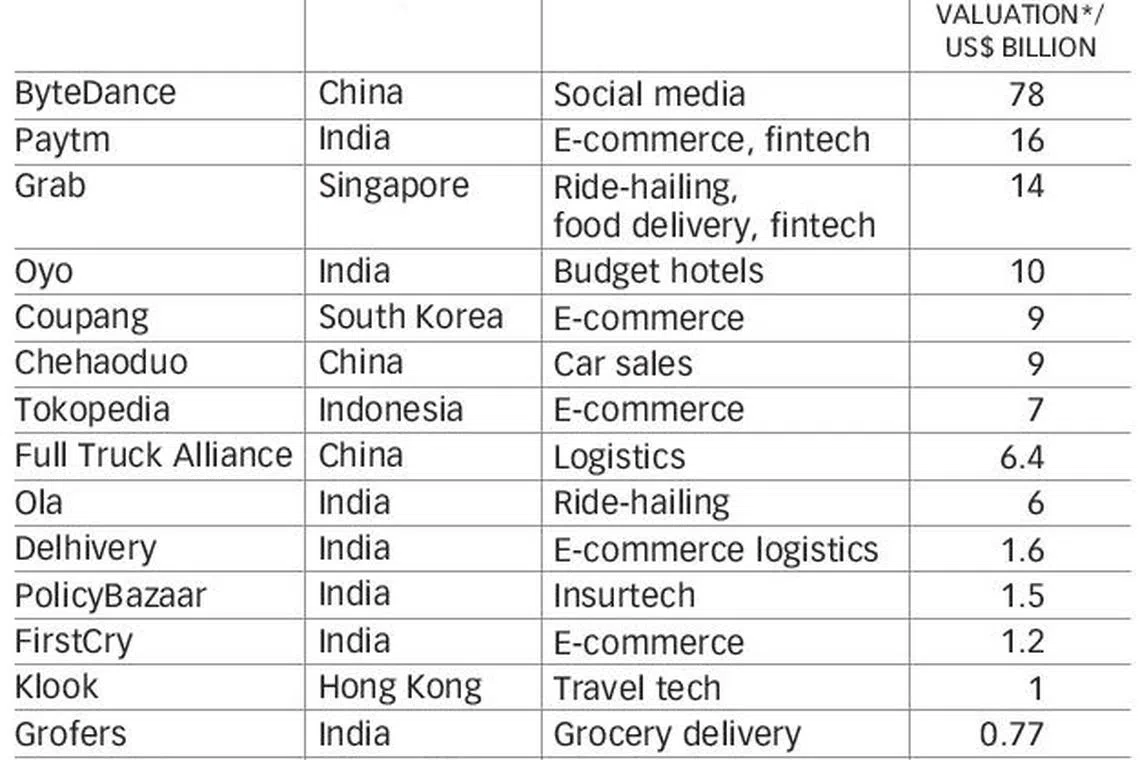
Closer to home, SoftBank has sunk at least US$1.46 billion in super-app player Grab and up to US$200 million in Vietnamese digital payments player VNLife. SoftBank previously joined a US$1.1 billion funding round in Indonesia's Tokopedia, and is reportedly planning to invest another US$1.5 billion with Alibaba and Temasek, according to a Financial Times report in January.
Some Vision Fund portfolio companies in Asia could find themselves cash-strapped amid the impact from Covid-19. Their resilience will then rest on whether they are able to tap other sources of capital independent of SoftBank.
"Since SoftBank is also facing pressure from its own shareholders and their next few investments will likely be heavily scrutinised, I would say that these shareholders' pressure will effectively flow down to these portfolio companies," said Terence Sim, an investment director at India-based Smile Group, which invests in and builds Internet businesses.
James Tan, managing partner of Quest Ventures, added: "Concentration risk is real and founders will now be forced to de-risk themselves and their shareholders by diversifying their investor pool with more domain-knowledge investors for go-to-market challenges."
Are any of the Vision Fund's Asian bets looking vulnerable? Indian budget hotel chain Oyo may be one, Mr Li of Momentum Works reckoned.
According to a November 2019 CNBC report, SoftBank is said to own 48 per cent of Oyo, while founder Ritesh Agarwal controls 30 per cent. Its latest round was bankrolled solely by SoftBank and Mr Agarwal, with the latter taking out US$2 billion in loans personally guaranteed by Mr Son.
Another Vision Fund player that could be vulnerable is Chinese robotics firm CloudMinds, which has been barred by US authorities from transferring its technology to China. The startup is now saddled with high cash burn amid repeated attempts to go public, Reuters reported in January.
There are other Asian Vision Fund companies that may be in a safer position thanks to their more diverse base of shareholders, but they may still face strong headwinds as a result of Covid-19.
For instance, e-commerce players backed by the Vision Fund, such as Tokopedia, South Korea's Coupang and India's FirstCry, may be beneficiaries of soaring e-commerce volumes amid Covid-19, but they will also need to contend with potentially higher supply chain costs. These players will need to manage their cash prudently in a segment infamous for cash burn wars.
Another Vision Fund company that is likely to be watched closely is Grab. In an April 20 report, analyst Kirk Boodry of Redex Holdings, who publishes on Smartkarma, said that SoftBank may write down the valuations on the Vision Fund's ride-hailing plays, which have been throttled by Covid-19.
In April, Uber said that it will make a US$2 billion writedown on investments. This could involve China's Didi Chuxing or Grab.
Mr Boodry speculated that SoftBank may write down its valuation of Grab by US$1 billion. But he added a caveat: "Grab is the toughest to figure because it is exposed but it also raised US$856 million from MUFG and Japanese IT company TIS Intec in February, so it has cash and a recent validation of value."
It is not clear how large a stake SoftBank has built up in Grab since it first backed the company in 2014. SoftBank also has indirect interests in Grab held by its other portfolio companies, Uber and Didi. Uber took a 27.5 per cent stake and a board seat in Grab after leaving South-east Asia.
When asked about its degree of exposure to SoftBank and whether there could be any impact from SoftBank's woes, a Grab spokesperson said: "SoftBank is a great partner to us and we are blessed to have their continued support."
Mr Li reckoned that Grab, like ByteDance, will be safe, thanks to a "solid business model, good competitive position in a promising market and good founders".
What will be the lasting impact of the Vision Fund on Asia's tech ecosystem? Has its aggressive investing strategy helped or hurt startups more? Sentiment is mixed at best.
Some like Hian Goh of Openspace Ventures, which is invested in Gojek, stand by the Vision Fund's contributions.
"Say what you want about SoftBank, but the facts remain that they have played a meaningful part in creating some of the most disruptive companies in the world: WeWork, Tokopedia, ByteDance, Slack, Didi and Uber. Softbank has accelerated the change in our lives, and made the future arrive faster," he said.
And to be fair, SoftBank has also been a critical early-stage investor beyond the Vision Fund. Its early-stage venture capital arm, SoftBank Ventures Asia (SVA), has also backed over 100 startups.
SVA's South-east Asian portfolio comprises familiar names such as Temasek-backed cashback app ShopBack and used-car platform Carro.
Mr Sim of Smile Group agreed that SoftBank has played "a very important role" in Asian tech, but also added: "Perhaps, it was too much capital, too soon. This has resulted in startups expanding into new markets even when the markets are not ready for it and I suspect we will see a few high profile failures over the next few years."
Another regional investor, who asked not to be named, says that any frothiness is to be blamed not on SoftBank, but more on venture capitalists' groupthink. "They chase deals because SoftBank or some large named investors have invested in those startups. This is a silly approach of hoping for valuation bumps along the way," the investor said.
Whatever the sentiment, it will be worth watching how the SoftBank-fuelled future of Asia tech shapes up, and whether Mr Son's 100-year vision passes the Covid-19 test.