Opportunities for Singapore firms in Russia's consumer, tech sectors
Average Russian spends 80% of disposable monthly income; e-commerce market to be worth US$21 billion by 2020

Claudia Chong
Singapore
SINGAPORE businesses will stand to gain by venturing into Russia's consumer and technology sectors.
This was the key message from yesterday's Russia Singapore Business Forum organised by Enterprise Singapore. The event saw more than 300 Singapore and Russia business leaders in attendance.
Kathy Lai, deputy chief executive officer of Enterprise Singapore, said local firms should seek opportunities in Russia's consumer market, which comprises 150 million people with a median population age of below 40.
"Wage recovery and growth has been fuelling consumer spending in Russia. With the average Russian spending 80 per cent of his or her disposable monthly income, Singapore companies can tap on this thriving sector, be it food, retail or education," she said.
She also highlighted the attractiveness of Russia's tech sector, pointing out that its e-commerce market has been growing at a rate of about 20 per cent annually over the past five years, and is expected to be worth US$21 billion by 2020.
"We see opportunities for Singapore startups to collaborate with Russian partners to co-create innovative tech solutions and products in e-commerce, warehousing services, fulfilment services, customer relationship management systems and more," said Ms Lai.
Her comments follow the inking of two memoranda of understanding (MOUs) on Wednesday, which give startups from Singapore and Russia access to business networks, markets and resources in both countries.
One MOU was signed between a Russian venture capital fund, Internet Initiatives Development Fund, and Singapore's Action for Community Entrepreneurship.
The other MOU was signed by the Russian Export Centre, Skolkovo Foundation, Sistema Group and Enterprise Singapore.
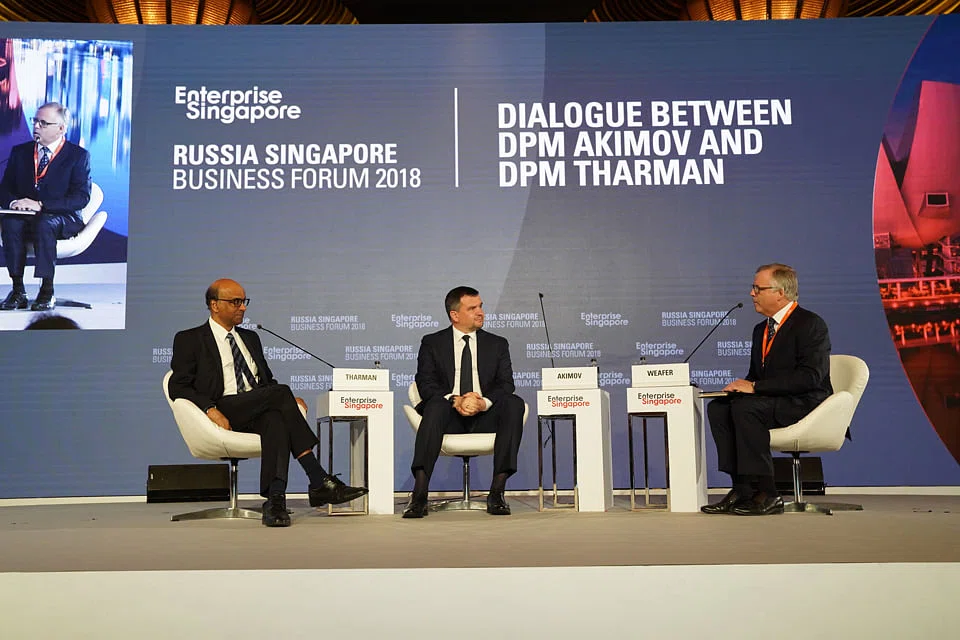
Deputy Prime Minister Tharman Shanmugaratnam, who took part in a dialogue with Russia's Deputy Prime Minister Maxim Akimov at the forum, stressed the importance of diversifying in a period of uncertainty about attitudes toward open trade and investment.
"We are diversifying, especially, in the last five or six years...and in an uncertain international environment, diversification holds us up as a small economy," said Mr Tharman.
He added: "Russia deserves more attention amongst our businesses. It's a very large market and one that is increasingly dynamic."
Bilateral trade between the two countries grew at a compounded annual growth rate of 15 per cent, from less than S$2 billion in 2007 to S$7.4 billion in 2017, said Enterprise Singapore in a press statement.
Meanwhile, Singapore's stock of Direct Investment Abroad (DIA) in Russia reached S$420 million as at end-2015.
The Russian economy has been through a challenging period, but is on a steady road to recovery, said Ms Lai. For instance, there is a renewed focus on improving physical connectivity within the country, particularly by road and rail. Some US$900 billion will be invested in infrastructure by 2030, with US$464 billion in rail alone.
Russia has also been pumping state funds into digitalising the economy. Mr Akimov, who highlighted that Russia is a gateway to emerging Europe and Central Asia, said key areas that business leaders in Singapore should look at in Russia include telecommunications, smart manufacturing and unmanned systems.
Platforms that facilitate investments into Russia include the Russian Export Center and the Russian Direct Investment Fund.
"In order to win the lottery, you have to buy the lottery tickets first," said Mr Akimov, calling eight in ten "lottery tickets" in Russia a "winning ticket".