Surge in demand for deep freeze solutions
SATS boosts dry ice output amid rollout of Covid-19 vaccine; other firms report increased demand for ultra-low-temperature freezing solutions

Singapore
CONCERNS have surfaced in many countries over looming shortages of dry ice needed to transport Covid-19 messenger RNA (mRNA) vaccines.
In Singapore, demand has increased for ultra-low-temperature (ULT) freezing solutions. Dry ice companies believe they can ramp up enough supply to meet the increased demand.
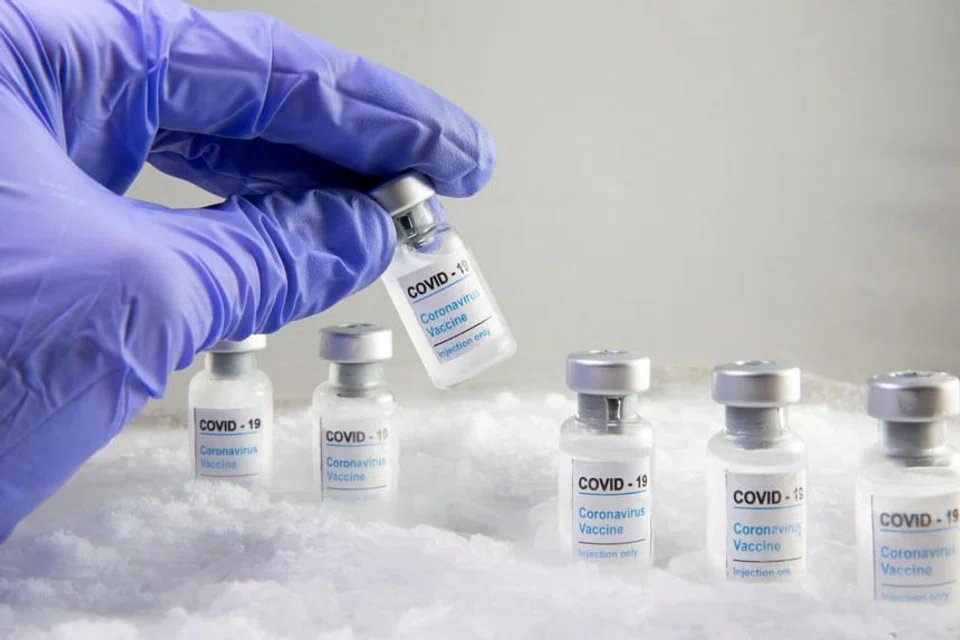
Vaccines that use mRNA molecules, including the front-running Pfizer-BioNTech and Moderna vaccines, need to be stored in cold temperatures to remain effective.
In particular, Pfizer-BioNTech's vaccine needs to be stored in ultra-cold temperatures of minus-70 degrees Celsius, and can only last in normal refrigeration temperatures for up to five days. This has sparked concerns in early-adopter countries, like the UK and the US, over potential shortages of dry ice, or solidified carbon dioxide.
Globally, Pfizer and BioNTech intend to roll out up to 1.3 billion doses of their vaccine in 2021 - a number that could require significant volumes of dry ice, especially to deliver vaccines to rural areas.
Earlier this month, China's Global Times reported that dry ice and its machine suppliers in China are "working in full swing" to respond to soaring demand.
In Singapore, Ravi Shastri, managing director for South-east Asia and Taiwan at Thermo Fisher Scientific, said demand for vaccine storages is accelerating, and is expected to double in the coming months. Already, demand for the company's ULT freezers has been three times as high in 2020 compared to previous years, with an "unprecedented demand" over the last several months.
The company, he added, had anticipated such a surge as soon as vaccine distribution began, and had adjusted its operations to meet its customers' needs.
However, the demand surge does not seem to be apparent in the dry ice market at this time, with multiple local dry ice manufacturers reporting no significant demand or price spikes.
Lee Choon Leong, director of Cold Solutions - a local manufacturer of dry ice, thermal insulated containers and dry ice equipment - said demand is anticipated to increase only in the first half of 2021, by up to 20 to 30 per cent. Currently, conditions are "business as usual", with dry ice prices in Asia "quite stable".
Meanwhile, ground-handler and caterer SATS has increased its in-house production of dry ice to 4.5 tonnes daily.
A company spokesperson told BT that Sats has "already built the capacity and capabilities" for its 8,000 square-metre Coolport to handle perishables such as vaccines, and that SATS will not be affected by any price increases in dry ice or freezers.
Separately, a spokesperson from ground-handler dnata said there are many suppliers in Singapore that deal directly with the airport community, which can produce "many tonnes [of dry ice] per day - more than we would likely need locally."
He added that while the vaccines are packed in boxes with dry ice or gel packs to achieve -70C temperatures, these boxes "can keep an internal temperature of -70C for quite a few days even if stored at ambient temperatures". Transport solutions like dnata's "cool dollies" - containers that provide a controlled temperature environment of between -25C to 25C - can be used to quickly transport these boxes before their packaging expires.
He also observed that manufacturers of freezer boxes have increased their production recently, and new players are entering the market with alternatives.
Some of these alternatives are less reliant on dry ice. According to Niklas Adamsson, the chief operating officer of Envirotainer, the majority of the company's temperature-controlled containers run on battery power.
Similarly, Andreas Seitz, the managing director of DoKaSch Temperature Solutions, told BT that its "Opticooler" container only requires a standard power socket.
Looking ahead, other vaccines that may arrive in the coming months may have less onerous requirements for extremely cold storage.
Last month, Pfizer's chief executive, Ugur Sahin, told CNN that the company was working on a formula that would allow its vaccine to be shipped at room temperature.
Moderna has said its vaccine can remain stable for up to 30 days in standard refrigerated conditions, within its six-month shelf life.
Finally, more traditional non- mRNA vaccines are less fragile. Sinovac researchers have said its vaccine can be stored at normal refrigeration of 2 to 8 degrees Celsius, and remain stable for up to three years.
- With additional reporting by Leila Lai