

New commercial project planned in Changi
Changi Airport Group bagged URA's nod in late-2019 for retail, office and hotel development

Singapore
AFTER opening Jewel last year, Changi Airport Group (CAG) has begun planning for another commercial project, although it may be some time before plans come to fruition.
CAG secured provisional permission from the Urban Redevelopment Authority late last year to develop a retail, office and hotel project along Tanah Merah Coast Road. The approval is for respective gross floor areas of 413,011 sq ft of offices, 621,938 sq ft for retail and 120,879 sq ft for the hotel component (which will have 251 rooms) - totalling nearly 1.16 million sq ft.
CAG declined to comment when contacted by The Business Times.
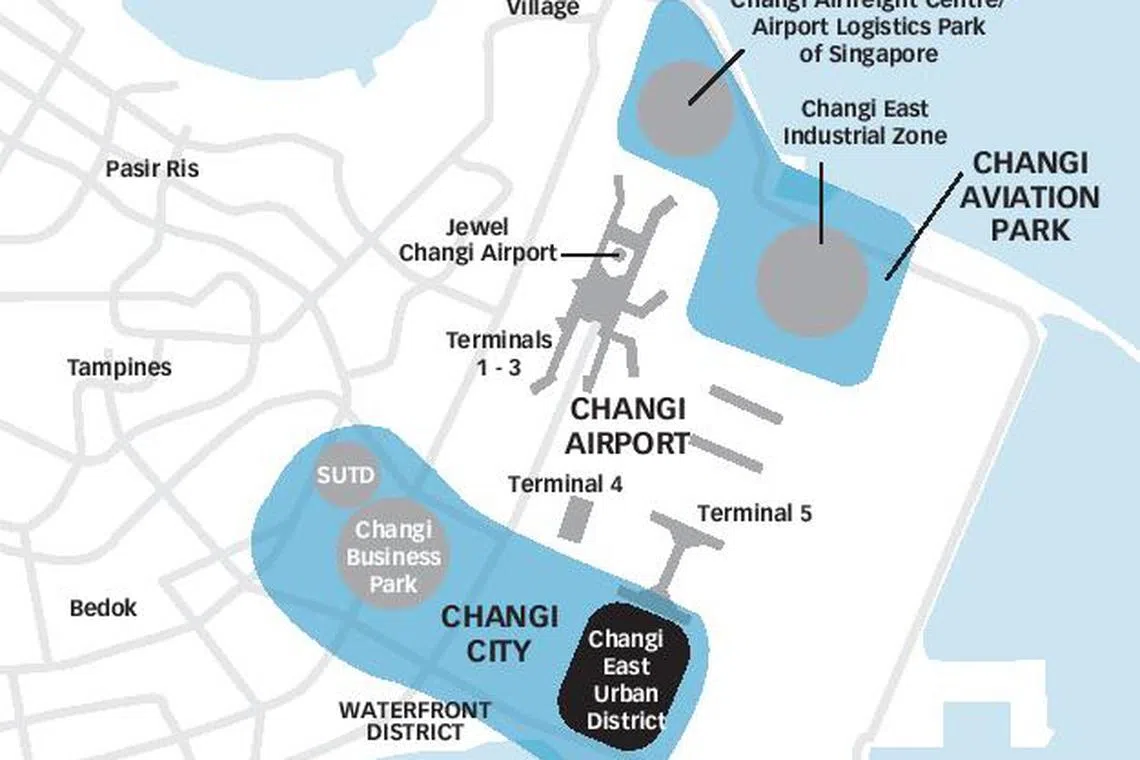
However, market watchers expect the proposed project to be part of the Changi East Urban District highlighted in URA's Master Plan 2019.
This new lifestyle and business district will be located at the doorstep of the future Terminal 5, which was originally slated for completion in the 2030s.
Amid uncertainty about how the Covid-19 pandemic will change the aviation sector, construction of the mega T5 project will be paused for at least two years, Transport Minister Khaw Boon Wan said on Tuesday.
He said that the government is currently carrying out a study of how Covid-19 will change the aviation sector, and that the design of T5 may need to be changed to take into account new safety requirements.
Last month, CAG consolidated the airport's terminal operations to optimise resources amid a sharp drop in passenger traffic and flight movements due to the global pandemic.
Operations at T2 have been suspended since May 1 for 18 months, in part to facilitate upgrading and expansion works. CAG has also temporarily suspended operations at T4 since May 16; resumption of services will hinge on when air travel demand picks up.
Changi Airport's Terminals 1 and 3 remain open.
As envisaged in URA's Master Plan, the Changi East Urban District could include new offices, smart work centres, flexible conference rooms and halls, hotels and serviced apartments, set amid lushly landscaped public spaces.
The district is envisioned as part of Changi City, which will also encompass an innovation eco-system leveraging on the Singapore University of Technology and Design (SUTD) and the Changi Business Park.
Riding on its strategic coastal location, Changi City may also feature a waterfront district in the longer term offering new recreational and tourism possibilities. With Tanah Merah Ferry Terminal just a stone's throw away, there is also potential for seamless inter-modal "fly-ferry" linkages from Terminal 5, according to information on the URA website.
Desmond Sim, the head of research for Singapore and South-east Asia at property consulting group CBRE, estimates that the retail space in the proposed project by CAG will amount to about 500,000 sq ft net lettable area (NLA), making it slightly bigger than Causeway Point in Woodlands, which has NLA of about 420,000 sq ft.
He estimates the NLA for the office component at 350,000 sq ft - slightly smaller than OUE Bayfront's 400,000 sq ft. "It seems that there is potential for a commercial hub in the Changi East Urban District."
The offices will be ideal for aviation companies. The retail space will cater to both the tourist and domestic markets; it would not be just for Terminal 5, Mr Sim opined.
"This could be another Vivocity," he suggested, referring to the mall at the southern tip of the main island of Singapore and which is next to an international cruise terminal and a regional ferry terminal.
"Taken as a whole, the Changi East Urban District will be the centre point that will synergise the existing areas that house the SUTD, Changi Business Park and also the future Terminal 5. With such a development, it will provide ample commercial space that will most likely be linked with the aviation hub that Singapore is establishing as well as other key commercial activities," said Mr Sim.
TRENDING NOW
World’s largest offshore wind platform by Seatrium consortium on track to be completed by 2028

Is stamp collecting enjoying an analogue revival or are its best days over?

GovTech retrenches another 38 staff in second round of layoffs
MBS adjusted property Ebitda falls 20.6% in Q3 with fewer high-roller visits, weaker hold

