

Samwoh, JTC to work on construction innovation
The two parties sign an MOU to undertake joint research into more sustainable construction materials and integrated automation solutions for construction, among other things
Singapore
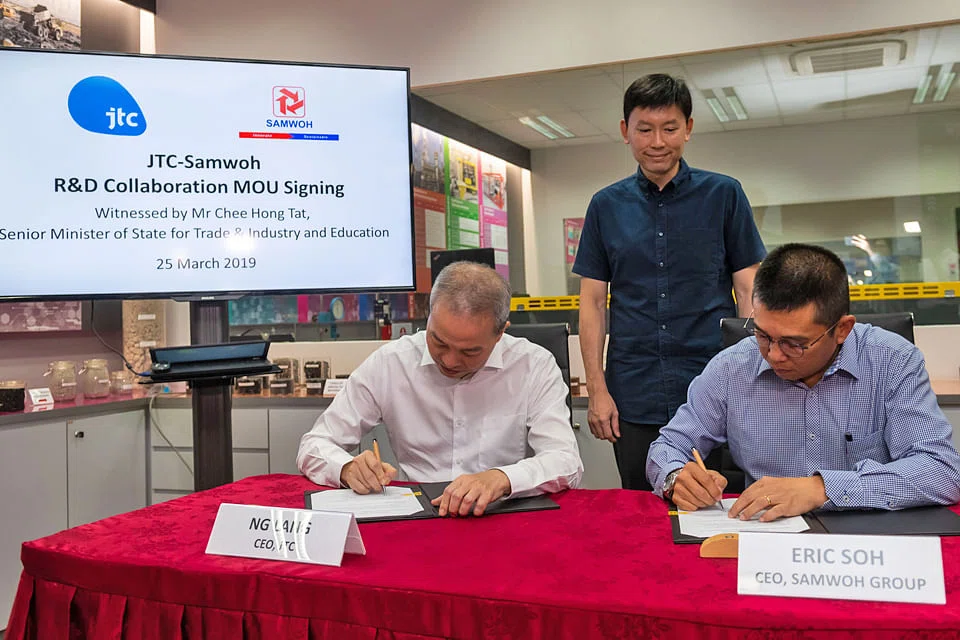
CONSTRUCTION and engineering firm Samwoh Corporation has signed a Memorandum of Understanding (MOU) with JTC Corporation to boost construction innovation in Singapore.
Under the agreement, JTC and Samwoh will collaborate and share resources in research and development, such as in equipment, laboratories, facilities and manpower.
The two sides will work together on three research tracks: integrated digital discovery, productivity and automation and sustainability and resilience. The collaboration promises to reduce the costs usually run up by research and development.
The MOU was inked on Monday at a ceremony witnessed by Senior Minister of State for the Ministry of Trade and Industry and for Education Chee Hong Tat, who pledged his support for Samwoh and JTC's joint initiative.
"Just as we're not done building Singapore, we're also not done looking for better ways to build Singapore," he said of Samwoh's drive to improve.
Samwoh and JTC will also explore the development of sustainable construction materials from waste recycling to improve Singapore's resource resilience while reducing the carbon footprint of building projects.
In line with the government's push to develop Singapore into a Smart Nation, Samwoh will be incorporating a cloud-based materials-tracking system for materials delivered from manufacturing plants to sites via the Internet of Things (IoT), which extends Internet connectivity beyond conventional computing platforms.
Smart sensors and mobile applications will also be deployed to enable better prioritisation of resources in road maintenance works.
In the area of productivity and automation, Samwoh seeks to develop integrated automation solutions for construction, which will improve productivity of highly repetitive jobs, while improving the precision of infrastructure projects.
Safety risks will therefore be lowered as a result of less human involvement in high-risk construction activities. While acknowledging the traditional strengths of the construction industry, such as the trust it enjoys from consumers, Mr Chee praised Samwoh for its efforts to "take the industry further through transformation and finding innovative solutions".
Also announced at the event was the development of the Samwoh Smart Hub. With the lease for much of Samwoh's current premises expiring in 2025, the firm will develop a positive-energy building to house all Samwoh's operations.
The four-storey building, with a total area of just under 3.4 ha, is significantly smaller than Samwoh's current premises, which covers more than 5 ha. However, a Samwoh spokesman expressed confidence that the company's output will continue to rise.
"The new building is customised for our specific needs, making it more efficient. We will also be collaborating closely with our counterparts in Switzerland to bring in newer, more efficient technology," he said.
"The Samwoh Smart Hub will be 15 per cent more efficient than other industrial buildings," he continued.
Slated for completion in 2020, the Smart Hub will be equipped with modern technology, such as a solar-powered DC water chiller plant, a smart fan coil unit, smart plugs and intelligent sensors to lower energy consumption.
TRENDING NOW
Singapore bars Alice Huang, woman tied to affair with Nvidia’s Jensen Huang, for misleading police

Nvidia prepares to oust Jensen Huang after news of second affair, with executive: reports

Higher rates, weaker spending: Is the Philippines entering stagflation?

Special dividend for SIA’s 80th anniversary? CEO says extra payout will need board’s nod

