

Red packets that aren’t red? More demand for other colours this CNY

Renald Yeo
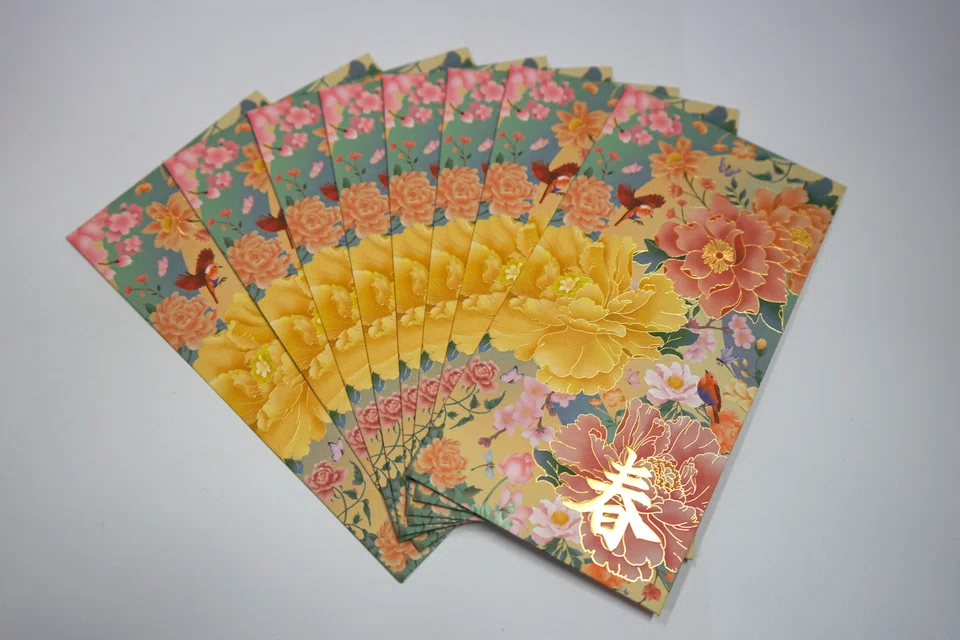
INSTEAD of traditional red packets, more corporates and consumers in Singapore are opting for cash-containing envelopes in other hues, printing companies have said.
This is even as overall demand for these slim festive envelopes has fallen, as large corporate buyers cut back on their orders.
Red, an auspicious colour in Chinese tradition, remains the most popular hue for red packets or hongbao, which are given out during the Chinese New Year (CNY). But printers are seeing greater demand for hongbao in non-traditional colours such as gold or pink.
That is because non-red envelopes can easily be used for other occasions featuring cash gifts, such as birthdays, weddings, or even Hari Raya and Deepavali, industry players told The Business Times.
Customised gift provider EzGift has noted that non-red envelopes make up three in 10 pieces sold, up from just one in 10, with gold being a popular choice.
“We received some enquiries (from clients) saying that they do not want red hongbao; some asked for champagne or off-white ones, which is not traditional at all,” said director Bryan Tan.
EzGift sells hongbao – which make up about 20 per cent of its overall annual sales – to corporate clients only. The company has yet to fully tabulate this year’s hongbao sales, but order volumes range widely from 2,000 to 20,000 pieces.
Printing company Craftwerkz has sold more than 10 million hongbao this CNY, with up to 15 per cent more requests for non-red ones.
“Our clients are more modern, and they are willing to break from tradition, to do brighter colours and colours outside the traditional red,” explained co-founder Michael Lim.
He noted that even as Craftwerkz has received more orders, there has been a lower average number of red packets in each purchase deal.
And orders have shrunk, which is why the number printed by Craftwerkz is down 10 per cent. Some regular clients who used to buy 100,000 or more red packets have cut back to five-figure quantities, he noted.
Sales value, however, has remained about the same, he added, because Craftwerkz’s clients are opting for more intricate – and thus pricier – designs.
CNY is central to Craftwerkz, with red packet sales making up about 70 per cent of overall annual sales. Corporates account for about 90 per cent of red packet sales, with consumers making up the rest.
In contrast, consumers account for 99 per cent of hongbao sales at retailer The Chinese Wedding Shop. Sales have risen across its five outlets here, though these envelopes still form “a very small” portion of annual revenue, said founder and director Michelle Neo.
Total hongbao sales figures have yet to be tabulated, but more designs are selling out more quickly than last year. Popular colours include pink and yellow, said Neo, who no longer stocks “traditionally red” envelopes due to a lack of demand.
Corporate demand
In Singapore, red packets are typically ordered by large, consumer-facing corporations such as banks and telcos, printers told BT. But as sustainability efforts ramp up, some large corporates are cutting back on these paper goods.
DBS cut its red packet numbers by 30 per cent this year. Jeremy Soo, managing director and head of consumer banking group (Singapore), said: “Over the years, in line with the bank’s commitment towards sustainability, we have been reducing the volume of red packets produced.”
But the bank has logged a 10 per cent rise in orders of “QR red packets”, which can be scanned to receive money. Though these are still physical printed items, they are more sustainable in avoiding the use of cash.
OCBC cut its red packet orders by about 10 per cent, and has encouraged its customers to send e-red packets instead.
“We recognise that many people still want to give red packets as part of their tradition,” said Jean Oh, head of branch service and risk management at OCBC. “To honour these rituals but also encourage greener ways of doing things, we have been steadily reducing the number of red packets we print for six years now.”
UOB also offers e-red packets, though it maintained its volume of red packets printed due to “sustained public interest and demand”, said Christine Ip, head of group strategic communications and brand. While red packets remain popular, “a balance must be struck between customer demand and environmental sustainability”, she added.
As part of recycling efforts, OCBC and UOB have red packet recycling boxes at all their branches. DBS has more than 40 recycling bins across all DBS and POSB full-service branches, and selected self-service branches.
Singtel has also cut its red packet orders over the years, with the volume now at about 60 per cent of the pre-pandemic level, said the telco’s group chief people and sustainability officer Aileen Tan.
“In addition, we have started designing our red packets without zodiac signs on them, ensuring they can be recycled for use in the future,” she added.
StarHub, which did not order red packets for the past three years due to the Covid-19 pandemic, resumed the practice this year.
However, the telco made a “deliberate move” not to have the typical red colour and zodiac animal motifs.
Said a spokesperson: “This is done so that our red packets can be used for other festivals such as Hari Raya and Deepavali, or for gifting during weddings, birthdays and other celebrations, and not just for this Chinese New Year season.”
Sustainability is also a concern for smaller firms such as media company TheSmartLocal, even though it printed 30 per cent more hongbao this year to meet demand.
Its founder and chief executive officer Bryan Choo said that the company did away with printing a customised sleeve as a container for each set of hongbao, opting instead for just a paper band to hold the red packets together.






