

Asia: Equities down as emerging market fears add to trade woes
 Add BT as a preferred source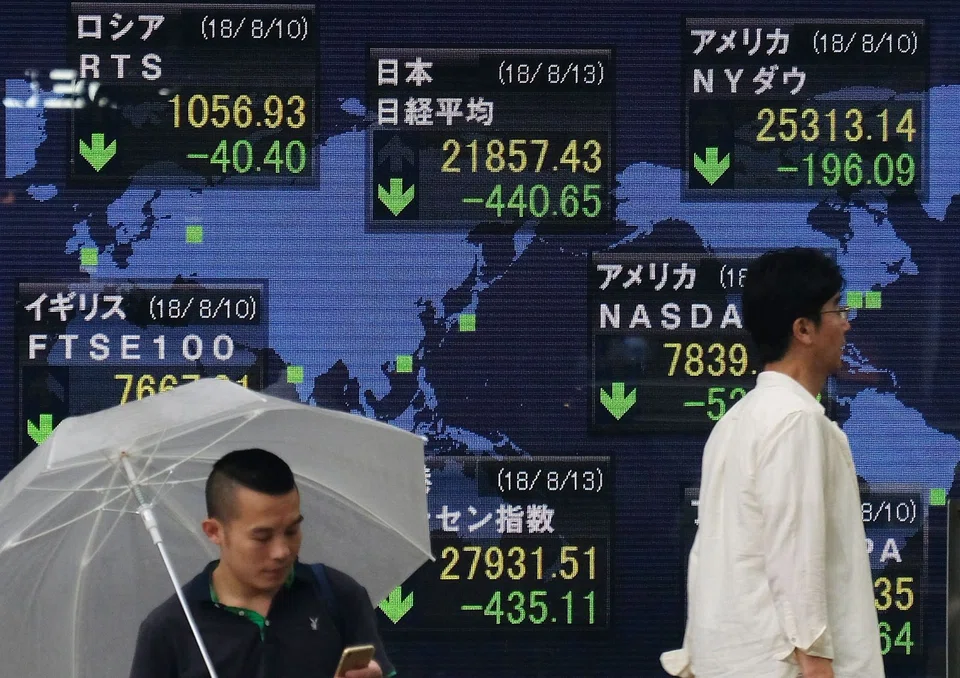
DeeperDive is a beta AI feature. Refer to full articles for the facts.
[HONG KONG] Asian markets resumed their downward march Wednesday on growing concerns about emerging market economies adds to the uncertainty stoked by Donald Trump's long-running trade rows with China and Canada.
After Turkey and Argentina's recent headline-making problems, South Africa became the latest country to spark panic Tuesday with data showing a shock plunge into recession for the one-time economic starlet.
The news sent the country's rand currency plunging in a similar way to the Argentine peso and Turkish lira in recent weeks, with observers increasingly worried the problems could spread to other emerging market (EM) countries and possibly spill over into major economies.
"South Africa is back in recession and that was not expected," said Greg McKenna, chief market strategist at AxiTrader.
"The big question is whether this is a ... tipping point for EM markets and if the idiosyncratic issues are now adding up to something more structurally pernicious for EM markets. My guess? Yes, it is."
The brewing crisis has seen currencies in a number of emerging markets - mostly with deep current account deficits - take a hammering, with India's rupee at a record low and the Indonesian rupiah at levels last seen during the 1998 Asian financial crisis.
Navigate Asia in
a new global order
Get the insights delivered to your inbox.
Adding to selling pressure on the EM currencies is the US economy's continuing strength, which is forcing the Federal Reserve to lift interest rates, in turn leading investors to seek better, safer returns in the US.
TRADE IN FOCUS
Data showing an index of manufacturing activity hitting a 14-year high bolstered expectations the Fed will continue to lift borrowing costs. Crucial US jobs data is due out on Friday.
Equity investors remain on edge as a deadline approaches this week for a public consultation on Trump's proposal to impose tariffs on US$200 billion of Chinese imports, on top of the US$50 billion already being hit.
While the two sides have held low-level talks there are fears the measures will be implemented, which would spark a retaliation from Beijing, and push the world's top two economies closer to an all-out trade war.
Tokyo ended the morning session 0.3 per cent lower, Hong Kong shed 0.9 per cent and Shanghai fell 0.3 percent, while Singapore gave up 0.2 per cent and Seoul dipped 0.1 pe cent.
Sydney fell 0.7 per cent despite news that the Australian economy expanded far more than expected in the second quarter thanks to a pick-up in exports and consumer spending. The local dollar rose 0.5 per cent.
Eyes are also on the resumption of talks Wednesday between the US and Canada aimed at reviewing the North American Free Trade Agreement. Optimism sparked by Mexico's deal last week with Washington was soon tempered by failure to close between the US and Canada, with Trump threatening to leave Ottawa out of the pact altogether.
Canadian Prime Minister Justin Trudeau stressed Tuesday that no NAFTA is better than a bad deal for his country.
AFP
Share with us your feedback on BT's products and services
TRENDING NOW

Shelving S$5 billion office redevelopment plan proved ‘wise’ as geopolitical risks mount: OCBC chairman

OCBC is said to emerge as lead bidder for HSBC Indonesia assets

Middle East-linked energy supply shocks put Asean Power Grid back in focus

Eurokars Group introduces rental car franchises Enterprise Rent-A-Car, National Car Rental, and Alamo to Singapore

