Local players tackle industrial water demand
Singapore
AS global water industry players flock to Singapore for this week's World Cities Summit, Singapore International Water Week and CleanEnviro Summit Singapore 2018, local companies are tackling water issues at home with their own innovations, in hope of fulfilling the country's ever-growing demand.
Singapore's Economic Development Board (EDB) notes that demand is set to rise in the non-domestic sector in particular, which includes industrial and commercial end-users such as manufacturing plants and commercial buildings.
The sector currently accounts for 55 per cent of Singapore's water demand, but this is expected to rise to 70 per cent over the next four decades.
"Traditionally, industries are very large consumers of water," said Tan Cheng Guan, head of renewables and environment business at Sembcorp Industries.
"They also often need water of a very high purity. As a country, we have to look at meeting this demand sustainably, and without putting too much strain on our scarce potable water resources."
Sembcorp started producing high-quality recycled water for industries on Jurong Island in the late 1990s, and continues to produce industrial water and demineralised water for industries using treated wastewater, noted Mr Tan.
He added that industries need to treat wastewater to meet environmental limits, as industrial water can contain higher concentrations of waste or salinity levels.
"Treating this kind of wastewater demands a high degree of expertise, and to date few players can offer solutions for it," he said, noting that Sembcorp is one such player with a strong track record for such treatments.
Even if they do not have the expertise to treat their own industrial water, individual companies should still strive to reduce their own water consumption and help manage the industry's overall demand, said senior researcher Lu Yinghong of Kurita R&D Asia Pte Ltd, the first research and development centre of Kurita Water Industries Ltd in Asia outside Japan.
With the diversity of industrial water, each type must be analysed and treated with different chemicals and optimised processes, and there is no standard system for treating industrial water. As such, "the individual companies have a social responsibility to invest in reducing their own demand", said Dr Lu.
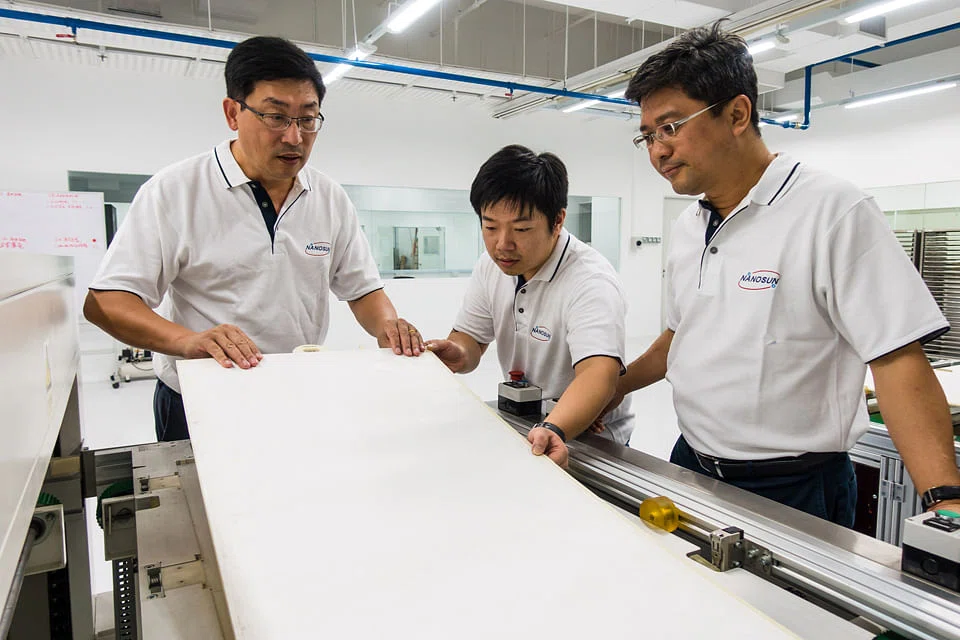
However, the water industry may not be dominated by large companies alone for long. Additive manufacturing and industry partnerships are presenting new opportunities for smaller players like local startup Nano Sun.
Founded by Nanyang Technological University associate professor Darren Sun and Wong Ann Chai, the water technology startup has developed a 3D-printed water treatment membrane that filters water at higher rates than conventional membranes made with porous polymers.
This is possible because the hierarchical structure constructed by 3D-printing nanofibers creates a hydrophilic material, attracting water to itself, explained Prof Sun. As a result, about five times as much water can be filtered using the same amount of pressure.
The startup has successfully deployed its membrane regionally, and can currently treat water to discharge standards.
However, Nano Sun has been asked to look into water recycling as well, and is working with industry partners to expand its pre-treatment capabilities to that end, said Mr Wong, who is also Nano Sun's managing director.
He expects this demand for water recycling to increase soon, saying: "The water fees going up is an incentive to our clients to recycle the water.
"Each time you discharge say, 5,000 cubic metres of water, you need to draw that same amount once again. PUB has to supply that water, so recycling the discharged water reduces the burden on national resources."
At Kurita R&D Asia, researchers are working on improving desalination and wastewater chemical treatments to treat water more efficiently and reduce maintenance costs for the water treatment systems themselves.
For instance, an antifoulant chemical could be used in seawater reverse osmosis systems for desalination. It would help reduce build-up of material on components and maintain stable pressure in the systems so that the plants require less-frequent cleaning and use less energy, Dr Lu said.
Kurita is also testing and developing an antiscalant chemical at one of the NEWater plants, with the aim of reducing build-up and increasing the amount of clean water that can be recovered from the feed water from 70 per cent to 90 per cent.
Beyond Singapore, water companies can leverage opportunities in the global and regional market. According to Global Water Intelligence, the global market for industrial water treatment technologies is set to expand by more than 50 per cent over the next five years.
Within South-east Asia alone, industrial water and wastewater treatment market revenue is forecasted to exceed S$4 billion by 2020.
"Singapore's water constraints have pushed us to strive for water sustainability and in doing so, turning our vulnerability into a strategic asset," said Gian Yi-Hsen, executive director of Cleantech at EDB.
"We continue to invest and develop deep capabilities in the sector not only to achieve long-term water sustainability, but also strengthen our global competitiveness to remain an attractive location for water companies to develop, test and commercialise their solutions for the region and beyond."
READ MORE: HDB looking at expanding use of floating system for solar panels in open sea