

Credit Suisse hopes to keep on backing Asian entrepreneurs
Singapore
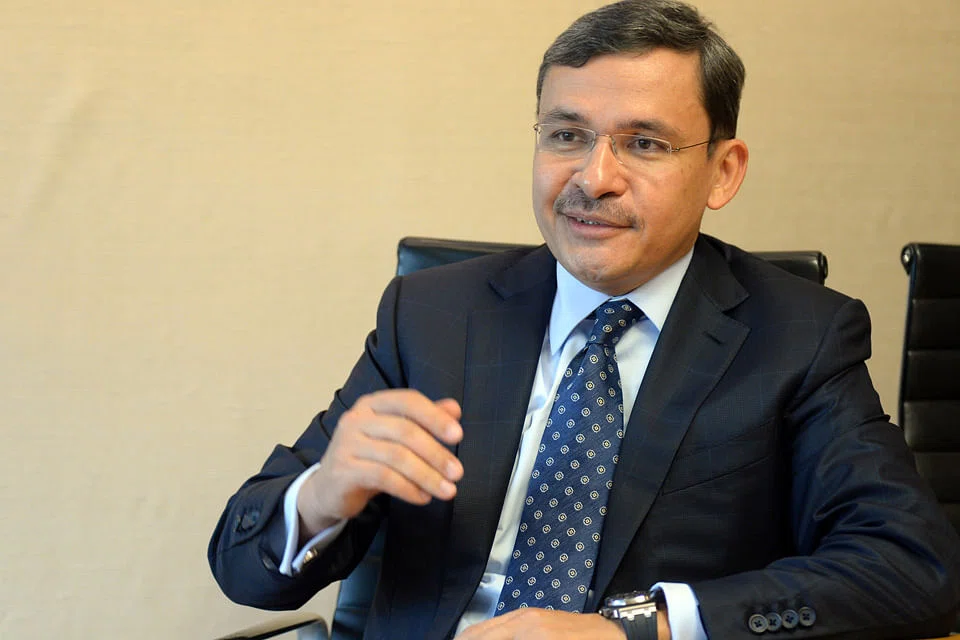
HELMAN Sitohang will say that his client base is a lot smaller than many other banks, but the CEO of Credit Suisse in the Asia-Pacific makes no apologies for it.
The approach has allowed the bank to boost its standing as what it calls an entrepreneurs' bank for Asian businesses, bringing about a steady boost in new assets over the last three years at a rate that is among the fastest in the industry on an organic basis, Mr Sitohang told The Business Times in an interview.
The second-largest wealth manager in the Asia-Pacific by assets added 2.8 billion Swiss francs (S$3.92 billion) in net new assets (NNA) in the second quarter of 2019, translating to an annualised growth of 5 per cent.
To be sure, against market conditions, this has trended lower compared against the higher NNA recorded in both the first quarter of 2019 and in Q2 of 2018.
Its total assets under management (AUM) of 219 billion Swiss francs rose 6 per cent from a year ago, even as it stands at just over half of the invested assets at the Asia-Pacific wealth management division of its Swiss rival, UBS.
Credit Suisse's approach is anchored by the bank's decision to have its Asia-Pacific wealth business organised and reported as a single unit, known as its wealth management and connected (WM&C) business, that more tightly intertwined the private wealth of Asian entrepreneurs with their business aspirations in this region.
The bank's WM&C unit reported a 29 per cent jump in pre-tax income to 216 million Swiss francs in Q2 of 2019 from a year ago, reflecting in part a 9 per cent boost in revenue.
Advisory, underwriting, and financing revenues for Q2 were up 16 per cent from a year ago, speaking to an increase in financing activities and debt underwriting.
Its private banking revenues were at its second-highest on record as a result of higher transaction-based revenues and net interest income.
Credit Suisse has, in recent times, been involved in several financial-market transactions to well-known Asian businesses.
Checks by BT showed Credit Suisse was the sole financial adviser to Lippo Karawaci's US$1 billion funding programme, meant to restructure Lippo Karawaci's balance sheet through deleveraging and repayment of certain debt obligations.
It was also the sole adviser behind the largest-ever public M&A transaction in Vietnam - that is, SK Group's US$1 billion investment in Vietnam's Vingroup in May.
Credit Suisse was also involved in the largest offshore high-yield dollar bond issuance in the first half of 2019 by China Evergrande Group, as well as Luckin Coffee's IPO in the United States.
To be sure, it is difficult to say definitively if the entrepreneurs behind these deals are also clients with the bank due to client confidentiality.
That said, there are Asian businessmen such as AirAsia's CEO Tony Fernandes who have openly acknowledged their banking relationship with Credit Suisse. It is public knowledge, for example, that in 2002, Credit Suisse privately funded US$30 million to Mr Fernandes, with that money used to grow the budget airline. It was said to be a contrarian move then as the aviation industry was scaling back.
More broadly, the bank aims to sell this approach to its Asian wealth clients looking to grow, bolster, and defend their businesses through capital-market fundraising and restructuring. With the high-net-worth individuals segment growing at a similar pace as that of the ultra-high-net worth segment, the bank is looking to grab a bigger market share of its clients' wallets across the board.
"In the ultra-high-net-worth space, there is more visibility on deals," said Mr Sitohang. "I think that kind of visibility inspires a lot of the high net worth individuals to say: 'This is a very interesting bank who understands the entrepreneurs'."
Like many other private banks, Credit Suisse is also seeing much less outflow of client assets as relationship managers depart the bank.
"Because of our model, our relationship with our clients becomes a lot more sticky," noted Mr Sitohang.
As the bank brings institutional expertise to clients, clients who are weighing whether to depart the bank to follow their relationship managers who have packed up and left, also weigh against the access to the investment banking advisory.
To add, the higher bar in compliance and due diligence standards at private banks today have meant that it is increasingly cumbersome for clients to set up a new private-banking account.
"Clients are actually tired of moving banks," said Mr Sitohang.
And this means that the bank can look to "pay competitively" for private bankers in this region, with its relationship managers' pool having already been trimmed by 2 per cent to about 600 today.
"Just bidding up talent for the sake of bidding up, I don't think it's a winning proposition," added Mr Sitohang. "And frankly, I don't think clients and the regulators appreciate it."
TRENDING NOW

Singapore identifies 7 firms responsible for haze fires, notices issued urging action: Grace Fu

Philippine power giant First Gen rebuffs foreign offers, plans up to US$2.6 billion in expansion
DBS remains analysts’ pick ahead of Q3 earnings after Singapore banks’ share slump

Indonesia imposes US$116 million in fines over manipulation of Sinar Mas, Prajogo-linked stocks

