Grand Venture Tech seeks to broaden its skill sets to chase next stage of growth

Yong Jun Yuan
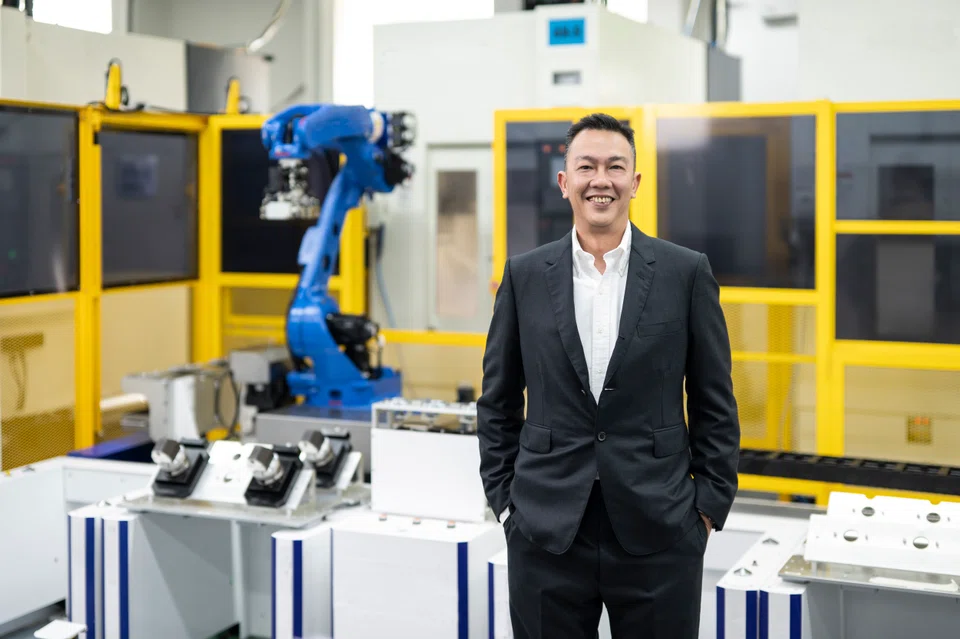
GRAND Venture Technology has had a difficult year. The manufacturing service provider has been navigating a cyclical downturn in the semiconductor industry, which is grappling with higher-than-usual inventory levels.
Despite this, the company is taking the initiative to build its capabilities – ahead of what could be another boom in semiconductor demand, driven by artificial intelligence and other use cases.
In December 2023, the company announced that it would acquire ACP Metal Finishing, a surface treatment specialist that has expertise in coating a range of metals.
At the time, the company said that the acquisition would allow the group to provide component machining, sheet metal fabrication, mechatronics module assembly and surface treatment works under one roof.
Chief executive of Grand Venture, Julian Ng, said the acquisition is part of the company’s culture of innovating and acquiring capabilities that will benefit other business units.
When the company first engaged the mass spectrometer market, he said that it did not want to be viewed as just a contract manufacturer that does sheet metal assembly.
Instead, the company’s culture has always encouraged further engagement with customers to learn the impact of the products it produces and innovate to make them perform better.
With the acquisition, the company is moving to generate more recurring revenue to buffer itself against cyclical fluctuations in the semiconductor sector.
Grand Venture has not shied away from expanding in recent years. In 2021, the company announced that it would acquire metal machining company Formach Asia in Malaysia and parts manufacturer J-Dragon in China.
In its business update for the nine months ended Sep 30, 2023, the company’s revenue from the semiconductor segment fell 32.5 per cent year on year to S$39.4 million as the industry continues to digest excess inventories. Most companies in the sector were plagued by the same issue for much of 2023.
“(We want) to work with the original equipment manufacturers (OEM) to understand their products, which (of them) are likely to be consumable, and see whether we can get ourselves involved so that it will give us good recurring business,” Ng said.
“This is part of our strategy to see (us through) the down period; we can still have this sustaining revenue.”
This would necessitate the sorts of capabilities that ACP Metal Finishing has, even though it currently derives a majority of its revenue from work it does in the aerospace industry.
The requirements for component treatment in the aerospace and semiconductor industry differ, but Ng believes that having the capability in-house will be important in the future.
At the moment, he noted that there may be two or fewer players working on the plating of front-end semiconductor components in the region. Larger component manufacturers also tend to have such capabilities in-house.
In addition, the company wants to work with more local researchers to develop the use of advanced materials, such as quartz and other advanced ceramics.
“We already have the knowledge of how to machine all these materials…the hardest phase is how to develop the material internally,” he said.
The company is also swinging towards other areas of semiconductor production.
It has been engaged in back-end operations of semiconductor production, such as die bonding, which connects semiconductor chips to integrated circuits. However, it aims to innovate and diversify into front-end operations, where chips are produced and later packaged.
Ng said that the company has begun working on new projects from an existing client in the advanced packaging segment, where chips are not simply built horizontally but also stacked to pack more processing power into a smaller footprint.
Since it can take about six months for a customer to approve its factories for production, he said that the company is already planning for 2025, when a more broad-based rebound in semiconductor demand could materialise.
While he was initially pessimistic about the impact of Covid-19 on the business, he said that the pandemic held lessons for the company.
“It taught us to be resilient and optimistic, even in the worst (of) times,” Ng said.
“We try to continue our way of looking ahead… probably two steps ahead, and start positioning our investments to actually ride the wave when it really comes.”