

Proper incentives, business acumen needed for internalised Reit manager model to work

THE failed merger between Sabana Shari'ah Compliant Real Estate Investment Trust (Sabana Reit) and ESR-Reit has resurfaced the question of whether an internalised Reit management model is viable for Singapore Reits (S-Reits) in the sponsor-controlled universe here.
Sabana Reit unitholders had tried and failed to internalise the Reit's manager at a 2017 extraordinary general meeting (EGM).
The only successful case of internalisation here is that of Japanese mall landlord Croesus Retail Trust (CRT) in 2016. CRT was bought and privatised by Blackstone in 2017, at a 23 per cent premium to its net asset value and 24 per cent premium to its last traded price pre-announcement.
The example of CRT would suggest that internalisation in the local context is possible and viable. But two ingredients are needed: A proper incentive programme for the internal manager, and a good relationship with a well-stocked sponsor. Without a sponsor relationship, business acumen to build up partnerships for an asset pipeline is crucial.
Pros and cons
There are cases to be made for both internal and external managers.
In Singapore, Japan and Hong Kong, external management is the default structure - mostly because Reits here started out as capital recycling vehicles for property developers.
Patrick Lecomte, associate professor in real estate at Henley Business School Malaysia, noted that in many Asian countries, Reits are passively managed legal structures rather than actively managed corporate entities with accountable management.
In Australia and the United States, however, Reits are mostly internally managed and this is widely accepted as best practice.
An internally managed Reit employs the managers and support staff running day-to-day operations. Management's remuneration is determined by a committee, usually headed by an independent director. Unitholders can endorse the appointment of directors. And the Reit saves on management, acquisition and divestment fees - paying only the salaries of the internalised management staff.
An externally managed Reit, on the other hand, outsources its management. Remuneration is usually dependent on distribution per unit growth or net property income.
Some observers say outsourcing creates potential for misaligned interests between the manager and unitholders. In Singapore, most Reit managers are wholly or majority owned by Reit sponsors. This would mean Reit managers' interests may be aligned instead with the sponsors'. Also, paying external managers fees for deals incentivises them to buy and sell assets.
A 2017 EY report observed that annual overheads for internally managed Reits were typically less than 50 basis points (bps) of total assets. Management fees on externally managed vehicles were more than 100bps of net asset value, excluding sales commissions and other fees.
But externally managed Reits were said to benefit from resources, talent and influence from the parent platform, which can be a differentiating factor for new and smaller Reits.
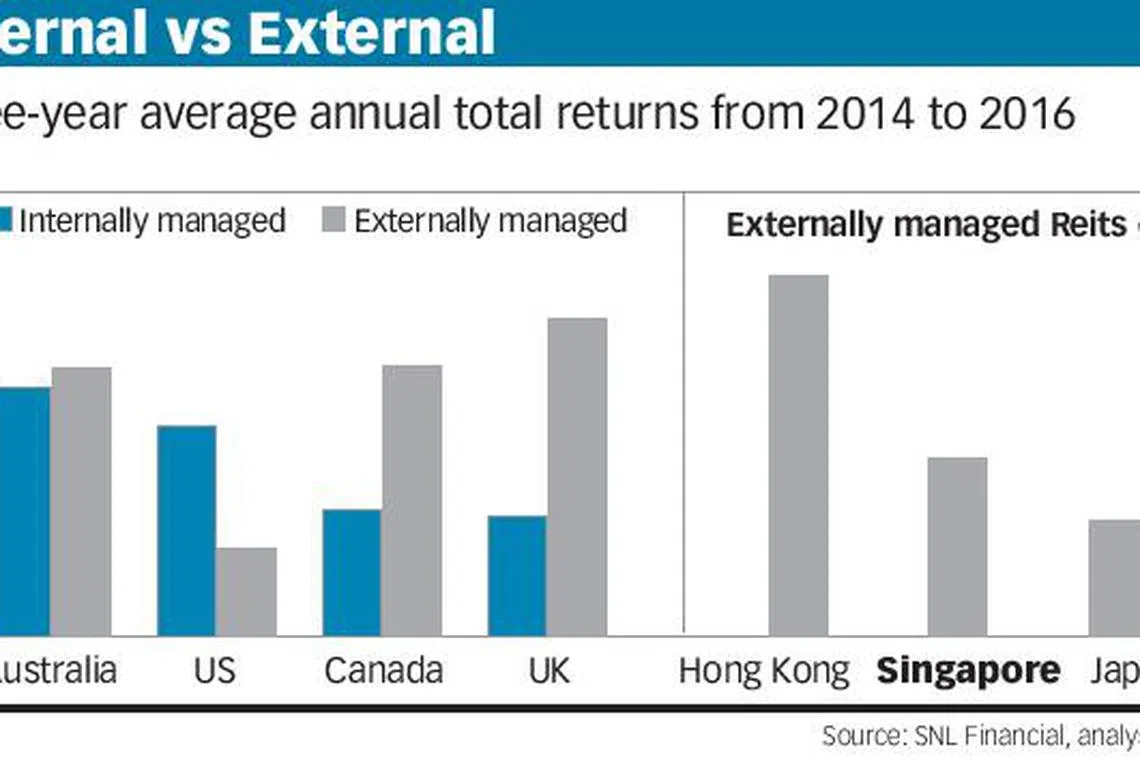
The report also said that while internally managed Reits generated higher returns from 2014 to 2016 in the US, externally managed Reits elsewhere have performed well - with particularly strong returns in Canada, the United Kingdom and Hong Kong.
In response to the debate on the two structures, externally managed Reits - including those in Singapore - have responded by changing their fee structures, EY said.
EY also suggested doing away with rewards for what is "routine", such as acquisitions from sponsors.
The Croesus example
Back in 2016, CRT had internalised its trustee-manager to solve a persistent undervaluation problem that had made it difficult for the trust to make yield-accretive acquisitions.
The experience of CRT's unitholders would suggest that some of the common objections to internalised Reits are surmountable.
Jeremy Yong, who had been a member of CRT's internalised management, said the trust had engaged human resource professionals to help it formulate an incentive programme aligning management's interests with unitholders'.
Speaking to The Business Times recently, Mr Yong said this was in response to unitholder concerns that the internal manager would not be incentivised to make accretive acquisitions for the trust without acquisition fees.
CRT also continued to be supported by its sponsor and strategic partners Croesus Group, Daiwa House and Marubeni. The trust's original rights of first refusal over various properties were renewed. On top of this, however, the manager sourced for joint venture opportunities to secure a growth strategy for the Reit.
The concept of a sponsored Reit is "perfectly compatible" with an internally managed one, said Prof Lecomte of Henley Business School.
He added: "The danger is to apply an ideological perspective to issues pertaining to market structure which are essentially contextual."
The applicable context for Sabana Reit is that the internalisation has been proposed by dissenting unitholders. An amiable relationship between the current sponsor and any new manager seems unlikely.
Making a case
ESR can be expected to vote against any internalisation proposal on the table, having gone to great lengths to gain control of Sabana Reit's manager.
At the same time, the existing manager of Sabana Reit has not proven very successful at delivering returns for unitholders.
It will fall upon both the existing and proposed managers to make a case for how each will improve performance.
TRENDING NOW

Government to bring forward raising of retirement age, give employers more financial support to create flexi-load jobs
Former minister Maliki Osman, Revolut chairman join Asia Gulf Holdings advisory board

Is Manila Asia’s new dining hot spot?
Simba at risk of losing operating licence over spectrum misuse

