

SingPost considers divesting S$1.1 billion SingPost Centre and floating Australian business


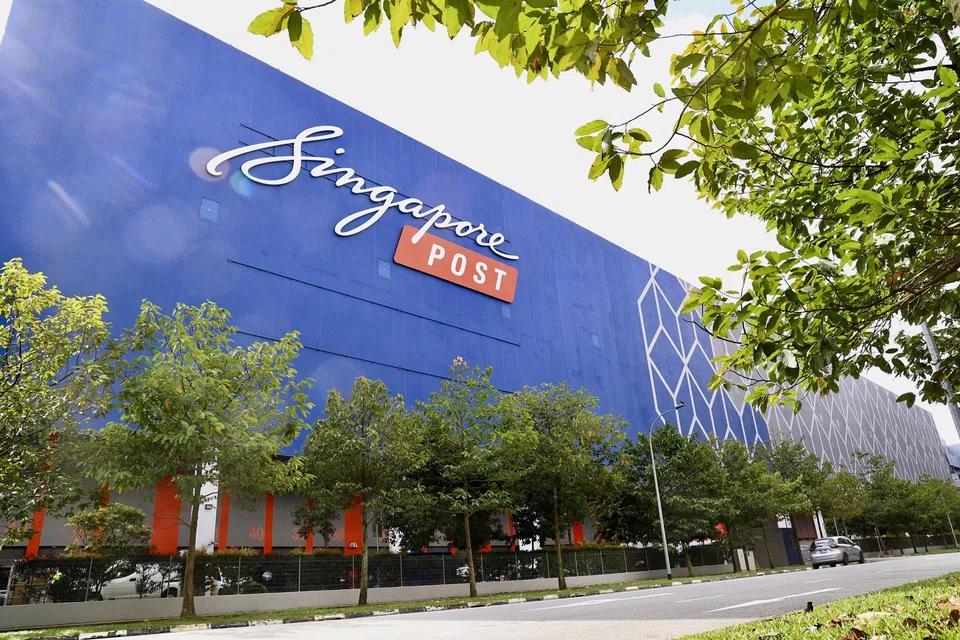
SINGAPORE Post (SingPost) is looking at divesting its non-core assets, including its flagship retail-commercial mixed development SingPost Centre at Paya Lebar Central. Floating its Australian business is another option that has stemmed from its strategic review.
In a briefing on Tuesday (Mar 19) to disclose the findings, the listed national postal service provider’s group chief executive officer Vincent Phang said that SingPost Centre – valued at S$1.1 billion as at September 2023 – is a non-core asset.
However, he did not want to provide a timeline of the divestment of this property or other non-core assets, as the company pivots to be a pure-play logistics player.
Chief financial officer Vincent Yik pointed out that the divestment will depend on several considerations, including market conditions, the use of funds, regulatory approval and operational needs.
The sale is subject to approval from the authorities and shareholders.
SingPost Centre has a gross floor area of 137,134 square metres with an annual yield of 3 to 4 per cent. Its retail segment is being managed by .
Floating its Australian business is also an option for SingPost, as the revised corporate structure following the strategic review creates “flexibility and (facilitates) future optionalities”.
Phang said: “We shared earlier that in Australia, we are seeking some options, potentially investment partners... It allows us to invite some equity and pare down some debt that we have taken on for the Australia business... But more importantly, a strategic partner would offer us a view of what the value of that business is.”
SingPost’s Australian logistics business has its own management, balance sheet and operational assets, he added.
The strategic review focused on transitioning the group to a logistics business and has five thrusts to be executed over the next three years, including the adoption of a new dividend payout scheme.
Firstly, the group will be reorganised into three business units: Singapore, Australia and international.
SingPost’s revenue is presently derived from its three business segments of logistics, post and parcel, and property.
Last year, the group posted its first full-year loss for the post-and-parcel business for FY2023, resulting in a group operating loss of S$15.9 million from an operating profit of S$24.9 million for FY2022.
“Each business unit will have the agility and empowerment to operate in (its) own markets, to develop market leadership and build on (its) core capabilities according to (its) individual strategies,” said the group of its revised corporate structure.
“This provides clarity on the valuation of the individual businesses against comparable market and sector ratings.”
Next, the group targets for each of these business units to generate a spread above the cost of capital.
To do so, it has identified a list of its non-core assets and businesses – including selected properties and various international assets – which may be monetised for capital recycling.
SingPost will also endeavour to pay out 30 to 50 per cent of its underlying net profit from FY2025. It said the board considers such a policy as “balanced”, in view of the group’s capital requirements and delivering “sustainable returns” to shareholders.
Previously, the group’s dividend policy was based on a payout ratio of 60 to 80 per cent of underlying net profit for each financial year.
“As a public utility, I think that dividend yield probably makes sense,” said Phang.
“From a public utility standpoint, it’s stable, it drives that consistent yield as a dividend for investors. However, we are not a public utility anymore. We have oriented (to)... a logistics enterprise.”
SingPost acknowledged in its FY2023 annual report that it did not adhere to this dividend policy range over the last three financial years, due to operating environment challenges and the need to conserve cash for its investment in growth initiatives.
For the financial year ended Mar 31, 2023, the group’s total dividends stood at S$0.0058 per share, comprising a final dividend of S$0.004 per share and an interim dividend of S$0.0018 per share. This represented about 40 per cent of the group’s underlying net profit for FY2023.
Lim & Tan Securities said that while the new payout ratio for FY2025 is lower, the brokerage believes extra cash retained would enable SingPost to have “more firepower to transform into a much better company following its strategic review”.
The other three strategic thrusts identified by the group comprise transforming urban logistics and deliveries in Singapore, achieving scale in Australia, and leveraging its asset-light model and fourth-party logistics platform to serve cross-border customers.
The group said that its current share price “does not appropriately reflect the intrinsic value of the company”, whose market value stood at S$860 million as at Monday.
Chairman Simon Israel noted that such a gap is “particularly apparent” considering SingPost Centre’s value of about S$1 billion as at end-September 2023, the Australia business, and the group’s overall growth potential.
“Management’s execution of our strategy will unlock value for shareholders, and deliver agility and sustainable long-term growth as an international logistics enterprise.”
Lim & Tan noted that SingPost’s recent share price levels were at an all-time low since the company’s listing in 2003.
“Although valuations are fair, we think that this strategic review is much needed to help SingPost unlock value for shareholders,” said its analysts.
SingPost closed at S$0.405 on Tuesday, up S$0.025 or 6.6 per cent, after its announcement.






