New floating Eco-Ark produces up to 20 times more fish than coastal farms
Singapore
SOME 5km from Changi Point Ferry Terminal, a ship the size of a quarter of a football field is anchored 24/7 in the same spot out at sea.
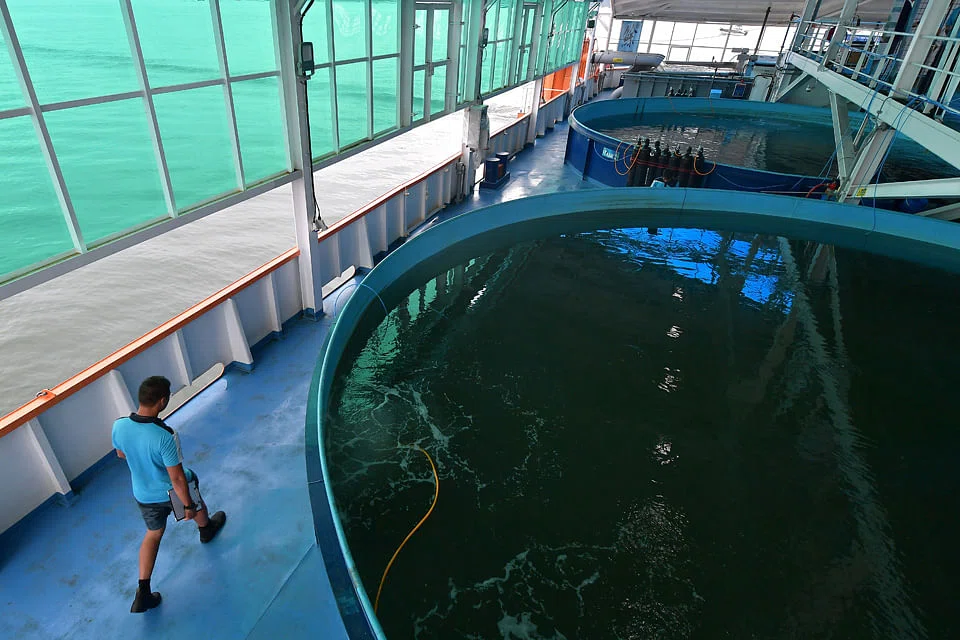
The vessel, measuring 48m by 28m, houses an atypical group of passengers: some 30 tonnes of fish of different varieties that are bred for food.
The Eco-Ark, built by Aquaculture Centre of Excellence (ACE), is said to be one of the first floating closed-containment fish farms in the world. It was named and commissioned on Tuesday.
The offshore farm, with a total capacity of 96 tonnes, is able to produce 166 tonnes of fish a year - about 20 times more than the minimum level set for coastal fish farms in Singapore.
Unlike a typical kelong where fish are reared in open-net cage farming systems exposed to the open sea, the fish in the Eco-Ark swim in isolation.
Housed in four tanks with 475,000-litre capacity each, the fish - which include species such as barramundi, red snapper fingerlings and groupers - are safe from threats that those reared in kelongs are vulnerable to. These include oil spill incidents as well as plankton blooms, which caused massive fish deaths in 2014 and 2015 due to the depletion of oxygen in the water.
The seawater the fish live in on board is free of physical waste, removed with a drum filter working around the clock. Bacteria, viruses and other pathogens in the water are also destroyed using an ozonation system.
Every hour, seven to 10 cubic metres of oxygen is pumped into each cultivation tank where the fish live, said ACE chief executive Leow Ban Tat.
All these improved conditions are supposed to help achieve "oceanic water quality", he added.
Currently, there are other closed containment fish farms located on land in Singapore. But an offshore one such as the Eco-Ark will save on land cost, as well as the costs of trucking and pumping seawater to land.
Koh Poh Koon, Senior Minister of State for Trade and Industry, said the offshore farm is also manpower- and space-efficient.
The 1,344 sq m facility needs only two workers at any one time and takes up only 14 per cent of the space needed for a typical fish farm that produces at the same capacity.
Speaking at the naming and commissioning ceremony on board the vessel, Dr Koh said the farm was a good example of an innovative farming solution to address problems such as algae blooms and water pollution, which could limit the potential for aquaculture production.
The Eco-Ark, which was developed with the support of the Singapore Food Agency's Agriculture Productivity Fund, costs about S$4.1 million to construct.
Dr Koh pointed out that there is a need to leverage smart technologies to produce more food in a sustainable manner, and to reach the national target of producing 30 per cent of Singapore's nutritional needs locally by 2030.