

Money thoughts for a lifetime
A year of articles on saving, spending, budgeting and life planning
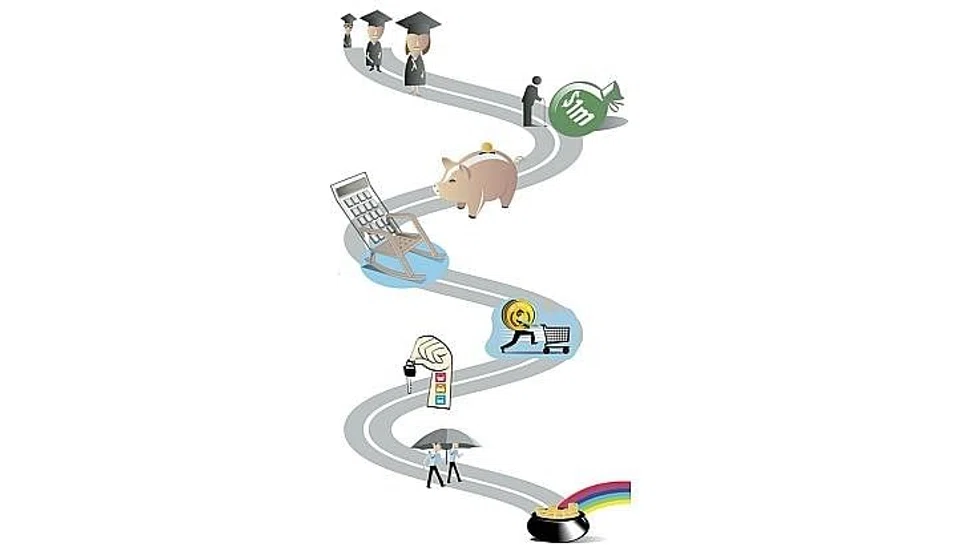
1 Money is important as a means to an end, and that end is arguably financial freedom. This happy state of affairs is defined by not having to work for a living, so one is freed to do whatever one deems important in life. This can be spending more time with the kids, travelling around the world, or taking time off to pursue a cause. With growing income inequality, ordinary people slogging in middle-class jobs might think they can never retire in their lives, and have to keep working till they are over 70. We beg to differ. For a start, those earning the median salary of $3,000 upon starting work stand a good chance of being able to attain financial freedom before they turn 60, or even 40 or 50.
This is because of two reasons: the mathematical effect of compounding, and the good financial habits one can build up over time. But you have to plan ahead, and above all, start young.
2 One question: Is one million dollars enough to retire on? Singapore is well-known for having one of the highest proportion of millionaire households in the world. Based on recorded spending patterns and a conservative rate of return of 4 per cent a year, along with inflation of 2 per cent a year, we calculated that $1 million would last a typical HDB family spending $3,600 a month today for 30 years. This means that a million dollars should theoretically be enough for a 50-something breadwinner to retire comfortably with. Of course, families spend more than $3,600 a month on both necessities like healthcare and more extravagant things like overseas holidays and overseas education. And the statistics show that a typical family living in a private flat or landed property could spend anywhere from $7,000 to $9,000 a month. In these scenarios, $1 million would not be enough to retire on.
3 Needs are limited and wants are unlimited. Give a person $10 million, and he or she can find a way to live such that the money gets spent pretty fast. Thus frugality has been talked of as a virtue - the idea that one should cut back on expenses by living simply and spending very seletively.
4 But being thrifty is easier said than done. Our spending patterns are influenced by social expectations and people around us. This is true across people of all incomes, from the young executive enviously admiring his colleague's new sports car, to the multimillionaire checking out his friend's yacht. Instead of keeping up with the Joneses, why not aim to spend a little less than your peers? In the meantime, you can make money on the side by turning your hobbies into part-time jobs, for example by teaching a skill you have like swimming or drumming.
5 On the flip side, in your quest to be thrifty, you might be called a ''cheapskate'', a derogatory term that implies you are too miserly to spend on things and on other people, even though you can well afford it. On this conumdrum we suggested three principles to get your spending right: be clear on why you are saving instead of spending, don't freeload off or inconvenience other people, and spend happily on the right people, in the right amounts, and during the right time.
Ultimately, some important things in life like love and health can be obtained even though one does not have much money. Being thrifty, therefore, doesn't mean you have to deny yourself of a fine life, because there are other things worth striving for.
6 What is a suitable number to retire on? Once decided upon, what is the best way to reach this goal? To find out, tracking your expenses using smartphone apps can help you figure out how much you spend a month. Having the discipline to record everything, even a $1.20 drink, is useful as an exercise to make one more aware of costs such that one can buy things at the right value.
7 Another helpful exercise in financial planning is thinking about long-term goals, such as what big-ticket purchases you want and when you want to retire. The golden rule in financial planning is to not spend more than what you earn, and save consistently while getting a yield on those savings by investing them. In the meantime, mathematical compounding will do the job. For example, invest $2,000 a month at a 5 per cent yield for 25 years, and your portfolio will be $1.15 million - enough to fund a lifestyle of $2,900 a month in today's dollars, assuming core inflation of 2 per cent a year. A difference of saving or spending $500 every month can add up to a lot over the long term. In the above example, investing $1,500 a month for 25 years adds up to $860,000, or almost $300,000 less.
8 To do all these personal finance calculations, an understanding of the time value of money is needed: the idea that money today is worth more than the same some of money in the future, because the sum of money can accumulate interest or can be invested for a yield. One has to learn how to calculate present values and future values, a process that has been likened to time travel. Understand the value of money through time, and one would see that it is wiser to invest money now rather than spend it all away.
9 After understanding the time value of money, spreadsheets and financial calculators can help you answer questions on financial planning, such as whether you can afford that $1.5 million condominium on your household income, how you can save to get half a million dollars in 30 years' time, or a $3,000-a-month pension. You just need to understand five variables that go into such calculations: PV (present value), RATE (interest rate), NPER (number of periods, PMT (payment per period), and FV (future value).
10 Playing the lottery is a tempting route to riches, but it is not a fair bet. Indulge only if you deem it entertainment. The expected return of paying for a Toto ticket in its annual $10 million hongbao draw, for example, is -37 per cent. Every time you play the lottery, the laws of probability are against you. Spend that lottery money elsewhere, for the humble dollar can go a long way still. The cost of basic items like food had stayed far below the rate at which wages have increased. A range of everyday items and food can be found for under $1 at thrift shops or supermarkets. Meanwhile, the cost of bus rides has only doubled over 30 years, even though wages have gone up by many more times.
11 Cars are more often than not a waste of money if you don't need it for work. A BMW buyer committing to an expensive loan will fare much worse financially than a public transport fan that saves the money and invests it in, say, public transport stocks. The concept of opportunity cost is thus important when thinking about purchasing a depreciating asset like a car.
If you really have to buy a car, be aware of the multiple components that go into the cost of a car: COE (certificate of entitlement), ARF (additional registration fee), OMV (open market value), customs duty, and GST (goods and services tax). Website onemotoring.com.sg has the list, which you can use to compare to what dealers are offering.
12 In planning your financial life, protection against unexpected catastrophes that drain your finances is critical. Hence the value of insurance. But be careful with the life insurance that you buy, and figure out how much coverage you need. Whole-life policies that bundle savings, investment and annuities have come under criticism due to investment returns being eaten away by middlemen costs like sales commissions and marketing fees.
13 Be careful on interest rate deals that you see on advertising. Always find out the length of the period in which the interest rates apply. A 10 per cent guaranteed rate on a structured deposit deal, for example, might be spread out over six years, making the yearly rate less attractive. Also recognise that many different types of interest rates can be advertised, but only one - the effective interest rate - really counts. The best way to deal with the middleman knowing more than you, and taking advantage of your ignorance, is to beef up on knowledge of personal finance yourself. And remember, if it sounds too good to be true, it probably is!
14 To sum up, personal finance is personal because everybody has a different idea of spending and saving. Figure out your own ideas and incorporate the best practices that you see, and you are on your way to achieving better control over your future.
Money makes the world go round, or as the Chinese say, it can make ghosts turn a grindstone. Most of us would like to make more money, to have more money, and to spend more money. Hundreds of books are available to tell you how to get rich, and plenty of motivational speakers do the same. This year, the Business Times-Citibank Young Investors Forum (BTYIF) ran a series of articles exploring issues surrounding the personal management of money, otherwise known as personal finance. Today, we bring you a summary of this year's personal finance topics you might have missed. Knowing how to earn more, spend less, can set financial goals is one thing. But being able to invest your money properly is another. Next week's issue will round up the investing topics this column also addressed.
TRENDING NOW

What shattered Crystal Jade? How the culinary empire shrank from 120 to just 9 outlets

Could Jensen Huang work for Elon Musk? It would be ‘a titanic ego death match’, says biographer

‘We’ll wait and see’: Investors wary after STI sinks below 5,000 amid global AI selldown

South-east Asia has lost Nvidia’s best salesman

