

Rough ride
THIS WEEK'S TOPIC: How should the bicycle-sharing business be regulated?
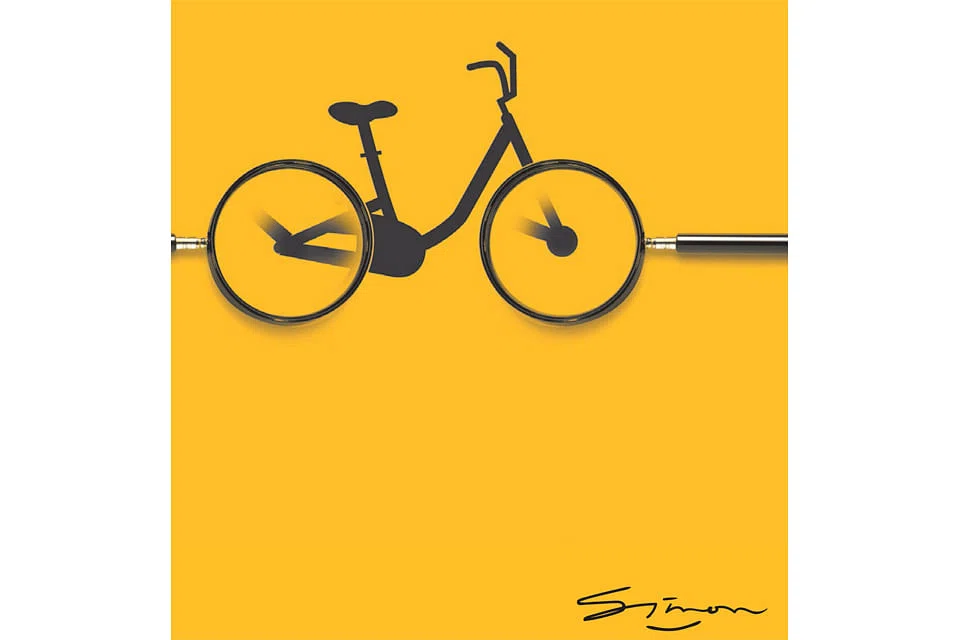
THIS WEEK'S TOPIC: How should the bicycle-sharing business be regulated?
Jeremy Tan Director CMS Holborn Asia
THE key to regulating disruptive technology is to strike the right balance between encouraging innovation and minimising negative externalities. With bike-sharing, this means finding a middle ground between the convenience of a large bicycle fleet and the use of public spaces in land-scarce Singapore. Licence fees and fines alone can only go so far to address the problems of rogue parking and disincentivise operators trying to achieve scale and profitability. Public awareness campaigns that indirectly influence the parking behaviour of users should also be considered as a complementary measure. Move-in Martin? #BikeRightBryan.
Karl Hamann Chief Executive Officer QBE Insurance (Singapore) Pte Ltd
BICYCLE-SHARING, like other concepts in today's sharing economy, are increasingly important in a resource-conscious environment. However, the sight of dumped bicycles on Singapore's famed clean streets has given rise to concerns. Geo-fencing and location-based parking regulations are possible options for improving such services. The providers may find these regulations financially burdensome, but they also present opportunity for collaboration. Working together, they could create a unified, brand-agnostic parking system that works for all shared bicycles. Less "bicycle pollution" on the streets will mean that Singapore retains its visual appeal while reducing the risk of accidents. More importantly, fixing the problem will improve the community's acceptance of the services.
Nick Waters CEO Dentsu Aegis Network Asia Pacific
BIKE-SHARING is a good concept for Singapore with its car-lite ambitions and need for last-mile transport solutions. This environmentally-friendly and cost-effective solution leverages the rapid growth of the sharing economy. As we enjoy its benefits, one fundamental question remains: How is responsibility in the sharing economy understood, assumed and shared? Any regulation should be the outcome of continuous and collaborative engagement between stakeholders - consumers, service providers and regulators. This is where data can provide us with meaningful insights and pinpoint key issues before educating stakeholders on their rights and civic responsibilities to create a sustainable sharing economy.
Victor Mills Chief Executive Singapore International Chamber of Commerce
FOR a country which prides itself on being largely litter-free and a city in a garden, bike-sharing just does not work. Users do not care about where they leave the bikes after they use them. The result is a proliferation of metal litter that is as dangerous as it is unsightly. It is impossible to provide the infrastructure to support bike sharing. China - where it all began - has ended up with hectares of abandoned bikes. Singapore does not have the space for bike racks across the entire island to meet every possible last-mile journey. A rethink is badly needed in terms of business model and regulation.
Walter de Oude CEO Singapore Life Pte Ltd
I LOVE bike sharing. I hate driving. I use bike sharing a lot. It is super convenient - when it works. I like it so much that I sold my car. Just like everyone needs easy insurance, everyone needs easy transport.
Like everyone, we are all frustrated to see bikes poorly maintained or the system abused. The onus rests on bike users and the community to value the service and help maintain the ecosystem - and some regulation to drive consumer behaviour is probably useful. For example, penalise bike abusers based on their GPS-tracked activities, and reward those who add value to the community - for instance, fault reporting or finding wayward bikes and returning them to a proper location. I think it would help consumers act responsibly!
Lim Soon Hock Managing Director Plan-B ICAG Pte Ltd
THE issue is not about bike-sharing, which will contribute to a car-lite Singapore - especially in the first and last mile of a person's commute. Public order must be maintained, not just in the act of cycling on public roads or paths for public safety, but in ensuring that the bicycles are not indiscriminately parked. It is an eyesore in an otherwise orderly and very liveable Singapore.
For this, I am for fines to be introduced on either the riders and/or the bike-sharing firms, for "illegal" parking of bikes. The government must provide for more designated parking lots for bikes, such as at bus stops, MRT stations or mandated spaces in buildings, shopping centres, HDB car parks or void decks, etc. It is also vital that the number of registered shared-bikes be controlled, to maintain public order and safety, and not to cause public disamenity. Singapore can also learn from the experiences of other cities, such as Paris, London, Sydney.
The bicycle-sharing business also need to be regulated to promote the larger objective of social grace and courtesy.
Albert Phuay Yong Hen Chairman and Group CEO Excelpoint Technology Ltd
BIKE-SHARING is an ingenious concept, creating convenience for people and making public transportation more accessible at low cost. However, it has been making headlines for the wrong reasons lately. Indiscriminate parking and obstruction of public spaces and high maintenance costs are the main issues plaguing bike-sharing operators.
To tackle indiscriminate parking and obstruction of public spaces, it is important to educate the community on the responsible use of bicycles. Providing users with some incentives could also motivate them to park their bicycles in a considerate manner or ride them to designated locations. Conversely, errant users should be imposed with appropriate penalties to stop irresponsible behaviour.
Bike-sharing operators could collaborate with tech companies to develop advanced technology to track improperly parked bikes more efficiently, and use big data analytics to manage the demand and supply of bikes based on public travel patterns. This could help ease congestion and allow more efficient allocation of bikes, instead of the addition of new bikes.
Operators could be given some subsidies to help them cope with high maintenance costs such as maintenance personnel, equipment and technology investments, since they provide eco-friendly, convenient and affordable connectivity to the masses.
The above measures and consideration for others could help steer Singapore towards being a smart and sustainable liveable city for all.
Daniel Sherrington Regional Director, APAC OC Tanner
IT was clear from the get-go that bike-sharing was not a concept designed by the companies themselves to particularly contribute to the wellness of people; it was a way to drop thousands of cheap bikes into a market and make money out of the people using them - the game plan seems that simple.
These companies came out of nowhere, with seemingly no face to them. Who was the local corporate social responsibility or communications person, the managing director? It was as if overnight, they disappeared after dropping off thousands of bikes and just waited for the money to come in with little to no regard about where the bikes would be kept and stored.
We saw no attempt by any of the companies to do anything community based (ie bike events for charity or to help get people onto bikes). So I feel that they lost the chance to connect to the public. The majority of people who do not use the bicycles just see them as a nuisance clogging up lanes, pathways and bus stops.
At the first sign of the government stepping in with "OK, enough is enough," some of them packed up and left, and made no effort to work through a long-term strategy. So while I like the environmental impact of getting people out of cars and onto bikes, I am not sure that did the trick at all. I mostly saw migrant workers and families with young children using the bikes.
I would suggest that the government cap the number of bikes allowed based on a percentage of the population and have designated bike parking zones. Just allowing the bikes to be left wherever may be convenient for the user but a nuisance for just about everyone else.
Helen Ng Chief Executive Officer General Storage Company Pte Ltd
BIKE-SHARING has become ubiquitous worldwide. It used to be an obvious win-win for consumers and urban planning departments by offering an affordable and accessible alternative to private cars and public transport.
But recent events involving oBike have called into question the sustainability of bike-sharing. The authorities should learn from the oBike experience, and develop a framework to address hot-button issues such as consumer protection and irresponsible parking. New players should demonstrate the ability to adhere to the standards of the framework before being granted a licence to operate in Singapore.
Lynette Seah Founder & CEO Alpha7
BIKE-SHARING brings great convenience to Singaporeans. To work effectively, it requires concerted efforts from the users, the bike suppliers, the authorities and the public.
Bindu Bhatia Managing Director, Asia Pacific Carlson Wagonlit Travel
BESIDES the obvious benefits of being environmentally friendly and a healthy way to commute, bicycle-sharing services are also a great way for tourists and business travellers visiting Singapore to explore the city.
However, some degree of regulation is necessary to ensure that these bikes do not become a public nuisance, and the measures being taken by the Singapore government look to be a step in the right direction.
The docked approach to bike-sharing in cities such as London and Dublin still appears to be the most effective at preventing chaos from ensuing, as riders are incentivised to return their bikes to designated parking spots. If they do not return their bike to a docking station, they will continue to be charged.
Henry Tan Managing Director Nexia TS Group
BICYCLE-SHARING is an efficient resource allocation effort, and also one that promotes sustainability practices. When implemented and used properly, these twin objectives can be achieved. What creates problems is a lack of proper planning and failure to understand user behaviour.
In my view, more regulation alone may not be helpful. Technology should be planned ahead. If a bicycle is not returned to the designated parking place, the proximity detection technology should be able to ensure that usage charges continue until it is parked. Also, after a day the charges should escalate. Consumer behaviour will be reined in by this; most of us would treat our own bicycles well.
Think of supermarket trolleys. Why do most people return trolleys? It is so that they can get back their dollar coin. But for some, $1 is too small a cost to force a change in behaviour. The last thing we want to do is to stop innovation but rather, use technology to solve problems created by technology disruption.
Ian Lee Regional Head, Asia Pacific The Adecco Group
BICYCLE-SHARING is an economical and environment-friendly first and last-mile transportation solution. However, one of the key issues with the business model here is the dockless system which, although offering flexibility to users, can lead to a parking nuisance - which is exactly what happened. Users too displayed a lack of civic behaviour and misused the shared bikes.
To avoid this, we need a combination of regulatory, technological and societal change. Bicycle parking spots need to be assigned, users must be encouraged - in fact required - to park the bikes in these designated spots, and tech solutions need to be put in place to immediately identify and penalise violations. In other words, we must adopt a mindset around bicycle-sharing similar to what we have around owning and using motorcycles and cars.
Dora Hoan Group CEO Best World International Ltd
THE idea of bicycle-sharing is a terrific one: It gives Singapore commuters a convenient and affordable travelling option, making public transport even more accessible at a low cost.
However, problems have emerged that call for attention. Many people just leave the bikes anywhere, without giving a thought to whether they cause obstruction. Also, a lot of cyclists ride on pedestrian pathways even though it is illegal for them to do so.
The bike-sharing companies could invest more in better technology, business planning, and bike management that will promote responsible use of the bicycles. The onus is also on the users to adhere to these rules.
Bicycle-sharing is a green means of transport. It has an important role to play in the call for a car-lite society. Hence, we hope it will be successful and safe for everyone. All parties involved should make concerted efforts to solve the various problems that have cropped up.
Amit Saberwal Founder RedDoorz
I BELIEVE that the bike-sharing industry clearly needs to have a starting and ending point, ie a docking station. The rider needs to take responsibility for dropping off the bike at the right spot. Countries such as Italy have implemented this efficiently. There are specific places where you can unlock the bicycle, and again clear spots where it can be dropped off. Such a system can only be executed by having the right regulations. The other factor to bear in mind is that Singapore is not a large market, and hence controlling the number of players entering the market will also help. Given the size of Singapore, it is best to restrict it to two to three bike-sharing firms.
Zaheer K Merchant Regional Director (Singapore & Europe) QI Group of Companies
ALTHOUGH widely recognised for the convenience that it brings in bridging the last-mile transport needs for consumers, the bicycle-sharing business faces issues of theft, vandalism and disorderly parking.
A licensing regime is in place, but regulators can set a ceiling for shared bikes which will not only help maintain public order but also prevent cut-throat competition among bike-sharing operators.
Additionally, the competition among the operators should be on the technological and service fronts, not in the number of bicycles. This will allow technology to be used to regulate the cyclists' behaviour, track usage and compel proper parking.
Finally, bike-sharing operators can explore a system to record users' irresponsible behaviour and deduct points from their personal credit records as a deterrence.
Toby Koh Group Managing Director Ademco Security Group
BIKE-SHARING is a great solution for the last-mile transportation challenge. It is here to stay. Whatever regulations the authorities come up with, I do hope that it will consider the commercial viability aspects as well as human behaviour.
Education of users to be considerate in using the bikes is paramount. Whether legislative pressure on the bike rental companies will change user behaviour is doubtful.
A more holistic approach may have to be considered for the longer term. This is a process that cannot be rushed. I hope the benefits of bike-sharing in our transport puzzle do not get wiped out because of unrealistic expectations.
Olive Tai Co-founder and Managing Director beautiful.me and Synagie.com
YES, I think bike sharing should be regulated. This is still a new concept for Singapore. and after one-and-a-half years and having faced so many obstacles, I feel we should continue giving this concept a chance. After all, even business owners like myself need more than just 18 months to build up companies and see efforts through.
The biggest issues are parking and cyclists not knowing how to share pedestrian paths and walkways. Regulation should focus on that. I don't know about reducing bike inventory - the government needs to consider that from a business point of view. A certain critical mass may be necessary, or this whole concept will just fall flat on its face. And yes, bike sharing is a great idea in reducing carbon emissions.
David Leong Managing Director Peopleworldwide Consulting
BICYCLE-SHARING is not a new concept nor a new transport modality. It provides the last mile connection and convenience. Regulating this bicycle-sharing business is not as challenging and complex as for the other modes of transport (rail, bus, taxis) or even the ride-hailing and ride-sharing services.
Bike availability-on-demand and parking control are two key concerns. Currently, the dockless format creates a visible mess along the streets, and the bikes can be a hazard when they fall over and become obstacles.
Regulators must consider the benefits versus costs of having bike-sharing, and regulating the business should not be confined to just fines. But too much punitive fines will only cripple the business. They earn by the cents per hour per bicycle, but the fine can come up to thousands of dollars for each infringement.
At the end of the day, it is still about inculcating habits of responsible usage of these bicycles.
Maren Schweizer Director Schweizer World Pte Ltd
DISRUPTIVE bike-share companies create some negative externalities that call for regulation. When their reaction is delayed, it leaves grey areas, and authorities end up needing to take a stricter stance than they would if they acted proactively.
As with most industries, regulation would help to prevent fraudulent practices and regulate behaviour. Nonetheless, it is certainly up to the masses to practise courtesy and good judgment when it comes to civic behaviour.
In general, the bike-sharing industry provides a good alternative to other forms of transport as it promotes exercise and contributes to reducing carbon emissions, and thus is cleaner for the environment.
Tan Mui Huat President and CEO, Asia International SOS
THE sharing economy has not only forced a collective re-think of traditional business models, it has also highlighted the need for regulation to ensure sustainable and responsible growth.
Bike-sharing startups offer enticing career prospects because of its allure of skyrocketing growth in a new sector. But such sudden disruptions impact not only customers but employees too. One aspect of regulation that we take a keen interest in is how companies can do more to ensure the protection of basic labour rights and secure workplace environments - one of the key tenets of the United Nations Development Programme's Sustainable Development Goals.
Yvonne Butler Managing Director The Information Source
WHILE these bikes offer a convenient, cheap, and environmentally-friendly alternative as a mode of transport, it is certain that more efforts are needed to regulate the industry. The scramble to establish a viable bike-sharing business has all but ended in Australia, leaving behind broken and abandoned frames and a business model that did not work. The business model for these bike-sharing services has more to do with data mining, advertising and turning a profit by interest on the bike rental deposits, as opposed to the relatively low bike rental fees.
TRENDING NOW

South-east Asia has lost Nvidia’s best salesman

Demand, tech capabilities position Apac and AI as Skyscanner’s next growth frontiers: CEO Bryan Batista

Peter Kwee’s Ridley Park bungalow on the market with S$100 million asking price

Beyond the greenback, Vietnam’s big borrowers turn to Asian-currency bonds

