

US job growth beats expectations in April; jobless rate falls to 3.4%
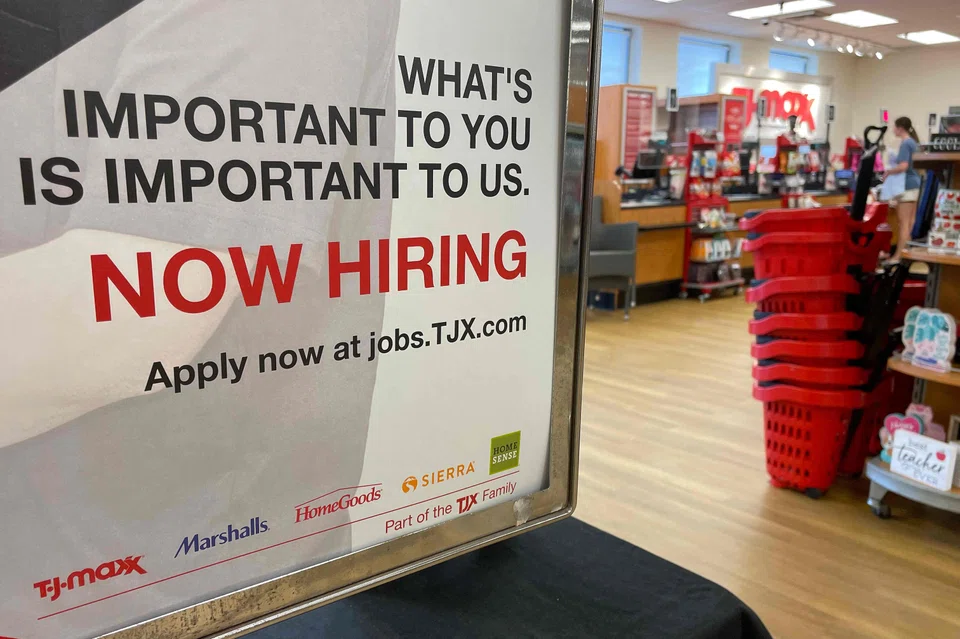
US EMPLOYERS boosted hiring in April while raising wages for workers, pointing to sustained labour market strength that could see the Federal Reserve keeping interest rates higher for some time.
Nonfarm payrolls increased by 253,000 jobs last month, the Labor Department’s closely watched employment report showed on Friday (May 5). Data for March was revised lower to show 165,000 jobs added instead of 236,000 as previously reported.
Economists polled by Reuters had forecast payrolls rising by 180,000. Payrolls are well above the 70,000-100,000 monthly increase needed to keep up with growth in the working-age population.
The unemployment rate fell to 3.4 per cent from 3.5 per cent in March.
Average hourly earnings gained 0.5 per cent after advancing 0.3 per cent in March. Wages increased 4.4 per cent on a year-on-year basis in April after climbing 4.3 per cent in March.
Other measures such as the Employment Cost Index and the Atlanta Fed’s wage tracker also show momentum.
Wage growth remains too strong to be consistent with the Federal Reserve’s 2 per cent inflation target.
The Fed raised its benchmark overnight interest rate by another 25 basis points to the 5.00 per cent-5.25 per cent range on Wednesday, and signalled it may pause the US central bank’s fastest monetary policy tightening campaign since the 1980s, though it kept a hawkish bias. The Fed has hiked its policy rate by 500 basis points since March 2022.
Some economists, however, believe that the labour market is overstating the health of the economy, pointing to the divergence between consumer spending and job gains as well as a continued decline in worker productivity.

Consumer spending stalled in February and March. Productivity has declined on a year-year basis for five straight quarters, the longest such stretch since the government started tracking the series in 1948.
Economists also noted that job growth was becoming more concentrated in the leisure and hospitality industry as well as state and local governments, sectors where employment remains below pre-pandemic levels.
With risks of a recession mounting because of the punitive borrowing costs and tighter credit conditions amid financial market stress, the hiring landscape could change quickly.
For now, the consensus is that the economy will continue to create jobs at least until the fourth quarter. REUTERS
Decoding Asia newsletter: your guide to navigating Asia in a new global order. Sign up here to get Decoding Asia newsletter. Delivered to your inbox. Free.
Share with us your feedback on BT's products and services
TRENDING NOW

Singapore expects all parties to honour commitments, says PM Wong after Indonesia cuts gas exports

Gas Supply may pursue remedies if contract breached following Indonesia’s export cuts: Tan See Leng

SoftBank’s Son plans US$50 billion Malaysia tech outlay: Anwar Ibrahim

Is Manila Asia’s new dining hot spot?

