Singapore is designing for a hotter future, but can it beat the heat?
Shrinking forest cover pushes urban planners to balance development with mitigating rising temperatures
[SINGAPORE] The mercury is rising uncomfortably in Singapore’s concrete jungle.
The annual mean temperature could rise by up to 5 degrees Celsius by the end of the century, the latest climate projections from the Centre for Climate Research Singapore show.
And as climate change raises background temperatures globally, urbanisation also adds a warming effect at the local level.
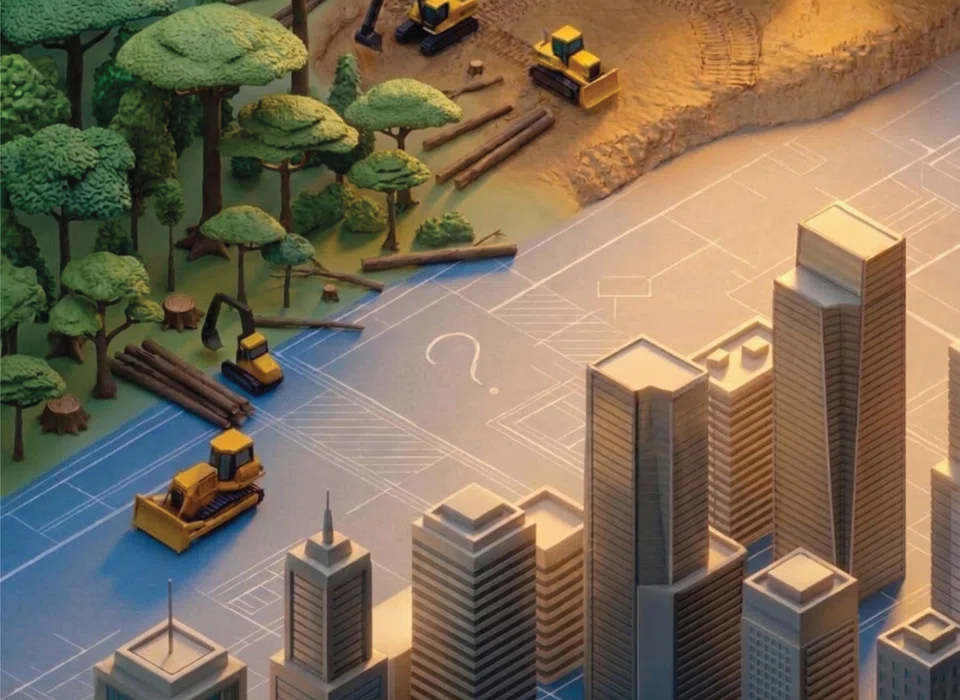
To meet its housing and infrastructure needs, the Republic has been clearing some secondary forests, which consist of regrowth over previously cleared woodland and make up most of the island’s forested area. These biodiverse ecosystems naturally mitigate urban heat.
To beat the heat, observers flag the need for urban planning that reduces land clearing, as well as adoption of heat mitigation and efficient cooling strategies to compensate for the loss of green cover.
While Singapore’s heat mitigation solutions are largely mature, the challenge now lies in integrating them effectively at scale, watchers tell The Business Times.
Shrinking forests
Major forest loss in recent years includes clearance to accommodate new public housing in Tengah, which will be built on 700 hectares (ha) of secondary forest. However, the Housing & Development Board (HDB) has said that around 20 per cent of this land will be set aside for green spaces.
Plans are under way to clear two-thirds of the 23 ha Maju Forest in Clementi – also for public housing needs.
In fact, roughly 1,780 ha of Singapore’s secondary forest – equivalent to more than 2,490 football fields – was cleared in the past decade for development, one study has found. And the research shows that another 7,330 ha – one-tenth of the island’s land area – could also fall to the axe in the coming decade.
To build up Singapore’s green spaces, the National Parks Board (NParks) launched a movement to plant one million trees between 2020 and 2030. So far, more than 900,000 trees have been planted.
The campaign is on top of greenery replacement measures – such as replacement tree planting and adding plant life to urban areas – that are meant to offset development-related clearance.
Taking into account features such as nature reserves, parks, gardens and other managed vegetation, Singapore’s overall green cover now stands at more than 40 per cent.
But scientists warn that urban reforestation cannot fully replace the climatic benefits of a forest and its mature canopies.
Ongoing research by ecological design firm bioSEA and the National University of Singapore (NUS) shows that the value of biodiversity in the Republic’s green and blue spaces may have decreased by more than 10 per cent since 2011.
“There is a need to prioritise mature green and blue systems, such as native-dominated forests, that have multi-tiered vegetation,” says Dr Anuj Jain, founding director of bioSEA. These provide “significantly higher biodiversity, carbon, cooling and air-filtration benefits” than urban streetscapes, parks and gardens.
Similarly, Associate Professor Yuan Chao from the NUS Department of Architecture tells BT that “no matter which solution we apply, we cannot go back to that benchmark” after a forest is cleared for urbanisation.
Pre-empting the problem
Singapore’s Meteorological Service reports that mean surface air temperature has risen by about 0.25 deg C a decade between 1948 and 2025. But the increase is not evenly distributed.
Buildings, roads and vehicles can trap and release heat into the environment, in what is known as the urban heat island effect. Research shows that this results in temperature differences of up to 7 deg C between the urban and less built-up areas of Singapore.
Still, Professor Matthias Roth from the NUS Department of Geography calls it “too simplistic” to say that Singapore is warming just because of deforestation or construction. This is because climate change, urban density and geometry, building materials, vegetation and wind flow “all matter”.
To tackle the complex challenge, Prof Roth lays out three key steps for urban planners. First, reduce heat gain and the need for cooling. Second, design naturally cool and well-ventilated neighbourhoods. Third, supply any remaining cooling needs as efficiently as possible.
Ngiam Shing Shian, senior consultant at sustainability and impact advisory firm Aeterni.eco, notes that maximising the use of existing buildings could help reduce land clearing.
This means urging developers to fully utilise existing facilities through retrofits where possible, rather than defaulting to demolition.
She says this would also involve the recycling of building materials that are already in circulation, and allowing more repurposing of spaces under current zoning policies.
“These are not happening at the speed and scale that we need now, often because of the financials and business case. Hence, sufficient incentives and disincentives would need to be designed to shepherd companies in this direction,” adds Ngiam.
Meanwhile, it is possible to integrate nature into the built environment, too. Initiatives such as the Building Construction Authority’s Green Mark certification, NParks’ Skyrise Greenery Incentive Scheme, and the Urban Redevelopment Authority’s Landscaping for Urban Spaces and High-Rises programme aim to drive this shift.
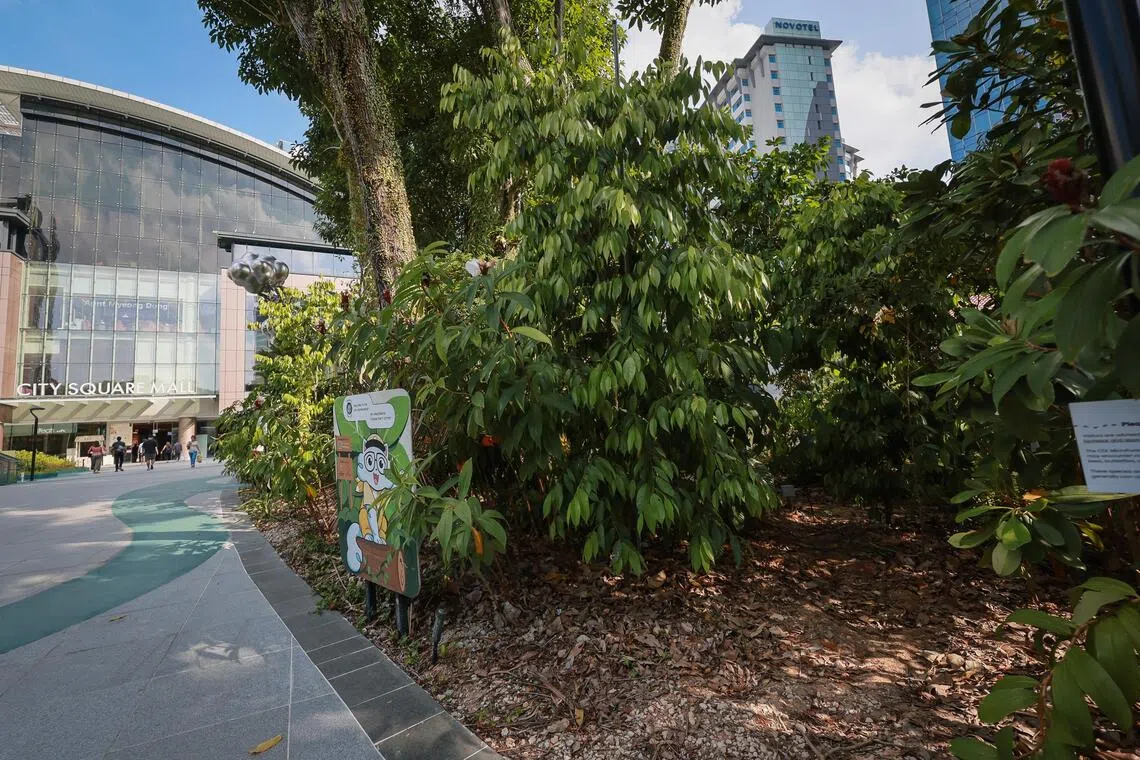
Having biodiverse microforests peppered around the city and allowing for healthy soil to be exposed to the air instead of being covered by concrete flooring have proven to be effective in heat mitigation.
For instance, the size of the microforest outside City Development Ltd’s City Square Mall was doubled to 520 square metres (sq m) in January 2026 after a study showed that the green oasis helped lower temperatures by up to 5 deg C, compared with its surroundings.
Nature-inspired designs can also help to mitigate heat, Dr Jain of bioSEA says. His company specialises in “biomimicry design” solutions – its “elephant skin tile”, for example, mimics the folds on elephant skin to create microclimate-cooling surfaces with low-carbon materials.

In his view, how available solutions “can work in tandem would be key... as opposed to (focusing on) one or the other”. “We envision some designs whereby our elephant tiles are able to integrate with (living green walls) where wildlife can create nests.”
Cooling needs
Climbing temperatures drive up demand for cooling services, which account for 40 to 60 per cent of an individual commercial building’s energy usage and around one-third of Singapore’s overall power consumption.
But waste heat from roads and infrastructure – including heat emitted by air-conditioning and other building cooling systems – is also contributing to the urban heat problem, Prof Roth notes.
“The challenge is not simply how to provide more cooling, but how to do so efficiently, sustainably and at scale,” says Jacques Boonen, Engie’s country manager and managing director of local energy infrastructures for South-east Asia.
Alternative technologies that do not rely solely on air-conditioning are gaining traction.
So far, nearly 50 buildings in Singapore have adopted methods such as hybrid cooling, where air-conditioning is set at a higher temperature of 25.5 to 27 deg C and paired with fans. These methods can reduce cooling-related energy use by up to 50 per cent.
Another option is district cooling, which involves the centralised production of chilled water that is piped to buildings for air-conditioning.
Heavy demand for cooling, particularly in commercial and industrial buildings, represents a significant opportunity for energy optimisation, says S Harsha, managing director for sustainable energy solutions at utilities supplier SP Group.
SP Group operates the Marina Bay District Cooling Network, the world’s largest underground district cooling system. The network, which began operations in 2006, is expected to serve 50 connected developments by 2030, including Marina Bay Sands’ upcoming Integrated Resort 2.
The expansion will increase the network’s capacity by up to 10,600 refrigeration tonnes (RT) to more than 75,500 RT – or enough to cool 30 Grade A buildings in the Marina Bay district, based on SP Group’s data.
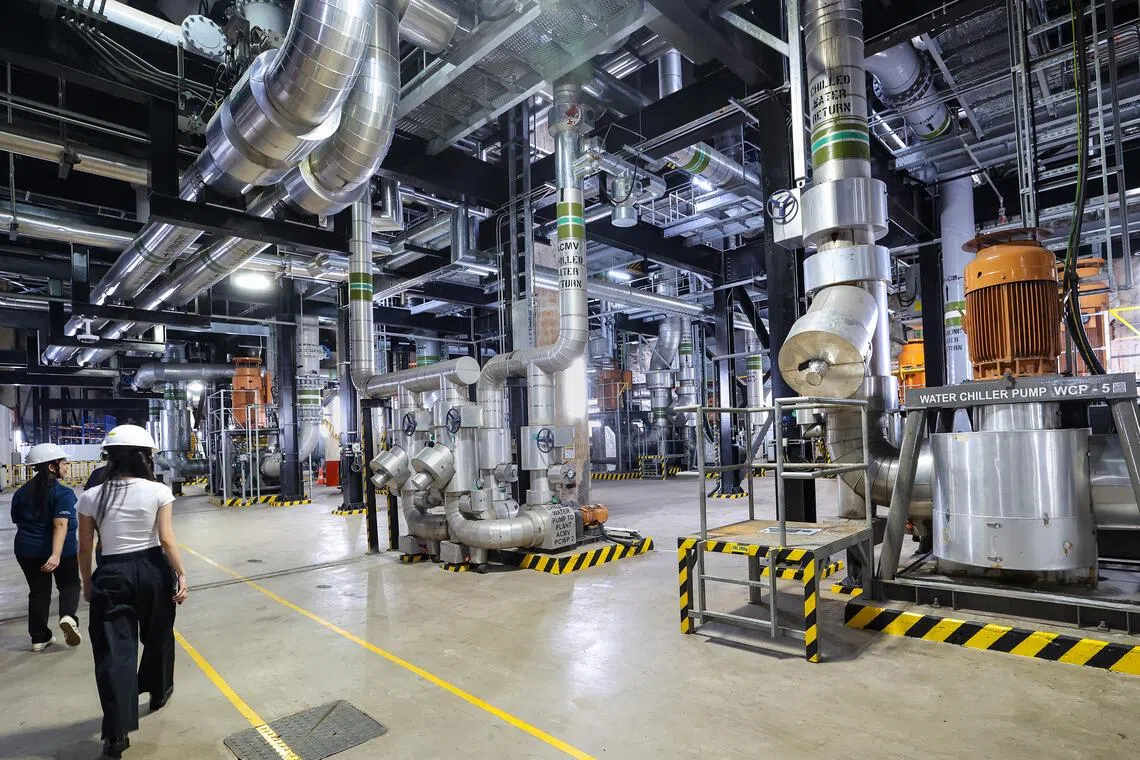
Harsha notes that, compared with standalone chiller plants, district cooling delivers at least 15 per cent in life-cycle cost savings by eliminating the need for individual building maintenance and overhauls.
Similarly, the centralised underground system that Engie operates at the Punggol Digital District is designed to yield roughly 30 per cent energy savings compared with conventional cooling.
Boonen expects the district cooling market in Singapore to roughly double over the next decade from its current capacity of 323,000 RT – driven by demand from new townships, semiconductor manufacturing parks, hospitals and data centre campuses.
As for scalability, he says it is “generally more straightforward” to deploy district cooling in new developments because the infrastructure can be integrated into blueprints from the outset.
For instance, the incorporation of a district cooling system into the Punggol Digital District master plan let the cooling infrastructure be planned alongside retail, commercial and institutional developments, “creating a more integrated and efficient solution”.
Meanwhile, retrofitting existing developments for district cooling may be more complex, but it is “far from impossible”, he adds.
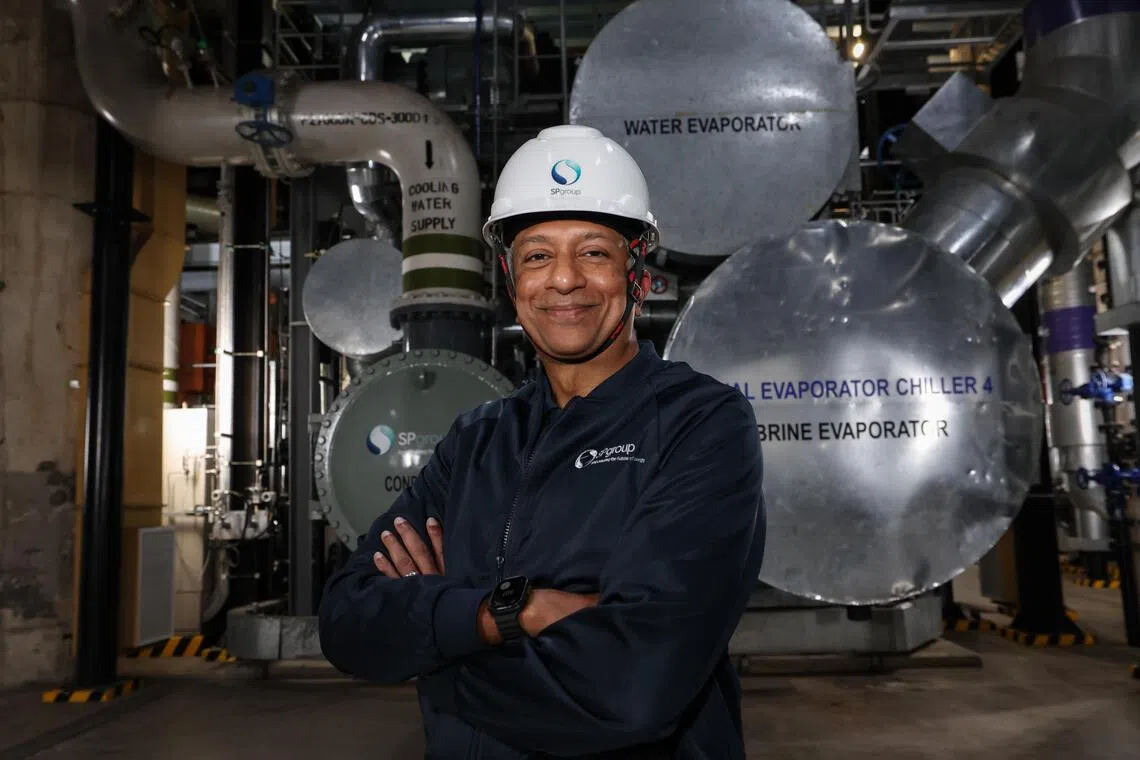
The manager of OUE Real Estate Investment Trust has invested S$43 million to connect its commercial and office development OUE Bayfront to the SP Group’s Marina Bay District Cooling Network. Earlier this year, it announced that it would convert 2,100 sq metres of floor area previously used for chiller systems into prime office space.
Boonen notes that ultimately, the “greatest potential” for district cooling lies in high-density, mixed-use developments where multiple buildings with significant cooling demand can be connected through a shared network – as in integrated districts that bring together commercial, residential, institutional, healthcare and transport infrastructure.
He adds that scalability depends on factors such as the cooling demand density, the mix of building types within a district, and the ability to coordinate infrastructure planning across multiple stakeholders.
Integrating solutions
While district cooling is important for reducing the energy needed for cooling, “there is no single technological fix” for urban heat, Prof Roth notes. “Reducing urban heat requires a combination of measures operating from the building to the neighbourhood scale.”
For example, digital twins are virtual replicas of an asset that can use building management system data such as energy generation and consumption to maximise energy efficiency in real time.
Matthew Chew, a digital twin system architect at mechanical and electrical engineering consultancy HY M&E, explains that digital twins allow cooling strategies to be simulated and fine-tuned before implementation.
“The built environment is there for the next 40 to 50 years, so you can’t have an ‘oops’ moment because it’s expensive,” he says.
Other available technologies include specialised paints that reflect solar heat from building facades. Having found that these “cool coatings” can reduce ambient temperature by up to 2 deg C, HDB plans to introduce them to all public housing estates by 2030.
But, more than ticking off a checklist of individual building features, heat mitigation requires stakeholders to coordinate short and long-term solutions seamlessly, says NUS’ Prof Yuan.
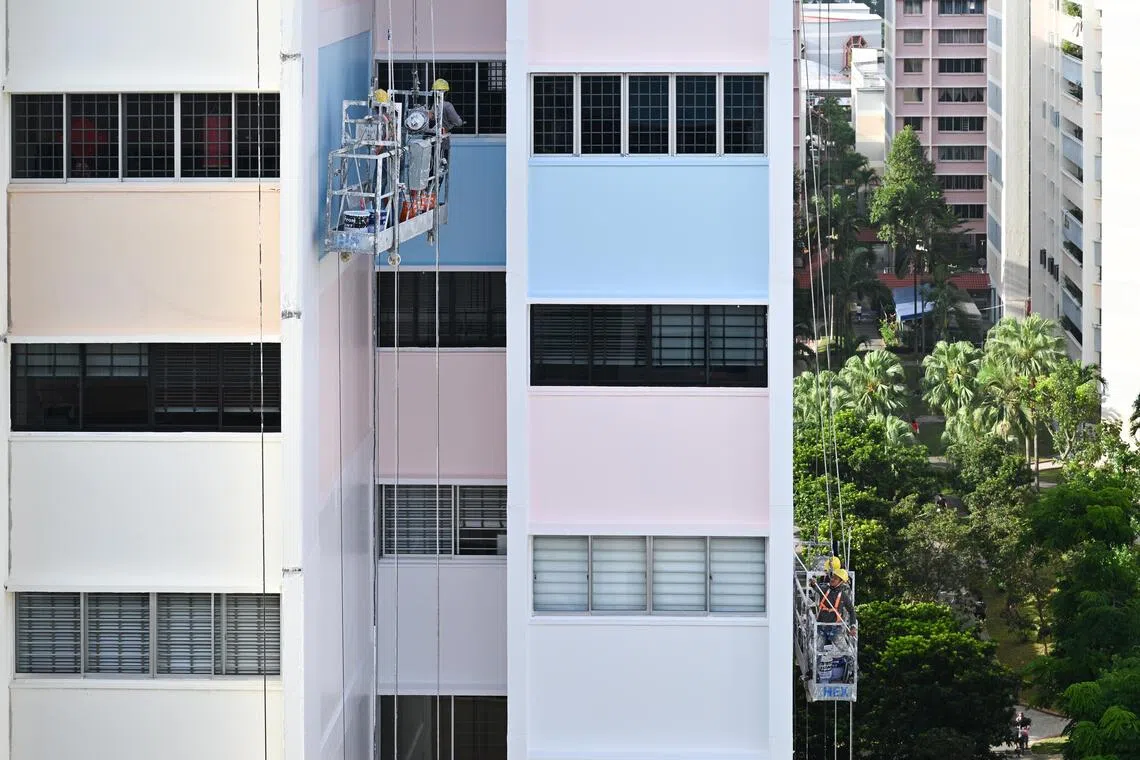
Indeed, conversations about heat mitigation technologies – such as heat energy-absorbing window glazing – must happen early in the design phase, notes Muhammad Khalil Shaiful Bahari, Boustead Singapore’s senior vice-president in the group technology office.
“Balancing sustainability goals with business values is essential,” he says, adding that “it’s not a zero-sum game”.
Drawing an example, he recalls “how office wear used to be – we wore shirts... and suits”. But as younger staff adjust to climate realities, “if they come in wearing T-shirts... that is much more environmentally friendly and comfortable at the same time”.
Based on research by the National Institute of Education’s Assistant Professor Wang Jingyu, between 2017 and 2024, Singapore’s “extensive urban green initiatives” helped lower the surface temperature of both deforested and non-deforested areas under daytime conditions.
However, the cooling effect was weaker in deforested areas.
“Urban reforestation is the most efficient solution to mitigate rising temperatures,” says Prof Wang, who also warned against “fragmented deforestation”.
Similarly, Prof Roth from NUS observes that urban development could amplify local warming and heat stress. “Preserving vegetation and designing developments to minimise heat storage and maintain ventilation can therefore help limit this additional urban heat,” he says.