Banyan Group bets big on branded residences
Segment hit a high in FY2023 with S$267.8 million worth of new sales and more growth is expected, especially in Thailand

BRANDED residences have quickly gained ground across the world and the market is poised for exponential growth in the next few years.
Banyan Group , formerly Banyan Tree Holdings, is a case in point.
In the group’s latest financial year ended December 2023 (FY2023), the total value of property sales from its branded residences and extended stay segment was S$267.8 million with 432 deals closed. That is around 23 per cent higher than FY2022’s S$217.2 million from the sale of 354 units, and makes for Banyan’s best sales performance thus far.
Unrecognised revenue from property sales as at Dec 31, 2023, was S$377.7 million, up 67 per cent from the previous year. Some S$92.6 million is estimated to be recognised in the coming year, with the remaining S$285.1 million recognised in 2025 and thereafter.
This brought the group’s total revenue in FY2023 to S$327.9 million, a 20.9 per cent increase from S$271.3 million a year ago. Net profit surged to S$31.7 million, from S$767,000 in FY2022.
“This is just the tip of the iceberg for property sales,” Banyan Group founder and executive chairman Ho Kwon Ping told The Business Times. “Unless property sales drop precipitously… we’re pretty much locked in the next few big years of profit.”
Much of Banyan’s efforts in growing its branded residences segment is focused on Thailand, where the group owns a massive four square kilometre plot of land – the size of a township in Phuket and around two-thirds of Singapore’s Marine Parade planning area.
Branded residences refer to residential properties that are affiliated with major brands, including international brands such as The Ritz-Carlton and St Regis. Branded residences typically offer higher levels of service compared to standard residential developments.
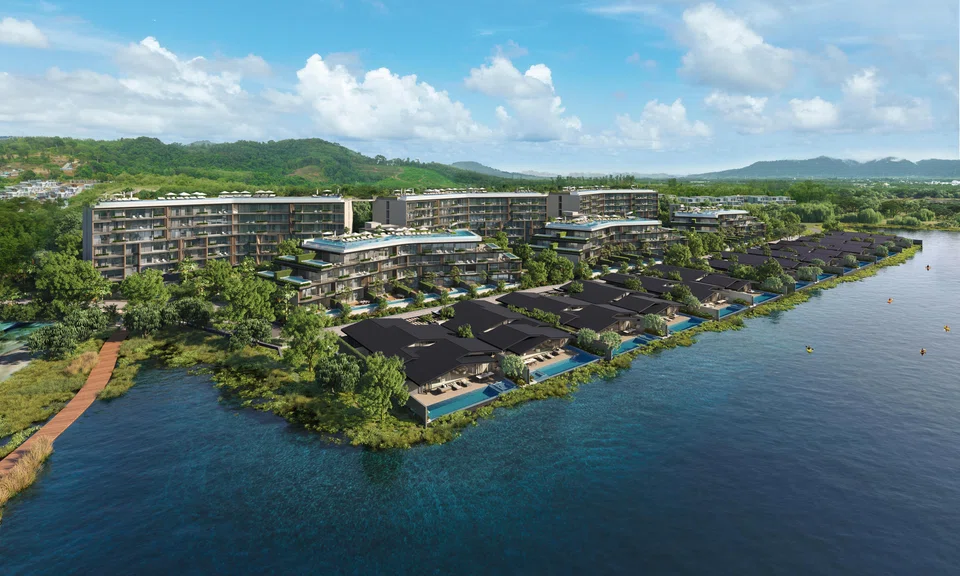
The group’s newest and most ambitious development this year will be the integrated development Laguna Lakelands on Banyan’s land in Phuket. Spanning 111 hectares, the project will incorporate biodiverse, native vegetation into various residential living zones. It is expected to house the island’s largest private residential community upon completion.
Laguna Lakelands’ first phase in February saw the launch of 300 condominium units, ranging from one to three-bedders, and 14 four-bedroom villas.
Condo units are sized from 559 to 1,280 square feet, with prices starting from around seven million baht (S$260,000). The four-bedroom villas, which include private pools and gardens, have an average built area of 5,600 sq ft and a starting price of 60 million baht.
The next five to 10 years will see the construction of up to 5,000 residences in total, said Ho.
Phuket’s allure
According to a market report by Knight Frank in July 2023, Thailand is among the top five markets for luxury branded residences.
The country’s resort island of Phuket, in particular, is the top destination for branded residences in Asia-Pacific, a similar report by Savills found.
Ho attributes much of this boom to the “coming of age” of Phuket as a global hotspot, similar to the likes of Majorca or Ibiza in Spain and the Caribbean.
Lifestyles have evolved post-pandemic, with more looking for a second home to either get away from the bustling city life or as a “safe haven” from political upheaval in their home country, said Ho.
For instance, Banyan recently saw a surge in demand from Russian and Chinese tourists. They now account for two-thirds of the group’s client base, and Singaporeans just a small proportion of buyers, he added.
Phuket is also an ideal location for those who can work remotely, Ho pointed out. It is a short distance away from other Asian cities, and has several new international schools and hospitals. Moreover, there is a “pull factor” of working at a “beautiful” location with dry warm weather during the typical winter season, he said.
More importantly, Ho highlighted that purchasing a property in Phuket costs a fraction of the price back home. Those in the middle class or upper-middle class, for example, are still interested in buying a second home but may not be able to afford it in cities like Singapore, where a bungalow can cost S$20 million to S$50 million, he said. Phuket is therefore a more affordable option for them.
Ho added that he was initially concerned rising interest rates would affect property sales, but fortunately, this has only made the “slightest of dents” to sales so far.
“This seems to confirm my theory that people are not buying for investment, because if you were, you would obviously not (want to do so) in a higher interest rate environment where your yield may be lower from (these sales),” he said.
Instead, it is enough that the returns – which are “moderately decent” at 4 per cent – cover any expenses, he added.
For those reasons, Banyan is “doubling down on property development” in Phuket, Ho said. The entire Laguna Lakelands project, for instance, is worth an estimated US$2 billion.
Ho’s optimism on Banyan’s branded residences segment may be warranted.
Based on the Savills report, demand for branded residences will remain strong and “ever-growing” in the coming years. This is especially so in global cities that are business and education hubs offering lifestyle and cultural attractions, as well as “unique experiences”, it said.
“With strong historical and forecast economic growth, as well as increasing numbers of high-net-worth individuals, brands can be confident in increasing their presence in these locations,” Savills said.
Still, the Knight Frank report noted that the branded residences segment is not without its challenges. These include the need to “synchronise the timelines of purchasers and developers, substantiate the value of brand associations, and demonstrate unwavering commitment to sustainability”.
But overall, the consultancy said there is much potential for both developers and operators. “Despite the current economic headwinds, the demand for branded residences is expected to persist, underpinned by the pillars of wealth creation, travel, and investment fundamentals, thus fortifying the industry’s growth trajectory.”
TRENDING NOW
Grab CEO’s wife Chloe Tong on life with Anthony Tan and finding her purpose
He built the Vingroup empire. Now South-east Asia’s richest man is handing some key roles to his sons
US says China to buy 10 million tonnes of coal in 2027 and 2028
Tokyo reverses baby bust with AI matchmaking and generous subsidies