

A rift with consequences - and opportunities
THIS WEEK'S TOPIC: What's the impact on business as relations between the United States and China fray and tensions mount?
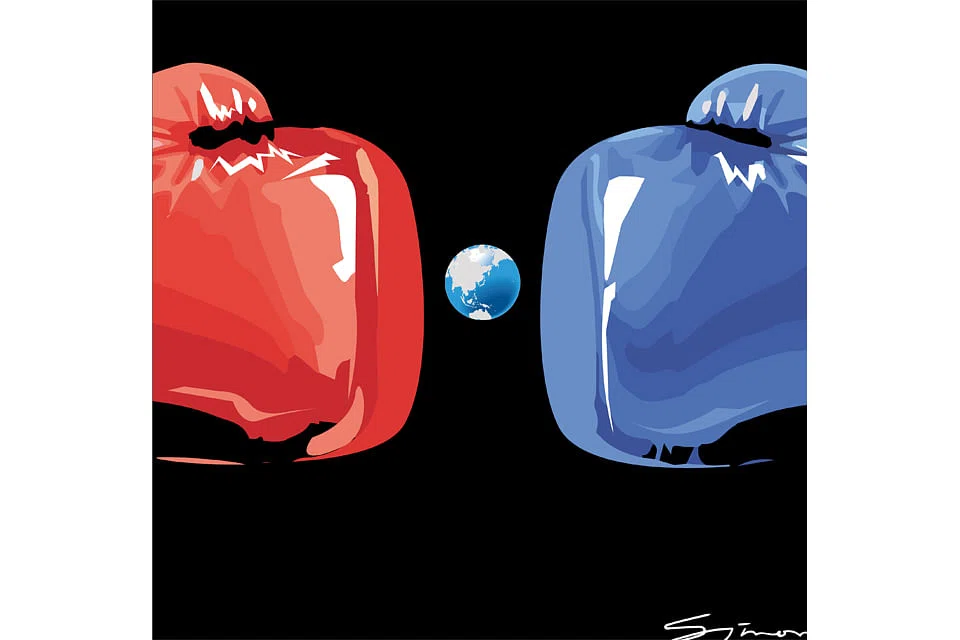


THIS WEEK'S TOPIC: What's the impact on business as relations between the United States and China fray and tensions mount?
Yeoh Oon Jin Executive Chairman PwC Singapore
When the tension between the two largest economic giants escalates, there is an unavoidable ripple effect on the rest of the global economies, including Singapore. To manage the risks that the polarisation brings, companies must relook at their strategies and supply chain resilience. Businesses must be able to adapt to a possible bifurcated global economic system, rooted on separate technology platforms (for example, Whatsapp versus WeChat, Amazon versus Alibaba), infrastructure (for example, 5G) and business conventions. Few businesses will be spared - even local businesses will have to contend with the consequential differing preferences of US and Chinese visitors coming to Singapore.
Despite the risks, there are also opportunities to seize. The need for supply chain diversification will create new opportunities for Asean businesses in the region. Organisations should also tap on new digital technologies to manage the fragmentation of supply chains, unlock new possibilities and drive business performance amid the uncertainty.
Victor Mills Chief Executive Singapore International Chamber of Commerce
Given the many challenges which we humans and our planet face, it is very worrying and dangerous that relations between the two largest economies are so sour. The present state of the relationship impacts businesses negatively in multiple ways. It increases uncertainty in an already uncertain world struggling to overcome a global pandemic, the severe economic fallout from it and increasing incidents of catastrophic climate change. It increases business costs by disrupting business plans, often forcing the re-routing of supply chains, and by increasing the risk of technological decoupling. Lastly, it increases the risks of accidents which could result in conflicts.
John Bittleston Founder and Chair Terrific Mentors International Pte Ltd
The world has a serious pandemic to deal with, which may be a precursor to other virus diseases. At the same time, we have a serious climate change to contend with. In addition to these two global crises, we are seeing the biggest international social revolution we have ever experienced. Our world economic structure is under enough pressure to disrupt even stable relations. Trade and territorial tensions between a dysfunctional United States and a fast-growing China add stress to a point where sensible handling of the situation becomes increasingly difficult. Businesses are struggling to adapt and cope with these pressures. A cooling of the US-China tensions would significantly help to make that possible.
Lawrence Loh Director, Centre for Governance, Institutions and Organisations NUS Business School
The United States and China have a spectacular geostrategic love-hate relationship now. It is really like two proverbial elephants battling and the grass beneath gets trampled upon. And this grass is the business community. The situation has moved from trade war to tech war. After Huawei, the series of successful social media apps are targeted. There will be no winners, even more so for businesses which are bleeding from the pandemic. The high-profile fight is on TikTok now. Country leaders have to realise that any counterproductive move will backfire. It is like a clock counting down to a loss in the coming election, and that is going ''tick tock, tick tock''. Businesses just cannot wait for all these wars to stop.
Vadim Berman Chief Executive Officer Tisane Labs
Singapore (and, by extension, South-east Asia) is in a unique position to benefit from the tensions between the United States and China. Historically, it paid to be a neutral, stable country in the mid of a global conflict, like it was with Sweden, Switzerland and others. Both the US and China view Singapore as a ''neutral ground'' trusted enough to set up regional branches and keep money. Additionally, the transition of manufacturing from China to South-east Asia is already underway, and Singapore will benefit from it both directly (as the South-east Asian offices are traditionally located in Singapore) and indirectly.
Stephen Keys President IFS Asia-Pacific, Middle East & Africa
It is normal for there to be areas of conflict between two great powers, and also opportunities for collaboration. The key is not necessarily to trust each other completely - an unrealistic goal - but rather find a way to trust each other enough to talk openly and candidly, especially where there is shared interest.
As a business, we depend on stability to help create a secure, predictable environment in which we can make a living. I hope the US and China will each tend to its many interests and investments across the region. Properly managed, regional stability can be an asset for both powers.
Charles Ferguson General Manager, Asia-Pacific Globalization Partners
The US-China trade war has disrupted the global supply chain and given rise to new international opportunities, as well as standards and regulatory compliance that businesses need to navigate. As companies reimagine success as a result of the ''great reset'', forging the right partnerships, embracing new technologies and ultimately, being bold and brave to test new markets will be crucial to securing future growth. We are privileged to be in this part of the world, where decades of infrastructure and experience in trade are being brought to the fore.
Prospects across Asean in emerging markets and tested hubs alike are tremendous as global businesses pivot their production facilities and tap into new sources of supply there. Favourable government policies coupled with a rebalanced stream of outbound foreign direct investments from China and other large economies, create immense opportunities to be seized in this dynamic region.
Choe Peng Sum Chief Executive Officer Pan Pacific Hotels Group
The US presence in this region has helped to underwrite regional peace and stability.
As an international hospitality player headquartered in Singapore, this is critical for our business growth and investments. It also facilitates regional travels within Asean which is important as these countries do not have a sizable domestic market.
China and the US are key feeder markets for our hotels globally, making us vulnerable to this tension. It will be detrimental to business performance to lose guests from either country. The tension has adversely affected the global economy. This is a poison potion on top of the Covid-19 situation, which will cause further economic downturn, thereby impacting consumer confidence and overall spending especially in sectors like travel and tourism.
Alva Qian APAC Chief of Strategic Initiatives Capgemini
Businesses should consider the supply chain disruption caused by tariffs and the removal of Hong Kong's special trading status, technology ecosystem disruption caused by national security based restrictions and potential changes to the financial ecosystem. As immediate adjustments, businesses must adapt their supply chain to strike a new balance between cost and supply. In the mid-term, businesses will have to fundamentally rethink how the technology components of their products and services are procured and integrated, and whether these components are national security safety proven. Costs will be added to many existing business models. At the same time, new opportunities will arise to meet the business needs created by these disruptions.
Pavlos Spyropoulos Country Manager, Singapore and CEO Lloyd's Asia
Global trade tensions and the broader shift towards protectionism pose a significant threat to foreign direct investment and international supply chains. Insurers have seen an increase in demand for insurance solutions from businesses seeking to manage their political risks.
These include expropriation or nationalisation of their foreign entities, losses arising from their inability to convert currency due to exchange restrictions and losses stemming from damage caused to their assets due to protests, riots or other acts of violence intended to achieve a political objective, to name a few.
Covid-19 and the resulting economic downturn will continue to exacerbate political tensions globally and lead to increased state intervention to protect public health and domestic economies. It is important for global businesses to assess their exposures today and manage their risks given the uncertainties that lie ahead
Long Jek Aun Singapore Office Head Simmons & Simmons JWS
Like a never-ending storm, it is inevitable that the tensions between two of the largest economies in the world have had a profound impact on most businesses to varying degrees. Businesses are likely to be tested even more in the months ahead with the increasing fractiousness bearing down on the global economy.
Not helped by the ongoing pandemic, these tensions have magnified the complexities and uncertainties of navigating the international commercial, financial and economic terrain, as well as challenged many past assumptions.
Creativity, resilience and pragmatism will be required in abundance on the part of businesses to adapt to the evolving circumstances, weather the storm and to seize opportunities that arise on the pathway to a more peaceful economic climate and equilibrium.
Jeffery Tan Group General Counsel & Chief Sustainability Officer Jardine Cycle & Carriage
There is an old African saying: ''When elephants fight, it is the grass that suffers.'' In an environment of heightened tension between the top two economies, it can only spawn economic polarity in the best of times and potentially a global economic catastrophe in the current pandemic. One hopes that both sides will allow cooler heads and warmer hearts to prevail - thus enabling them to see the greater number of common traits that unite the two countries, rather than divide them.
It is probably apt to recall the wisdom of Albert Einstein, the father of the atomic bomb: ''Peace cannot be kept by force; it can only be achieved by understanding.''
Dileep Nair Independent Director Thakral Corporation Limited
The deepening rift in the US-China relations will drastically affect global trade. Being the most open economy in the world, with trade more than three times its gross domestic product, Singapore's businesses will be severely impacted. Our firms exporting to China, as well as those with factories in China exporting to the United States, will be hit. Additionally, supply chains will be affected as industries start the decoupling process to establish alternate sources of supply and production bases.
Another fear is a downward correction in equity markets which already are in disconnect with the economy, compounding business anxiety. Worrisome too, are the headwinds caused by the acrimonious relations, on any growth and recovery after the pandemic. The biggest danger though, would be an outbreak of hostilities between the US and China. All businesses can do to hedge their bets is to diversify their markets and investments in this increasingly polarised global economy.
Toby Koh Group MD Ademco Security Group
The jury is still out as far as what 2021 may look like for the China-US relations, depending on the outcome of the US presidential elections. If Joe Biden wins, we expect calmer skies. If US President Donald Trump continues into his second term, there is little doubt that the bifurcation will be accelerated.
Ironically, there may actually be more business opportunities if trade relations between the two giants sour. Multinational corporations are awaiting the outcome of the elections before taking the strategic decision on supply chain diversification, relocation of plant away from China and more. The move into an East-West divide will create new opportunities which businesses can benefit from. Singapore will play a more important role juggling and providing a conduit between America and China. Asean will grow in importance as an economic bloc that will be wooed by G20 countries.
Benjamin Tan Vice President Ultimaker Asia Pacific
The mounting tensions between the United States and China are not likely to abate anytime soon. Rather, the two powerhouses have even started decoupling in trade and tech, causing knock-on effects to the rest of the world. With the US pursuing protectionist policies, prices of imported goods and services may increase for other countries, including Singapore, due to high trade tariffs being imposed. Countries may turn inwards for domestic production and consumption, leading to stagnation of trade and innovation globally.
With our 3D printers manufactured and imported from the Netherlands, this may deter businesses from investing in the technology, thus preventing them from reaping the benefits that 3D printing brings. Singapore is an open economy that is highly reliant on trade. Any disruption or slowdown to global trade will hit business, consumer and investor confidence hard.
Bharath Vellore Managing Director, Asia-Pacific Accuity
The United States has imposed sanctions on 11 Hong Kong officials under the Hong Kong Autonomy Act, continuing its trend of using sanctions as a foreign policy tool.
The implications on financial institutions and corporations, including those in Singapore, are that they may face secondary sanctions designations or be targeted for enforcement if deemed to have conducted or facilitated significant transactions with sanctioned entities. This is due to the US dollar's prominent role in international trade, which puts any cross-border transaction in USD within the regulatory scope of America's Office of Foreign Assets Control, regardless of where it originates or clears.
China's national security law, which has extraterritorial application, also prohibits anyone from receiving instructions from a foreign country to implement sanctions against Hong Kong.
With complex compliance obligations under both the national security law and US economic sanctions, businesses must carefully assess the practical risks and adopt a risk-managed approach when dealing with other entities.
Eryk Lee Chief Executive Officer AAM Advisory
When two giants collide, some businesses will inevitably be caught in the crosshairs. But as a wealth management business, we help clients plan for the long term and prepare for short-term volatility and disruption in the market, such as those caused by the US-China tensions. Regardless of what causes market volatility, our job is to help our clients ride through the storm and come out unscathed. In this sense, the US-China tension is less relevant as it is merely one element of disruption among many, including the outcome of the impending US election. While we cannot ignore the impact of increasing trade tensions when looking at investment opportunities, our investment strategies are diversified and are not overly concentrated in any particular economy, sector or asset class.
Svend Janssen Head of Asia Western Union Business Solutions
These are challenging times for businesses. They not only need to navigate through the global pandemic, but also through worsening relations between the world's biggest economic powerhouses. But only a minority of global trades involve physical goods, which currently are subject to trade wars. Together with Oxford Economics, Western Union Business Solutions has just released a study on the global services trade revolution. 55 per cent of all cross-border trade flows are in fact services - and some of them are remarkably thriving. We are however living in a long period of rapid change. It will remain important for companies to have proper risk management strategies in place to protect their bottom lines, eg when it comes to foreign currency volatility.
Joe Keen Poon President Kaplan Singapore
Kaplan is one of the world's leading education companies. The business of education has two drivers - the desire to equip and improve one's prospects and an environment for teaching to take place.
The Sino-American decoupling does not impact the Chinese desire for learning. This is too deeply ingrained in the Confucian culture.
American degrees are still viewed favourably but studying in the United States is not. We see a spike in interest from both American colleges and Chinese students reaching out to us to continue that quality education in safer alternative locations such as Kaplan Singapore's campuses.
As globalism wanes in the face of great power rivalries, Kaplan Singapore and other Singapore enterprises can step up to play a pivotal and profitable role of being the neutral third party conduit to bridge the supply and demand from these two economic giants.
Mario Singh Chief Executive Officer Fullerton Markets
Ever since Mao Zedong established the People's Republic of China on Oct 1, 1949, US-China relations have been cordial at best and complex at worst. Rivalry has certainly intensified in areas such as diplomacy, politics and economics.
Global business will certainly take a hit if tensions mount between the world's two biggest economies. Specifically, the business world will be watching the developing situation around high-profile Chinese companies like ByteDance, WeChat and Huawei.
If either Microsoft or Oracle conclude their acquisition of ByteDance and if the US takes more measures against WeChat and Huawei, Beijing would likely respond. This could come in the form of a boycott against high-profile American brands that are doing well in China, like the National Basketball Association (NBA), Starbucks, Apple and Coke.
That said, a possible strategy in all the media hype that the US is mounting on China could simply be to drum up news coverage ahead of the November elections, where US President Donald Trump is seeking a second term.
Maren Schweizer Director Schweizer World Pte Ltd
Tearing Chinese and American corporate worlds apart would hurt everyone. Arguably, deglobalisation has been underway for more than a decade. Covid-19 has accelerated the process by providing a justification for re-shoring.
As de-coupling accelerates, two hostile economic blocs are emerging, one centred around China and the other around the United States.
Moving manufacturing operations to China's neighbouring countries might not be sufficient. History has shown that proximity is one key parameter in predicting which countries become members of which economic blocs, even against their will.
Businesses need to consider the possibility that large parts of the world may no longer be viable host countries for their supply chains. Restructuring and relocating to (geographically speaking) ''safer'' countries come at an extra cash burden and resources at the wrong time. For certain industries this is not a viable option at all, especially if there is no remaining local supply side to start within the ''safer'' countries.
We have to avoid blocs and find a way to work together.
Edward Tay Chief Executive Officer Sistema Asia Capital
Tensions between United States and China during the pandemic will certainly affect the global supply chain and economy. For a strategic hub like Singapore that is a gateway to South-east Asia, these developments have possible implications to trade and digitalisation efforts locally and regionally. Businesses should prepare to create new capabilities, business models and jobs to remain competitive. In the startup ecosystem, we see new opportunities and value created from emerging technologies such as cloud, artificial intelligence, e-commerce and data analytics. We believe that partnerships between governments, industry and startups will ensure business recovery and resilience amid this changing economic environment
Praba Thiagarajah Group CEO Basis Bay
The trade tensions have far-reaching implications, not the least of which is the impact on investor confidence globally. Business deals are being postponed and the worst may not be over for job losses. As expected, the coronavirus pandemic adds a further, more significant dimension to the issue. That said, there may well be opportunities opening up in this region as a result of the trade redirection that occurs. Some Asean countries are being viewed as alternative destinations for companies relocating from China. Also, businesses globally will perhaps focus on new business opportunities in the Asia-Oceania region minus China in the near future.
For the tech sector, this presents a call to action. Businesses are required to rise to the challenge of increased demand and changes in behaviour. They will do best when they can spot the opportunities that surface and respond quickly and effectively. Customer engagement has been and will continue to be key to solidifying the value proposition alongside service quality.
Lim Soon Hock Managing Director PLAN-B ICAG
Unlike the past detente between the United States and Russia, this new tension between the US and China started hot right from the beginning. It has since heated up to a dangerous level, with much tit-for-tat manoeuvres beyond trade, following the 2016 election of Donald Trump. Unlike the former Cold War, which was more political, the new hostilities have far-reaching economic implications, given that both are super-economic powers.
It is hoped that this is a pre-election ploy by Mr Trump and that it will ease post-election in November. But both the US and China have grown to be interdependent on each other for decades. Beyond the rhetoric and calibrated moves, the reality is that it will take a while for both to decouple from the inter-dependency. Businesses should seriously take advantage of this transition to prepare themselves for the worst and to operate in a new economic order by exploiting the comparative advantages of both countries.
The US and China can and should continue to compete and complement each other for the benefit of all, in today's new economic order.
Annie Yap Chief Executive Officer AYP Group
The tensions between the United States and China have caused significant strain on businesses not just in the two countries, but globally as well. The high trade barriers between both nations mean that global supply chains could be significantly disrupted. With trade slowing down, consumer goods may become less accessible and developments in technology less widespread. All these are especially so, given the fact that both the US and China are large nations with major roles in global trade and economy.
Should there be no efforts to de-escalate tensions, the strained relationship between the two nations can cause significant dents in businesses and economies worldwide. This includes basic consumer goods, but can spread to other industries where both nations are active in, such as the auto industry.
Zaheer Merchant Regional Director (Singapore & Europe) QI Group of Companies
In one word, significant. Business at every level, upstream and downstream, cannot normalise. Nor will relationships between entities, their permanent establishments or even their trade connections. Uncertainty at every level is the keyword, as is business-decoupling and shifting of production facilities to supply chains (think Apple and India now). Suddenly, sanctions and tariffs are fashionable from palm oil to protests. Countries have been dragged into the equation, not least Europe or Australia vis-à-vis Huawei but even at micro levels. It is a vicious circle spiralling into every facet of business at an international level.
There are silver linings for some countries such as Vietnam which recorded 7 per cent growth in gross domestic product from trade-war spillover. For everyone else, ''kungflu'' (in US President Donald Trump parlance) or pandemic aside, unless an election resolves this new Cold War (which scarily has drawn commentary, however unlikely, on becoming a ''hot war''), the tensions are nothing less than quite horrible.
Henry Tan Group CEO Nexia TS Group
This geopolitical issue is going to split the world. I was joking with one business associate recently that maybe all countries have to divide themselves into two groups - East and West - so that the East side continues to work with China and the West side continues to work with the United States. The ''Berlin Wall'' can be re-erected and created across the world so we have East Singapore and West Singapore. Of course this is said in jest but you get the drift.
Countries are being forced to choose their allegiance and alignment. A classic example is panning out in both Hong Kong and Africa. This may be good for a country like Singapore because middlemen will gain in importance once again. Similar to the Cold War, there exist countries and brokers to play the middleman role. If Singapore can be this middleman, it bodes very well for our businesses too, and especially for us - we are a platform to connect the world and with this geopolitical divide, we can play a role even more to navigate the complex hoops businesses need to go through. Do I hope for this? No, I do not but I am ready for it if indeed the world divides.
David Leong Managing Director PeopleWorldwide Consulting Pte Ltd.
This can possibly lead to a bifurcation of global trades and technology standards and splinter trade alliances and pacts. The United States has been aggressively advocating its allies to distance from China and to cease adopting China's 5G technical infrastructure or allow Chinese technology platforms to be widely propagated. It is almost like the Cold War, which was a period of tense geopolitical conflicts between Soviet Union and the US with their respective Eastern Bloc and Western Bloc allies. The impacts on businesses can be dire with the dispute.
Singapore has to navigate between the two large blocs without offending either one of them and possibly being blocked from trading with one side because of our alliance and alignment with the other. It is a game of delicate brinksmanship.
Vick Aggarwala President/CEO Supreme Components Intl Pte Ltd
Our company's motto of value addition at the ''speed of thought'' for our customers and suppliers is being challenged big time. Shipment times are increasing, lead times are stretching due to raw material availability, and overall demand has gone down for most end-products. But there are some bright spots - for instance, data servers, medical and some communication devices.






