Digital banks should count on more than ecosystems, tech to expand in South-east Asia

Tan Nai Lun
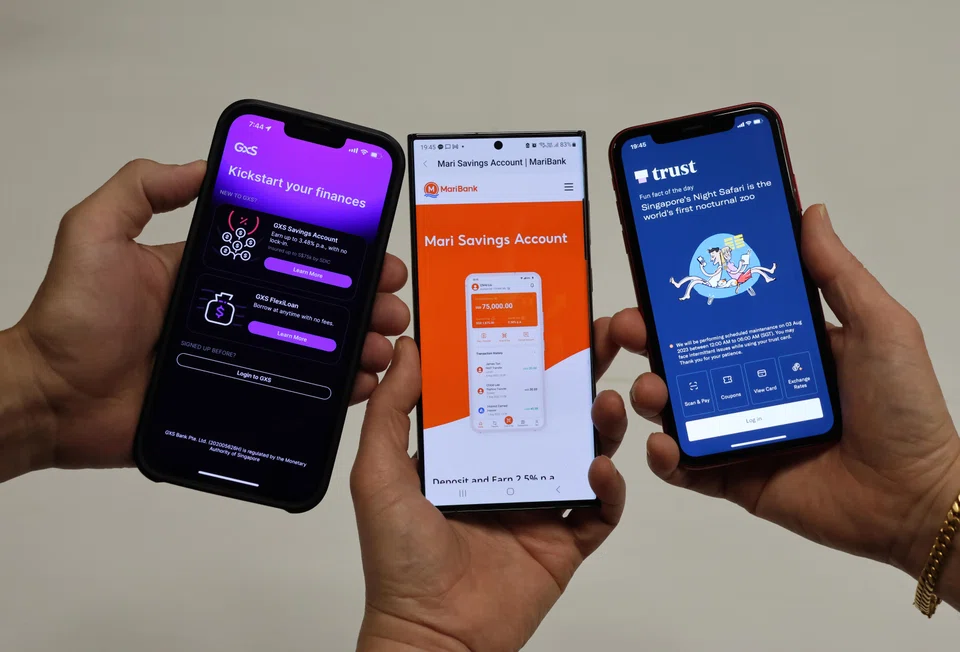
DIGITAL banks have emerged in South-east Asia as a means to reach out to the underbanked or underserved segments in a cost-effective manner. But strong competition is putting their strengths to the test.
Market observers said that for digital banks to succeed in the region, they will need to depend on more than their tech capabilities and ecosystems.
“Ecosystem partnerships are necessary for banks to attract customers, but they also need to differentiate and provide unique value propositions such as superior customer experience, better rewards or better interest rates,” said Liu Meng, senior analyst at Forrester.
The digital banking ecosystem – the interconnected platforms, tools, and systems that enable customers to access banking services – provides a wealth of data for digital banks.
Muthukrishnan Ramaswami, group chief executive of GXS Bank, noted that the bank knows more about its customers than big banks, purely because of the ecosystem data that it collects.
For example, customers who do not have a credit history may not be able to get a loan from a big bank. “What we do is we take the ecosystem data, try and build our own scores around how they’re likely to be based on the rest of that data, and we make loans,” he said.
This brings access to credit for a larger segment of the population, he added.
Ramaswami also oversees GX Bank, GXS’ Malaysia subsidiary. The banking group is part of a joint venture between Grab and Singtel, which also has a stake in Super Bank in Indonesia.
GXS is looking to target those in its ecosystem that are underserved by bigger banks, largely due to the fact that such clients cost traditional lenders more.
“All of them have bank accounts or are banked, but they are underserved in their access to a loan when they need one, or access to good interest rates or earnings on their money,” Ramaswami said.
He also sees potential in serving micro, small and medium-sized enterprises (MSMEs), where the owner is a single individual, such as mom-and-pop shops and hawker centre stall owners.
He noted that the group has partnerships with distributors of various commodities and fast-moving consumer goods in Malaysia and Indonesia.
From this, the bank is able to make credit decisions based on payment and supply data it collects, and become a supply-chain finance mechanism for these small entrepreneurs or suppliers.
“We insert ourselves into the flow within that ecosystem. The key to success for us long term is how well we integrate the bank with the ecosystem flows,” said Ramaswami.
Zennon Kapron, managing director of fintech consultancy Kapronasia, agreed that digital banks – through their ecosystems – tend to know more information about their customers than traditional banks.
For example, digital banks with links to a ride-hailing app can capture characteristics such as punctuality and work hours, whereas a traditional bank would only see the salary information of the individual.
“I think that is the advantage that (the digital banks) would have, but that’s just for the people that are in the ecosystem,” said Kapron.
But it may be difficult to tell if data collected by the digital banks from their ecosystems is meaningful in determining credit risks, said Dennis Khoo, managing partner of consulting and services provider allDigitalfuture.
He noted that digital banks may only have one side of the equation – which is the income that these MSME owners make – but no information on their debt servicing levels.
That is the importance of a credit bureau, Khoo said. But often, credit bureaus in Malaysia and Indonesia, for example, may not have quality data on the underserved or the unbanked, who are new-to-bureau or very short-to-bureau, he added.
Crucially, these ecosystems need to be sizeable enough for the digital banks to make a profit, given that the segments they are lending to tend to reap lower profits.
Khoo said: “(The digital banks) do have an ecosystem. The question is, do they have enough merchants lending from them that they can collect back?”
Competition – from both other digital banks and local bank players – is also strong. Malaysia issued five digital banking licences in 2022; meanwhile, in Indonesia, there are at least 15 digital banks in operation.
This drives up customer acquisition costs, as banks would need to provide attractive deals or subsidies to attract customers.
Kapronasia’s Kapron said: “None of these players have got a significant amount of market share in South-east Asia. They still need to subsidise acquisitions, but it’s very expensive to do that.”
Speaking on the profitability of its target segment, GXS’ Ramaswami noted that the bank needs to look at the segment that can provide enough returns for its efforts.
“It falls into two categories: are they unbanked because they are in a remote area and have no access (to a network or device), or they are unbanked because they are not attractive enough for the big banks?”
Tech and economies of scale
Meanwhile, digital banks often have another edge: their tech stacks are more nimble and cost-efficient than those of traditional banks, which often have archaic systems that require more funds to upkeep and more time to transition.
Kapron said it “makes a lot of sense” for digital banks to expand in South-east Asia, as the lack of a branch network means they can potentially grow their business among the unbanked for cheaper.
Khoo noted that digital banks’ tech stacks give them a starting advantage, especially when they are serving less complex customers that may generate less revenue.
But he added that digital banks need to go beyond cost savings. “I don’t think it’s a universal advantage, because once you become more of a universal bank, your systems are quite complicated no matter how you start.”
Banks have various areas that they need to be concerned about apart from technology, such as governance, regulation, risk management and product management, he noted. “Banking is an industry that leverages technology heavily, but it is not a technology business.”
Khoo also expects fewer economies of scale when expanding in the region for the banks, as a big part of the business depends on localisation.
But Forrester’s Liu said technology capabilities will support the banks to realise and achieve superior customer experience.
Ramaswami also noted that GXS was able to use its tech advantage to expand. It took technology that it built in Singapore – from how it set up its banking units to compliance and anti-money laundering controls – to launch in under 18 months in Malaysia.
“We have the experience of how it is to be set up, compared with someone starting from scratch,” he said.
He expects that with scale, the unit cost of servicing for the bank will go down as it is only technology capacity that is added.
Ramaswami still sees a long-term future for digital banks, as they can be an entry into organised finance for a lot of people.
“I guess, all of us are trying to play in the same niche, and therefore, it’s a function of who does it well, and who finds which service relevant,” he said.
“These are the experiments that everyone’s doing, and I think that there is enough room for all of these. Ultimately, people will decide how many digital accounts they need to have – only time will tell.”