With tech stocks in a frenzy, the AI party is still picking up steam
THE artificial intelligence (AI) bubble is already one of the biggest speculative events in human history, but it looks like it’s just getting started.
AI is a transformative technology, and the advances have been so rapid that a machine could almost certainly write this very article, perhaps even better than any journalist out there.
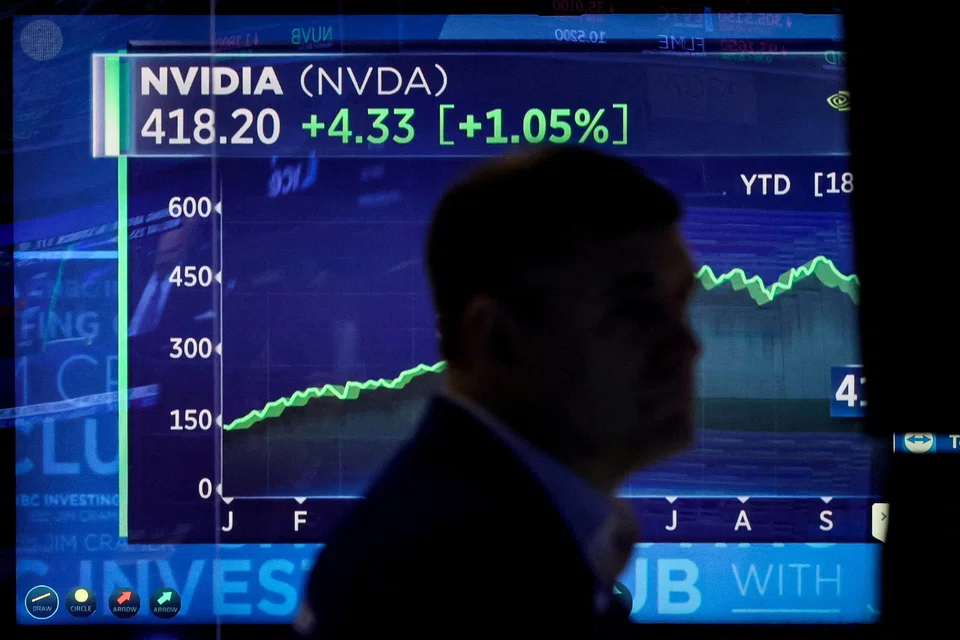
But AI is not advancing in increments of 5 per cent a day, as AI-enabling chipmaker Nvidia is on the stock market. Last week, the company’s market cap reached US$1.7 trillion – the same as all Chinese companies listed on the Hong Kong Stock Exchange.
AI is not even advancing by increments of 1 per cent a day, as the top 100 largest companies traded on the Nasdaq market are doing. As in 1999, a technology can be both transformational and the cause of a dangerously overheated stock market.
The Nasdaq doubled in value in 1999 on a vision of the future. People piled into exotic companies such as Amazon and Pets.com because they predicted that everything from dog food to cars would be bought by people sitting at home in front of their computers. That ebullient prediction was indeed realised, but not for another 15 to 20 years.
The economics of AI are just as compelling as those of the Internet, and the predictions that computers and robots will one day perform every human job as well or better than any human will also likely be fulfilled.
Even sceptics concede that AI is changing the world. Students who are now dispatching AI to write their term papers will soon bring these secret assistants to the workplace, and rely on them just as heavily.
Talk of an AI-led revolution is in the air all over Wall Street. Analysts at money manager BlackRock compared the “overarching race to build the smartest machines” to the industrial and information revolutions.
As in the industrial revolution, humankind has invented a machine the capabilities of which are challenging assumptions of what human lives look like, said JD Joyce, president of Houston financial advisory Joyce Wealth Management.
But investors sometimes behave as if the revolution will be completed overnight, said JJ Kinahan, chief executive of IG Market North America and president of its brokerage tastytrade.
“The excitement associated with 1999 and all things ‘dot.com’ was real, because it ushered in a new era of how business could be conducted online with the potential of reaching customers beyond brick-and-mortar limits,” said Quincy Krosby, chief global strategist at brokerage LPL financial.
“Anything with a ‘dot.com‘ next to its name was bid up amid the excitement and frenzy.”
There are already frenzied dotcom-esque events afoot. Take Evaxion, whose shares briefly doubled in one session in late January after it dropped a mention of AI’s role in its cancer-vaccine research.
Shares of consulting firm Palantir jumped almost 30 per cent after it cited the application of AI to data analysis for its better-than-expected earnings growth.
All that, of course, is dwarfed by the returns of the maker of the hardware that powers AI, graphics chipmaker Nvidia. No other company has grown so valuable so quickly during a speculative boom – not even Cisco Systems, the maker of Internet hardware that became the poster-child of the 1999 surge.
Two years ago, Nvidia was a fast-growing fringe player in the tech world, associated with hardcore gamers, bitcoin miners and other extremely heavy users of high-powered computing. It had already topped the annual list of gainers on the S&P 500, but it was still a minnow, never mentioned in the same breath as Microsoft, Apple or even Cisco.
Nvidia has added more US$1.2 trillion in value over the last two years, and over US$500 billion in the last six weeks. Exxon Mobil has taken about a century to build an oil-and-gas empire so extensive that its land holdings alone comprise roughly the same acreage as Ireland. Nvidia’s 2024 gains are equivalent to it swallowing Exxon whole for dinner, and having most of Cisco for dessert.
On the face of it, Nvidia is wildly overpriced. The company’s price-to-earnings ratio of 90, which means the stock is worth 90 times the estimated 2024 earnings, looks eye-watering, said Joyce.
If Nvidia’s rate of earnings growth is taken into account, however, the PEG ratio – or price-to-earnings divided by earnings percentage growth rate – is closer to the 1 mark, still fully priced but not crazy.
The problem is, the stock has entered the “parabolic” phase, where every session seems to generate a bigger percentage gain than the last.
Analysts at brokerage Stifel, one of the few firms to express scepticism on mortgage markets before the 2008 crash, argue that the stock market has already entered the “greater fool” stage.
The idea is that the only good reason to buy a stock like Nvidia is the belief that a bigger fool than yourself will then buy it from you.
Another symptom of the bubble might be the recent moves by Facebook parent Meta Platforms. Meta added the most in terms of market capitalisation in history when it added US$196 billion in the wake of its fourth-quarter earnings on Feb 1, when it also established a dividend.
When will it end? Joyce suggested a sign of the peak might be when companies start adding AI to their names just to get the attention of speculators, ravenously hungry for the next Nvidia.
Crypto and Bitcoin crept into company names around the peak of the cryptocurrency market two years ago, and the same famously happened during the dotcom days.
After the dotcom boom, of course, came the infamous dotcom bust. Some companies such as Amazon.com, eventually grew into the hype, and fulfilled their heady promises. Others such as Cisco never quite regained their giddy heights.
For now, however, the AI boom is still very much in full force with no signs of slowing down yet. And with a single company like Nvidia already worth as much as the entire Chinese stock market, we are fast entering mind-boggling territory.