Asean Business logo
SPONSORED BYUOB logo

Indonesia’s giant nickel miners double down on output even as prices slump

Elisa Valenta
Published Tue, Mar 19, 2024 · 04:23 PM
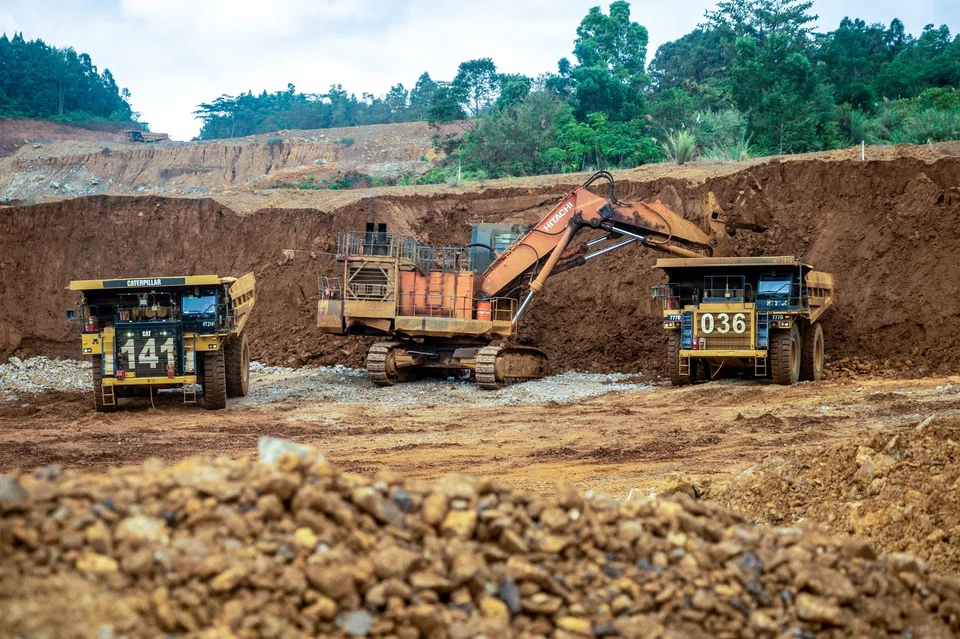
    • Excavators transferring soil to transport trucks at a nickel mine operated by nickel mining company Vale Indonesia in Sorowako on July 28, 2023. Government-backed Vale Indonesia aims to raise production to up to 70,800 tonnes.
    • Excavators transferring soil to transport trucks at a nickel mine operated by nickel mining company Vale Indonesia in Sorowako on July 28, 2023. Government-backed Vale Indonesia aims to raise production to up to 70,800 tonnes. PHOTO: BT FILE

    INDONESIA’S cash-rich giant nickel miners seem intent on raising output this year, even as the massive supply from the South-east Asian nation has suppressed the metal’s prices.

    Harita Nickel, one of Indonesia’s largest nickel producers, is armed with cash after it went public last year, and is intent on ramping up output.

    “We remain consistent in our expansion efforts, staying focused on completing the second factory, including the smelter, to increase production,” Harita Nickel’s president-director Roy Arman Arfandy said recently at a business forum in Jakarta.

    With reserves totalling around 108.4 million wet tonnes of nickel, Harita, which operates on Obi Island in Indonesia’s North Maluku province, aims to double its mixed hydroxide precipitate (MHP) nickel production to 120,000 tonnes this year. MHP is an intermediate nickel product derived from laterite nickel ore and is commonly utilised in the production of metal batteries for electric vehicles (EVs) .

    Towards this end, the company is set to proceed with the construction of a second smelter factory producing ferronickel this year, which costs 50 trillion rupiah (S$4.25 billion).

    Government-backed Vale Indonesia, a major nickel producer in the country, aims to raise production to up to 70,800 tonnes. This comes hot on the heels of the Indonesian government’s acquisition of a 14 per cent stake in the miner from Vale Canada and Sumitomo Metal Mining for US$275 million last month.

    Through mining holding company Mineral Industry Indonesia, the government now holds a 34 per cent stake in Vale Indonesia, to drive efforts to accelerate the country’s downstreaming policy.

    The prolonged slump in the price of nickel – a key component of EV batteries – is hurting producers.

    Vale Indonesia’s communications head Bayu Aji told The Business Times that the company continues to look for ways to cut costs as it waits for prices to rebound. If push comes to shove, it is also prepared to make more cuts.

    “Vale will work to improve matters that are within our control, such as streamlining the company’s operational cost,” he said.

    He added that the company is optimistic about the nickel market resetting later this year as supply and demand rebalance and result in higher prices.

    Last year, the company produced approximately 70,000 tonnes of nickel matte, an intermediate product in metallurgical processes with a nickel content varying between 30 per cent and 60 per cent.

    The downturn in the global nickel market is primarily attributed to an oversupply of nickel. Part of the reason is overzealous Indonesian miners cranking up output. The commodity is presently hovering around US$16,000 per tonne.

    Nickel prices on the London Metal Exchange (LME) have nearly halved in the last year, leading mining operations outside Indonesia to shut down.

    By and large, Indonesian producers trade against Shanghai’s lower-grade nickel pig iron benchmark for stainless steel production. Therefore, they are inherently less sensitive to the key LME prices that affect class-1 primary nickel, said associate director at S&P Global Ratings Minh Hoang.

    S&P projects the nickel oversupply persisting beyond 2025, with Indonesia expected to add 300,000 tonnes of capacity in 2024 alone.

    Indonesia’s ambition to create the value-add from its nickel resources over the past years has helped boost its global market share of nickel output to about 53 per cent last year, up from about 34 per cent in 2019, noted S&P Market Intelligence.

    Over the same period, Indonesia’s refined nickel market share rose to 41 per cent from 16 per cent, contributing to a 45 per cent fall in the global price of nickel in the past year.

    S&P projects nickel oversupply persisting beyond 2025, with Indonesia expected to add 300,000 tonnes of capacity in 2024 alone. In the meantime, demand remains susceptible to China’s reduced appetite for steel and slower growth in the production of EV batteries.

    Belt-tightening

    On the other hand, prolonged lower nickel prices have pushed medium-scale miners to the edge in order to preserve cash, said Meidy Katrin Lengkey, the secretary-general of the Indonesia Nickel Miners Association.

    Some medium-sized companies, with an annual production of below 20,000 tonnes, are currently focused on tightening their belts as they wait for the nickel market to correct.

    “We are worried that if it falls below US$15,000, we will be in real trouble and cannot cover our production expenses,” she told The Business Times.

    The association has proposed several recommendations to the government to prevent further corrections in nickel prices. One of the suggestions is urging the government to halt or impose a moratorium on the construction of new nickel smelters.

    “Let’s support the existing smelters so that our reserves won’t be depleted,” she said.