

Washington vs TikTok: Wide bipartisan push against Chinese ownership
LAST week’s overwhelming vote on Capitol Hill – 352 to 65, reflecting broad bipartisan support – to approve a Bill that would ban TikTok, the popular video-sharing platform, from US devices unless it gave up its Chinese ownership, was expected, if slow in coming.
The Bill – introduced by Wisconsin Republican Mike Gallagher and Illinois Democrat Raja Krishnamoorthi, and endorsed by Biden administration officials – would ban TikTok from app stores and web-hosting services in the United Services if the company doesn’t divest from its Chinese owner, ByteDance. The legislation allows the US president to prohibit social media apps that are controlled by “a foreign adversary”.
The message from Washington, including Congress and the White House, to TikTok was simple: Cut your ties with Beijing, or break up with the US.
“TikTok cannot continue to operate in the United States under the current ownership structure,” said Representative Gallagher last week after the Bill was approved in the House. The White House has made clear that President Joe Biden would sign the legislation if and when it reached his desk.
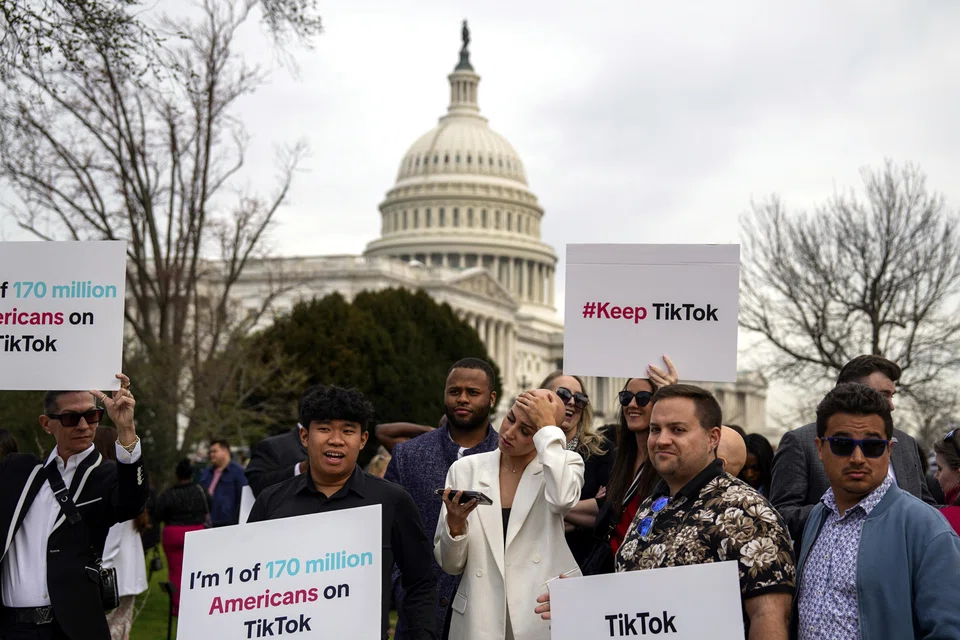
Ironically, it was the site’s popularity – with some 170 million Americans using TikTok, which has become a key source of news and online searches – that may have convinced America’s political leaders of the need to mitigate the national security and other risks of what is basically a popular social media app.
But seen from Washington, it is a powerful tool placed in the hands of a company with ties to a government that’s regarded as America’s leading global rival.
More specifically, American critics of TikTok have been worried – and those concerns are shared by FBI and CIA officials – that its Chinese-controlled parents would share data about US users with the Chinese government and could be pressed to advance Beijing’s agenda, and that the Chinese government would use the platform for cyber-espionage and political influence campaigns in the US.
Moreover, there are restrictions on foreign ownership of media such as media and television stations. Hence in the same way that Australian Rupert Murdoch had to become an American citizen before buying Fox Corporation, TikTok has to give up its Chinese ownership if it wants to operate in the US.
The company’s executives have denied that they would comply with the Chinese government’s demands. TikTok’s chief executive Shou Zi Chew has decried the outcome of the vote as “very disappointing”, and the company vowed to challenge it in the courts if it becomes law, contending that it is unconstitutional.
But at a time of growing tensions between Washington and Beijing on national security as well as economic issues, ByteDance’s contentions have been treated with scepticism by officials and lawmakers who were not in the mood to trust promises made by Beijing and its subsidiaries.
President Donald Trump tried in 2020 to force ByteDance to divest TikTok, warning that TikTok could funnel users’ personal information to the Chinese Communist Party, “potentially allowing China to track the locations of Federal employees and contractors, build dossiers of personal information for blackmail, and conduct corporate espionage”. But his executive order was blocked in court which insisted that the White House lacked authority from Congress to proceed with the action.
The company responded to the pressure from Washington by launching a massive public relations campaign and by insisting that restricting its operations violated free speech.
Indeed, when the State of Montana tried to ban TikTok, the company won an injunction temporarily blocking the state law, with a federal judge saying that it violated the First Amendment.
The company also says that there may be technical problems in separating the US part of TikTok through a sale or divestment.
But a powerful bipartisan alliance of critics of China has been busy marshalling public and Congressional support for banning TikTok. They have argued that posts criticising Chinese policies in Xinjiang and Hong Kong were suppressed on TikTok and that the site also promoted content that is critical of the US and has tried to sow political discord among Americans – allegations that were refuted by the company.
In that context, the position of TikTok’s critics’ in the debate was strengthened in the aftermath last year’s Oct 7 attack by Hamas on Israel, when researchers found more views on the site with pro-Palestinian hashtags than those in support of Israel.
While the company has stressed that it doesn’t promote one side in the issue over the other, the site was accused of being “pro-Hamas” and was lambasted last year after videos promoting Osama bin Laden’s 2002 “letter to America” went viral on TikTok.
The criticism directed at TikTok has been that its algorithms are managed by Chinese engineers, which may explain why posts critical of America go viral on the platform, while those that are critical of the Chinese government get relatively fewer views.
The House Bill passed on Wednesday (Mar 13) now heads to the Senate where its fate remains unclear. Senate majority leader Chuck Schumer, a Democrat from New York, declined to say whether he would bring the legislation to a vote.
The chair of the Senate commerce committee, Maria Cantwell, a Democrat from Washington, doesn’t support the Bill and is likely to demand changes or hold it.
Critics of the Bill – who include Representative Alexandria Ocasio-Cortez, a Democrat from New York – argue that it restricts the access of Americans to information, and that the legislation was rushed through the House.
Young “influencers” and “creators” who appear on TikTok have also been campaigning in support of the company, alleging that it is being persecuted by old white boomers in Washington who are trying to ban an app that is popular especially among members of Generation Z.
And former President Trump, who tried to ban the app four years ago, now says that he is opposed to the proposed legislation. He argues that banning TikTok would help Meta, the owner of Facebook which he has bashed as the “true enemy of the people”. Some argue that one of the reasons Trump reversed his position is that he is more popular on TikTok than President Biden, which just goes to demonstrate the power of the popular app.






