

Seeking relevance in a shrinking asset management sandbox
Clients will require a sensible amount of transparency, compliance, as well as some form of Uber-nisation of the investment platform.

THE asset management industry has not been exempted from the doom and gloom surrounding the financial services industry. The same forces that have made the sell-side's fees shrink, regulatory scrutiny increase, traditional sources of alpha more elusive, and various lines of business encroached by disruptive technology, have been affecting the buy-side industry as well.
But before we collectively throw in the towel and get out of town, it is perhaps instructive to take stock of how we got here and what the future holds for our once august industry.
The business of managing other people's money professionally and prudently goes back over a century. Today, the size of financial assets under management - some estimates place it at over US$70 trillion globally, which at an average total expense ratio of 100 basis points yields US$700 billion in fees - makes it one of the most important sectors of the global economy. Depending on what time of day you measure its market capitalisation, Greater China's equity capital market, for instance, is worth close to 20 per cent of that, while the world's top 10 asset managers manage over 25 per cent of that.
Asset managers (or their contractors) promise to not just take good care of the middle- and back-office functions like fund administration, accounting and supervision. More importantly, they also promise to either add value to the invested portfolios - academically known as risk-adjusted alpha - or in some cases, simply preserve the real value of the portfolios.
But how did such a simple job description, albeit one that requires good investments and risk management skills, get into so much complexities, hubris and trouble?
Like any other industry with a profit-making motive, the investment management industry has not been immune from evils: Greed (think late trading and market timing activities), Fraud (think Madoff); Tail risks and their mis-management (think Goldman's Global Alpha or JP Morgan's London Whale), and Overconfidence (think Bear Stearns' High-Grade Structured Credit Strategies Enhanced Leverage Fund's confidence in subprime, which caused this mouthful of a structured strategy to structurally collapse).
It is thus not surprising that the asset management industry has become more regulated, cautious, volatile, unprosperous and generally woeful, especially after the global financial crisis.
Some have even gone to the extent of saying it is a sunset industry with exchange traded funds (ETFs), online retail investing platforms like Nutmeg and Yu'e Bao, as well as automated robo-advisors and FinTech now taking over the business of managing assets.
But before writing its obituary, let's revisit a jargon that the industry has been famous for coining - the "core-satellite approach" to investing, which also makes eminent sense in describing the asset management industry.
The core-satellite approach is a strategy of constructing an investment portfolio to minimise costs, tax liability and volatility while providing an opportunity to outperform the broad stock market as a whole.
The "core" incorporates traditional fixed-income and equity-based securities such as index funds or ETFs, thus providing a low-cost and diversified portfolio, while the "satellite" is all the other high-octane, higher-fee, active management stuff.
Like Zeus of Greek mythology, the core-satellite approach rules over other jargons like strategic beta, smart beta and no beta (aka market neutrality), or asset allocation, target date and lifecycle funds, or portable alpha and cash equitisation strategies.
It is clear that the investment world has already evolved - or will soon evolve - into a core-satellite, bifurcated investment management galaxy. Consider the core-satellite investing approach's primary attributes:
SIZE IS KING
Cerulli Associates once presciently declared that trillion-dollar asset managers will rule global assets. Indeed, Cerulli reported in 2013 that the world's 50 largest asset managers accounted for more than US$38 trillion of assets under management.
Large low-cost fund managers who provide core investing services and have built global brands such as BlackRock, State Street Global Advisors and Vanguard will eventually dominate this space.
Economies of scale are critical to surviving within this core investing sleeve where products are of the plain vanilla variety. As for intermediaries like robo-advisors, traditional financial advisors, market timers, or tactical asset allocators, they can package and offer more complex products off the, shall we say, "lower core" shelf.
SKILL IS QUEEN
Satellite investing is the part of the portfolio that adds real value (alpha) but at a much higher cost.
Boutique fund managers, hedge funds and others with the skill and foresight to take advantage of opportunities in the financial, real and digital economy occupy this space.
Here, super-size is not as important. Rather, a critical mass of assets, a good long-term track record and the ubiquitous brand are important attributes.
PROCESS IS THE CROWN PRINCE
Be it core or satellite, a systematic and disciplined process for investment and risk management is key to long-term success. Clients will also require a sensible amount of transparency, compliance to internal and external requirements, as well as some form of Uber-nisation of the investment platform, to borrow the name of the app-based taxi service that is up-ending the industry.
In summary, while jobs and compensation in the investment management industry may not be as plentiful as in their glory days, a functional view of the business reveals that it will not change fundamentally from what financial jargon already provides for.
Asset managers who think functionally and who are quick to seize the day, will (continue to) reap the benefits.
TRENDING NOW

He built the Vingroup empire. Now South-east Asia’s richest man is handing some key roles to his sons

Seatrium allocates S$200 million for new share buyback programme
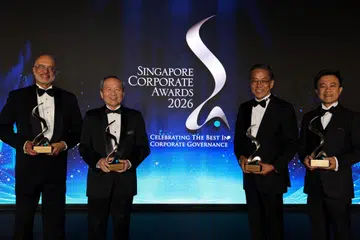
32 companies, 6 individuals bag accolades at Singapore Corporate Awards 2026

Stocks to watch: Mapletree Logistics Trust, Seatrium, Keppel DC Reit, Food Empire

