Reflections at Keppel Bay owner resells unit for S$6.6m higher - just one year on

Seller’s stamp duty for properties held up to a year is typically 12%; and 8% if held for over a year but up to two years.

Nisha Ramchandani
Published Mon, Oct 24, 2022 · 05:50 AM
    • For 2022 as a whole, Cushman & Wakefield expects the proportion of loss-making deals in the resale market to remain relatively low owing to the tight labour market, which should continue to support holding power for owners.
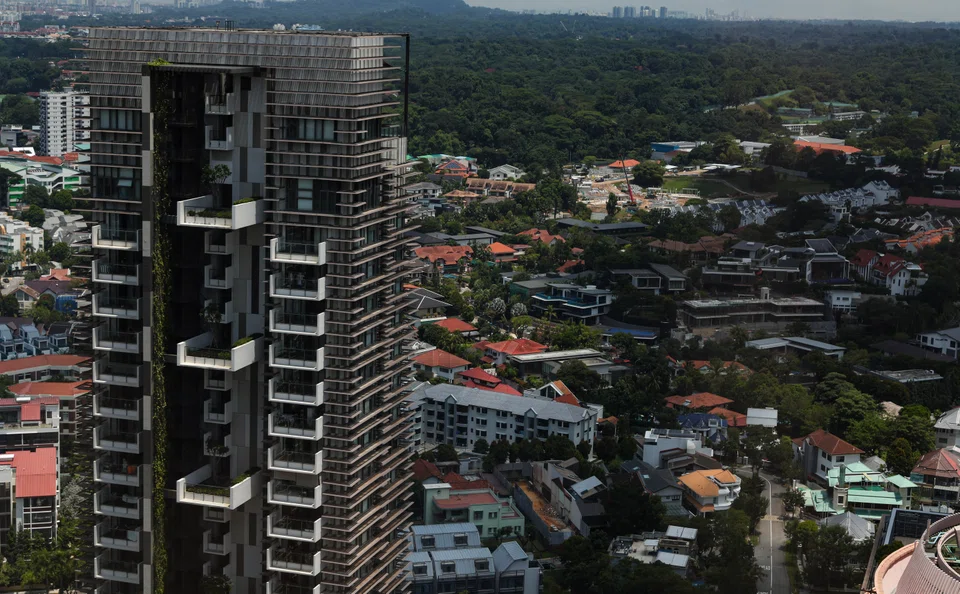
    • For 2022 as a whole, Cushman & Wakefield expects the proportion of loss-making deals in the resale market to remain relatively low owing to the tight labour market, which should continue to support holding power for owners. BT FILE

    THE seller of a 7,050 square foot (sq ft), 40th floor unit at 99-year-leasehold Reflections at Keppel Bay divested the unit for some S$6.6 million more in the space of about a year, making the deal the largest profit-maker by quantum in the secondary market in the third quarter this year.

    However, according to data collated for The Business Times by Cushman & Wakefield, the seller would have to pay seller’s stamp duty (SSD) – which suggests that the actual profit is lower – since the unit was bought for S$11 million (S$1,560 psf) on Sep 10, 2021 and sold for nearly S$17.63 million (S$2,500 psf) on Sep 12 this year. SSD for properties held up to a year is typically 12 per cent; and 8 per cent for properties held for over a year but up to two years.

    Still, at 60 per cent (prior to transaction costs, such as SSD), the annualised profit for the top-floor unit is nothing to sneeze at.


    Real estate consultancy Cushman & Wakefield studied caveats for private, non-landed homes with a prior purchase history that were transacted in Q3 2022 for the period between January 2012 and September 2022. It then ranked the top five profit-making and loss-making deals, both by percentage and by quantum. The analysis did not take into account transaction costs and taxes, such as buyer’s stamp duty and SSD.

    Meanwhile, the biggest profit-maker (by percentage) in Q3 was a 2,723 sq ft, second-floor unit at freehold Jade Mansion at Leedon Road in district 10, which transacted for S$5.08 million (S$1,865 psf) in September – 75 per cent, or S$2.18 million, more than the seller bought it for.

    Given the initial purchase price of S$2.9 million (S$1,065 psf) in March 2018 and the holding period of roughly four-and-a-half years, the annualised profit worked out to 13 per cent.

    Cushman & Wakefield’s head of research, Wong Xian Yang, said: “Notably, this is the first time in 2022 – based on our analysis period – that a property in the Core Central Region (CCR) has come in the top five transactions in terms of percentage profit. This suggests that there could be value-unlocking opportunities within the CCR market, especially as the price gap between CCR and other market segments, the Rest of Central Region (RCR) and Outside Central Region (OCR), narrows.”

    Turning to loss-making deals, a 60th floor unit at 99-year-leasehold Marina Bay Suites emerged as the biggest loss-making transaction both by quantum and percentage in Q3. The 2,691 sq ft unit in district 1 was acquired for S$8.25 million (S$3,066 psf) in December 2013, and sold for S$5 million (S$1,858 psf) in August this year, resulting in a loss of 39 per cent, or S$3.25 million. Based on the holding period of a little over eight-and-a-half years, the annualised loss was 5.6 per cent.

    Noticeably, the lion’s share of the loss-making transactions in Q3 were located in the CCR and RCR. “Most of them were purchased in 2012 to 2013, during the peak of the market,” Wong pointed out.

    In addition, to survey market health, Cushman & Wakefield examined the proportion of loss-making deals (in both the landed and non-landed segments), which retreated further from 6.4 per cent in Q2 2022 to 5.3 per cent in Q3 2022 as the residential property market continued to see keen demand.

    “Rising headwinds brought by the high interest rate environment and newly introduced cooling measures could add upward pressure on the proportion of loss-making deals,” Wong cautioned.

    Still, for 2022 as a whole, he expects the share of loss-making deals to remain relatively low owing to the tight labour market, which should continue to support holding power for owners.