Using data to farm fish more efficiently

Paige Lim
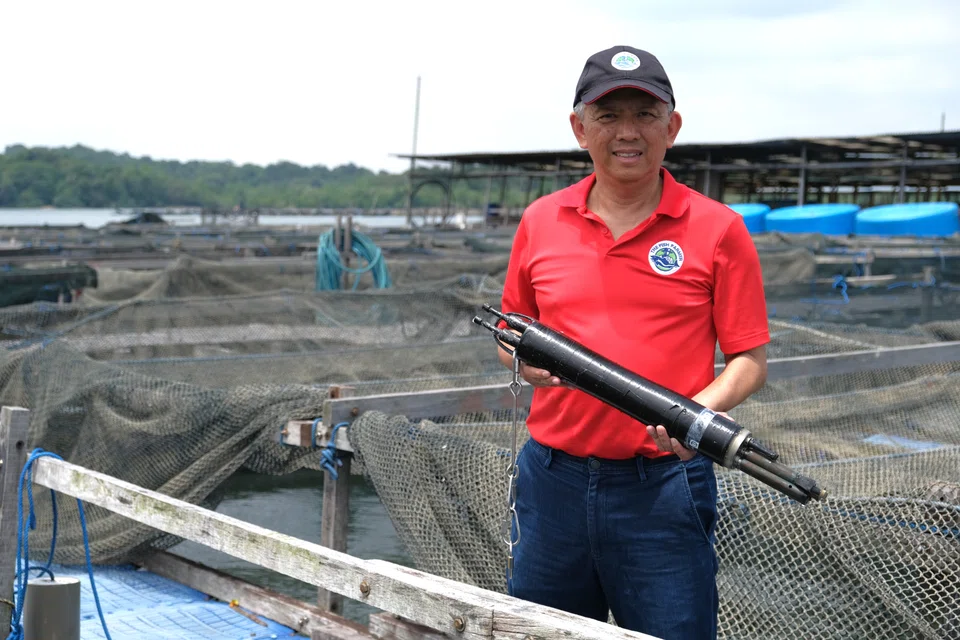
FACED with space constraints and rising costs, home-grown aquaculture company The Fish Farmer is using sensors and artificial intelligence (AI) to farm fish more efficiently.
“It’s very challenging to grow fish in Singapore as there are many competing uses for sea space,” said chief executive and founder Malcolm Ong in an interview with The Business Times.
“So if you have limited space, then you have to think of innovative ways of growing fish using technology.”
Established in 2007, The Fish Farmer operates four farms located in the waters off Changi and Lim Chu Kang. It produces about 1,000 tonnes of fish annually, including species such as milkfish, garoupa, red snapper and barramundi.
The rising costs of fish farming have fuelled the need for productivity improvements, said Ong.
Compared to pre-pandemic times, overall fish farming costs have gone up by about 25 per cent, he said. These include the cost of labour, raw materials, transport, feed and baby fish fry.
Tracking fish inventory accurately
While industries such as manufacturing can turn to automation and robotics to improve productivity, this is out of the question for fish farms based in the sea, said Ong.
“Seawater is very corrosive, so things don’t last. Even if you put in a lot of equipment, something will fail after three months.”
Any form of technology being used on a farm would also need to have low energy consumption and be able to run off a battery or a similar standalone power source, as sea-based farms are not connected to any electricity source, he added.
With these considerations in mind, Ong spent the last decade developing an Internet of Things (IoT) farm management software for The Fish Farmer.
This was done with help from information technology solutions provider Metropolitan Wireless International (MWI) – a separate company which Ong founded in 2009 but does not manage.
The IoT software – which runs on the cloud – is linked to physical sensors located in his four farms. The sensors run on solar power and thus do not need to be connected to the power grid.
Each sensor monitors different aspects of the farm environment, from the water quality in the tanks of live fish to the temperature of cold rooms and chiller facilities where harvested fish are stored.
Real-time data captured by these sensors is fed back to a central digital dashboard, giving farm employees a comprehensive overview of the conditions in each farm at any given point in time.
“Our earlier versions only contained basic functions. We’ve had to redesign the software to add on new applications along the way,” said Ong.
For instance, Ong recently worked with MWI to create an AI-based fish counting application that would allow The Fish Farmer to track its fish inventory across its farms.
Previously, Ong’s employees had to pull up nets of fish and manually count them – a process that was not only time-consuming and labour-intensive, but also prone to human error.
This often led to inaccurate estimates of fish stock, said Ong.
“We may think we have 10,000 fish at the start, but it turns out that we only have 7,000, because some fish may escape or die along the way. So we end up communicating the wrong number of fish supplies to our customers.”
With the new AI application, fish counting can now be carried out more frequently and accurately across his farms.
Farm employees merely need to record videos of fish swimming across a net, then upload them to the cloud. The software will analyse the videos and automatically count the number of fish on screen.
The software is also able to measure the length of each fish in uploaded videos, thus helping employees to monitor if the fish are growing well, said Ong.
Keeping tabs on water conditions
Ong has also worked with MWI to develop an improved water quality monitoring sensor.
The previous version of the sensor, rolled out in 2014, could only measure dissolved oxygen levels in the water.
Last December, the sensor was upgraded to include more parameters, such as acidity and turbidity levels, oxidation reduction potential, barometric pressure and water temperature.
Farm employees are now alerted whenever the sensor detects any changes in water conditions, allowing them to quickly take action to save the fish, said Ong.
This has allowed the Fish Farmer to significantly reduce incidents where its fish stocks were depleted due to adverse water conditions. Such wipe-outs used to occur at least six to seven times a year.
“By collecting the right data, we can manage our farms better and reduce farming risk. The data coming in allows us to react a lot faster to any problems that arise,” he added.
These technologies have also freed up farm employees’ time for higher-value tasks, said Ong. The Fish Farmer plans to send some workers to take up a diploma in aquaculture management and technology at Temasek Polytechnic, so they can learn more about fish behaviour and water quality.
“Many traditional fish farms have a lot of experience in the trade, but they may not have the know-how to implement the right tech that works for them,” said Ong.
“We’re fortunate to be able to adapt our technology to fit our farm conditions, increasing our production of fish in the process.”
TRENDING NOW
Grab CEO’s wife Chloe Tong on life with Anthony Tan and finding her purpose
HDB reviewing ‘jumbo’ flat scheme after Telok Blangah unit listed for sale at S$2.18m
He built the Vingroup empire. Now South-east Asia’s richest man is handing some key roles to his sons
Singapore judge raises doubts iron ore trader Radiant World is owed US$1 billion