How Australian billionaire ‘iron lady’ Gina Rinehart built a thriving mining empire
Days after turning 70, the chairman of Hancock Prospecting was named by Forbes once again as her country’s richest person

Zhao Yifan
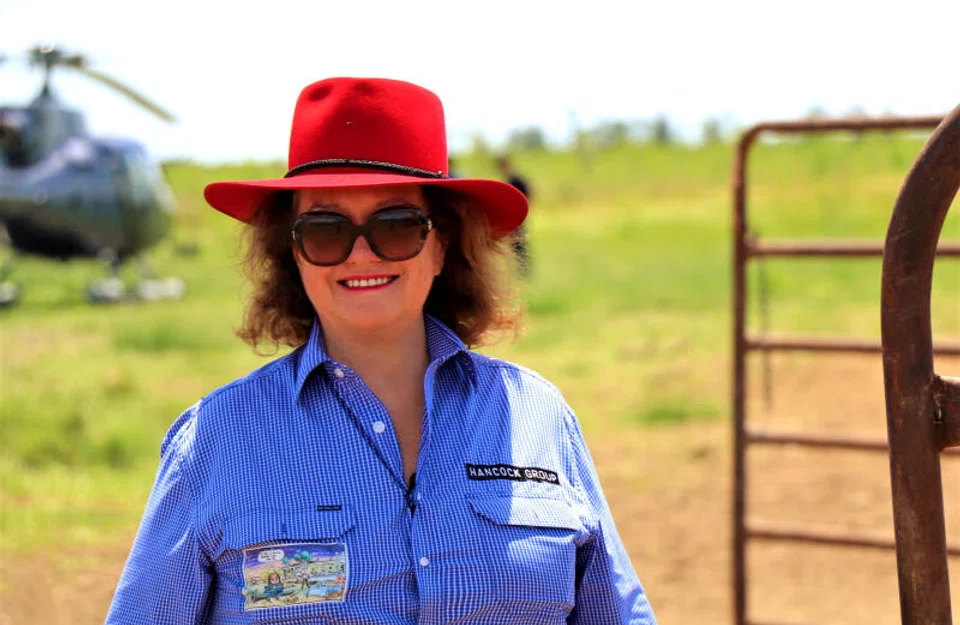
MINING magnate Gina Rinehart, the wealthiest person in Australia, turned 70 earlier this month but she appears far from slowing down.
She remains actively involved as the chairman of her company, Hancock Prospecting, with no obvious successor in sight, and continues to make strides towards her goal of elevating the firm into a lithium empire.
With a net worth of US$30.2 billion – a slight dip from the previous year’s US$30.6 billion – Rinehart once again topped Forbes’ latest list of Australia’s 50 richest people released on Thursday (Feb 15).
Reviving a distressed company
As the only child of iron ore explorer Lang Hancock, Rinehart began her career as her father’s personal assistant.
In 1952, Hancock discovered one of the world’s largest iron-ore deposits in iron-rich soils in Pilbara, a state in the north of Western Australia. He went on to establish Hancock Prospecting in 1955.
His company subsequently entered into a royalty agreement with the British-Australian mining giant Rio Tinto to exploit the Pilbara iron.
After her father’s death in 1992, Rinehart took ownership of Hancock Prospecting and became its executive chairman.
Capitalising on the burgeoning Chinese demand for iron in steelmaking, Rinehart transformed Hancock from a company primarily reliant on iron ore royalties to one directly managing its own mines.
This move proved highly successful, leading Hancock Prospecting to become one of Australia’s biggest iron ore exporters and evolve into a multi-billion dollar conglomerate.



Hancock’s largest asset is the Roy Hill mining project, which started shipments to Asia in 2015. According to Forbes, she has paid off the US$7.2 billion debt that was taken on for this project.
Rinehart “transformed the family business by spotting, earlier than most, the vast potential of the China market,” wrote BBC journalist Nick Bryant in his book The Rise and Fall of Australia: How a great nation lost its way
The company grew further by diversifying its interests through both domestic and international collaborations and entered the agricultural business with beef and dairy production. It is also engaged in exploration for various minerals, most notably coal.
Rinehart has also diversified her holdings in the early 2010s with purchase of shares in media companies, including Australia’s Fairfax Media and Ten Network Holdings.
Partly due to a boom in commodity prices, Rinehart’s fortune doubled between 2010 and 2011.
In February 2011, Forbes magazine named her Australia’s wealthiest person, marking the first time a woman had held that position. She has remained among the top ranks on the annual list ever since.
Advocating against red tape
Beyond wealth, the Australian “iron lady” is also known for her pro-business activism on issues such as taxation and government regulation.
She has publicly expressed concerns that excessive regulation and taxation, imposed in the name of environmental protection, are adding a toll on the resource sector and could harm Australia’s economic growth.
In 2010, she strongly opposed and even joined street protests against the government’s proposed Resource Super Profits Tax to be imposed on the mining industry.
Despite being seen as media-shy and rarely giving interviews, Rinehart’s political connections span the globe.
Well-known as a supporter of former US president Donald Trump, she has been spotted among Trump’s inner circle at some events held at his resort in Florida.
She also met privately with Indian Prime Minister Narendra Modi during his visit to Australia in May 2023, praising his efforts to reduce governmental restrictions and promote economic growth.
Ambition for a lithium empire
As the growth of the mining industry is curtailed by environmental concerns, Rinehart has been busy expanding Hancock Prospecting’s interests in lithium, a crucial metal in electric vehicle batteries and a key player in the world’s electrification transition.
Australia, the world’s top producer of lithium, continues to play a significant role in the global race to establish dominance in the lithium market.
Last December, Rinehart and Chile’s SQM, the world’s second-largest lithium producer, agreed to jointly acquire Western Australian lithium hopeful Azure Minerals for A$1.7 billion (S$1.5 billion).
The agreement came after Rinehart’s strategic buildup of an 18 per cent stake in Azure Minerals, which threatened to scupper SQM’s deal.
She has also accumulated a 19.9 per cent strategic stake in another Australian-listed lithium prospect, Liontown, during the time when a US$6.6 billion takeover offer from New York-listed Albemarle was on the table.
Now that Albemarle has abandoned its bid, citing “growing complexities” as the reason, the market awaits Rinehart’s next move in the takeover battle.
Her ability to transform Hancock Prospecting into a serious lithium player, which requires a long-term effort, has been questioned by some observers due to her lack of succession planning.
Rinehart is currently embroiled in legal disputes with two of her four children, Bianca Rinehart and John Hancock, over their family trust. None of her children are currently involved in the running of Hancock.
In September 2023, Hancock Prospecting disclosed that it had US$5.44 billion in trust accounts.
Decoding Asia newsletter: your guide to navigating Asia in a new global order. Sign up here to get Decoding Asia newsletter. Delivered to your inbox. Free.
Copyright SPH Media. All rights reserved.