‘The genie’s out of the bottle’: When AI meets politics
It’s getting harder to discern what’s AI-generated versus what’s real. With major elections happening this year, more needs to be done to fight AI misuse.

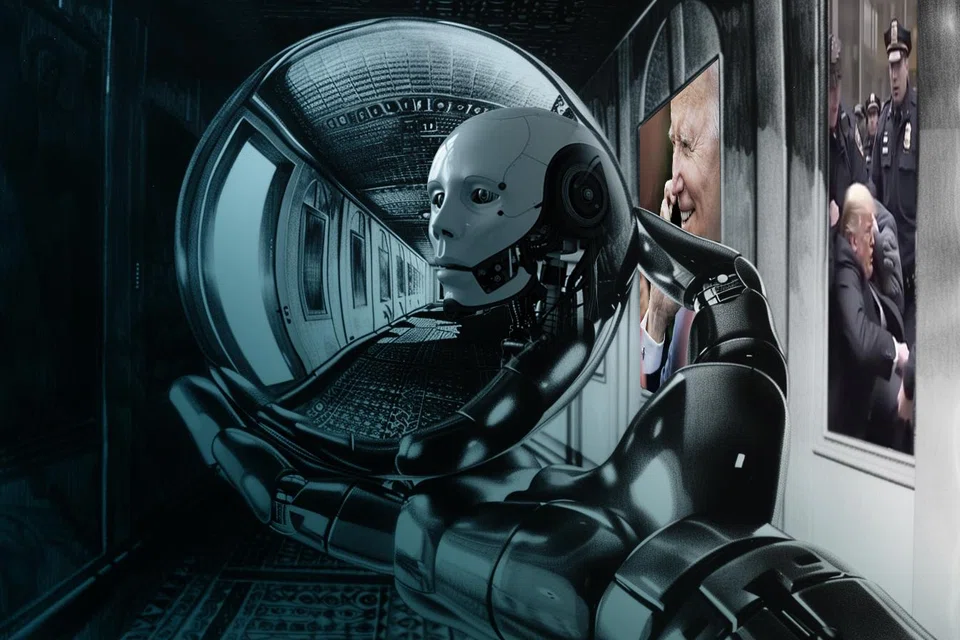
IN January this year, a robocall using US President Joe Biden’s voice told New Hampshire residents to “save their vote” for the presidential elections at the end of the year. It implied that residents could vote only in the primary or the presidential elections, although they can vote in both.
It was later revealed that political consultant Steve Kramer had commissioned the robocall for US$500 while working for a rival candidate. He said that he did so to raise awareness about the dangers of artificial intelligence (AI) in politics. The US government has since banned robocalls that use AI-generated voices.
Today, it is much more difficult to pick out the tell-tale signs of AI-generated content, and such technologies could be used to mislead and disenfranchise voters in an unprecedented way.
With a record number of elections taking place this year, it is now more critical than ever for governments to address this issue head-on – or face the consequences.
Rising dangers
Eugene Tan, an associate professor of law at Singapore Management University (SMU), says that when people talk about voter disenfranchisement, they typically think of situations where voters are not able to exercise their right to vote, or live too far away from polling stations to do so.
“(In this case), we’re talking about disenfranchisement in the sense that voters are effectively denied choices as a result of AI manipulation,” he says, adding that such actions have the potential to compromise the democratic process.
National University of Singapore (NUS) Professor Hahn Jungpil says that, as with other technological developments in the past, AI is a tool that can be wielded for both good and bad.
While it can democratise the use of computer-generated imagery for educational purposes, it can also lower the barriers to entry for creating convincing misinformation.
AI has come a long way since its humble beginnings. While most people would have at least heard of ChatGPT, which led to a watershed moment for AI adoption when it launched in November 2022, there were many such developments brewing in the background – only they were not quite good enough yet to make it into the mainstream.
For example, in September that year, Meta (formerly known as Facebook) unveiled a new AI system called Make-A-Video. It did what its name suggested, generating videos with tech prompts.
But the quality left a lot to be desired. A video of a young couple walking through rain had their shoulders stuck together and warping in a disconcerting way, with their white plastic umbrella wobbling like rice paper. Of course, things have changed drastically since then – to the point where it might not be clear to the casual observer which are real and which are AI-generated.
A video generated by Meta’s Make-A-Video AI system in September 2022.
A video generated by OpenAI’s text-to-video model, Sora, in February 2024.
This is certainly not limited to the political realm. In January this year, a multinational company lost HK$200 million (S$34 million) after its Hong Kong staff were scammed.
In one incident, an employee was invited to a group video conference call and ordered to transfer money to the scammers. Everyone on the call, including the UK-based chief financial officer, was digitally recreated with deepfake technology.
“With video-editing technologies before generative AI, it was probably much more difficult and costly to produce deepfakes,” says Prof Hahn.
“Now, that technology has got to a point where it’s much cheaper to create loads of (them), and to create customised, very personalised versions of deepfakes.”
Ernst & Young Advisory consulting partner Ritin Mathur notes that this is a challenge for regulators as they seek to manage the harms of AI.
“The dilemma is, how do you balance the innovation potential and the beneficial aspects of the technology with the risk aspect of it?” he says.
Countering tech with tech
If the harms are clear but the medium has changed, how can regulations keep up and who should be held responsible for them?
In certain cases, companies have stepped in with safeguards to prevent the misuse of software for nefarious purposes.
For instance, Adobe Photoshop prevents customers from opening detailed images of banknotes as part of its counterfeit-deterrence system.
Similarly, companies that run generative-AI services have tried to prevent their use in specific situations.
In November 2022, AI startup Stability AI updated its image generator, Stable Diffusion, to kneecap its ability to generate not-safe-for-work content, as well as pictures in the style of specific artists.

However, these AI models are “black boxes”, meaning that it is not always possible to understand how they work, or stop them from malfunctioning. Users can still alter their prompts to trick generators into producing certain content.
In January this year, some users of Microsoft’s Designer AI image generator sidestepped the software’s safeguards to produce sexually explicit images of celebrities such as Taylor Swift.
Within 17 hours, one such photo of Swift gained more than 45 million views on the site. The account that published the photo was suspended, and the loophole was closed only days later.
Ben Chester Cheong, a Singapore University of Social Sciences law lecturer, says that the opacity of AI algorithms makes it difficult to understand how they work.
“This ‘black-box’ effect hinders efforts to ensure fairness and accountability, leaving room for potential discrimination and unintended consequences,” he says.
NUS’ Prof Hahn notes that to combat AI-generated misinformation, watermarking technology is being actively researched.
Such technology could be used to add invisible watermarks to AI-generated content that could be “seen” by special software.
Still, he says, it may not be effective to legislate for such an approach since there are open-source AI models that individuals can run independently. By altering the source codes, individuals can prevent their content from being watermarked.
“Going after companies is much easier than going after every individual, but because of all the open-source software that’s already out there… the genie’s out of the bottle,” he adds.
In certain jurisdictions, there are already laws in place to address online falsehoods or “fake news”.
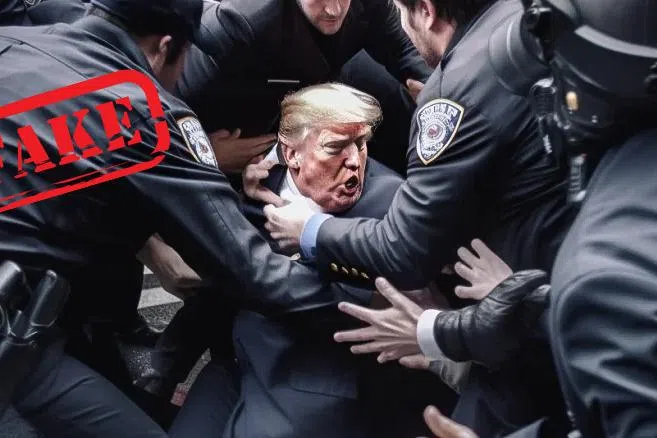
In what was considered Europe’s first attempt at addressing this problem in 2018, France empowered judges to order the immediate removal of online falsehoods during election campaigns. Critics argued that the law could be used to censor the press.
South Korea also attempted to pass a Bill to address online falsehoods in 2021. It would have required media outlets, including Internet news service providers, to issue corrections for erroneous reports. It would also have raised the amount that courts could order for the publication of false or fabricated reports.
However, it was scuppered after critics said that the law could be used to stifle critical coverage by the press.
SMU’s Prof Tan believes that the onus should be placed on social media platforms to detect and take down harmful deepfakes.
“I see them really as the starting point because they are ultimately the vehicle by which these falsehoods are being circulated,” he says.
Because misinformation can be created at a faster rate than governments can detect them, he believes that social media platforms should be made to filter such content out in a timely manner.
That said, he notes that it will cost these companies additional resources to detect AI misinformation.
“They will take the view that ‘if no one else is doing it, why should we be doing it?’” he says.

Prof Hahn points out that another way to deal with deepfakes is to use deep-learning models to proactively analyse and detect how users behave when they encounter misinformation posted on social media sites.
“We can find behavioural cues (through which) we can infer that this is fake content. It doesn’t have to be somebody explicitly reporting or saying: ‘Oh, this might be fake’,” he says, adding that this could be an easier solution than watermarking all AI-generated content.
How to legislate
During the Ministry for Communications and Information’s Committee of Supply debate in March, Minister Josephine Teo said the government took a strong stance against AI-generated content.
“Targeted legislation to deal with them swiftly is thus one pillar in this infrastructure,” she said.
“This includes the Protection from Online Falsehoods and Manipulation Act (Pofma), which enables us to issue corrections and label AI-generated misinformation with the correct facts. We can also consider disabling directions if the content poses serious harm to public interest.”
While Pofma can help combat AI-generated misinformation, Prof Tan says that damage could already be done if the content remains online for even a day, adding that laws are insufficient at the moment.
“We are always playing catch up,” he notes.
But on a more positive note, Bain & Company partner Mohan Jayaraman says that while Singapore is a small jurisdiction, it has taken a very progressive view on technology.
To balance the pros and cons of AI, the nation also works closely with companies to develop AI governance frameworks.
An example of this is the Fairness, Ethics, Accountability, Transparency Principles developed by the Monetary Authority of Singapore in collaboration with other governing bodies, such as the Personal Data Protection Commission as well as financial institutions.
The fairness principle ensures that certain segments or individuals in society are not systematically disadvantaged through AI and data-analytics-driven decisions, unless those decisions can be justified.
“It wasn’t just regulation. It was put together as a set of tools that was also provided for people to support them to manage the regulation,” says Mohan.
“I think Singapore has found very good ways of making sure that risks are controlled but in line with… industry participation.”
Director of law firm Covenant Chambers Khelvin Xu says that one approach to legislation could be taking on guidance from bodies such as the European Union, which is currently working on an AI Act.
“The benefit of this… is that it is likely to lead to more harmonisation of the Singapore approach with (those) taken by other jurisdictions,” he says, adding that the Republic stands to benefit if AI tools can be used seamlessly locally and in other areas.
Public education
As important as it is to legislate on AI-generated misinformation, Prof Hahn notes that technology could also be used to identify sources of human-generated content that the public can rely on.
“Instead of trying to detect what’s AI-generated, we’re trying to prove what is human-generated,” he says. “Whatever is not signed by a human then is AI, so caveat emptor.”
He adds that without the necessary tools for users to identify real or fake content, it would be irresponsible to place the burden of identifying such information solely on consumers.
“We do need to educate (users), but also make it easier for them to use that knowledge.”
Private-sector media agencies and tech companies have collaborated in open technical standards such as the Coalition for Content Provenance and Authenticity to verify content that is published.
The standards will provide ways to tag content with information about who created it, as well as how, when and where it was created or edited. Such details can then be shown to users to verify that what they are seeing is, in fact, human-generated content.
Companies in the coalition include Adobe, the BBC and public relations company Publicis Groupe.
The Infocomm Media Development Authority also launched the AI Verify Foundation in June last year to develop testing tools for the responsible use of AI.
SMU’s Prof Tan says that while companies and citizens will have a role to play, politicians will also have to be ready to disavow deepfakes, even if they could be beneficial to them.
This is especially since Singapore will have to call for an election before November 2025. Once elections are called, it can be difficult to expect reason to be the dominant mindset among the electorate, he adds.
“We must remember, ultimately, that it is politicians and political parties that perhaps pose the gravest threat to election integrity.
“It cannot be the case that if a particular deepfake undermines your political rivals that you keep quiet about it because it is supposedly favourable to you,” he says.