Positive moves to tackle shortage of Singapore MNCs
Invite-only Scale-up SG programme latest in bid to groom strong external wing that the economy needs
GETTING local companies to venture overseas to build the "external wing" of the Singapore economy is nothing new. But ever since internationalisation was proposed as an economic strategy back in 1993, just how many globally competitive companies have made a name for themselves worldwide, if we exclude government-linked corporations?
Of course, there are some lifestyle and consumer brands that one thinks of, such as Charles & Keith, Tiger Beer, and Jumbo Seafood. But it is nowhere close to the level of having a sizeable pool of home-grown multinationals that are able to compete with the very best on the world stage.
This is a result of legacy issues, as Singapore had initially depended on multinationals (MNCs) to drive its economy while the grooming of promising local enterprises took a backseat. But after almost three decades of talking about growing Singapore's "external wing", there are now glimmers of promise, even as the global environment remains challenging.
For context, the term "external wing" was first introduced way back in 1992 by the late Lee Kuan Yew. Mr Lee warned that Singapore could be falling behind in the regional competition if people are not prepared to leave behind their comfort zones here to venture abroad, as rivals South Korea, Taiwan and Hong Kong already had two "wings" - domestic and external.
This was consistently echoed over the years by various ministers, notably former prime minister Goh Chok Tong. In a landmark National Day Rally speech in 2001, he outlined a new economic strategy of turning Singapore into a hub for the greater South-east Asian region by extending its hinterland to countries and cities within seven hours' flying distance.
Fast forward to today, the novelty of growing globally competitive companies has since dulled.
The question remains: why aren't there more big Singapore MNCs that we can boast about?
After talking to various small and medium-sized enterprises (SMEs) over the years, there are some perennial bugbears that stand in the way.
For one thing, getting the right talent to support the business to expand overseas is a real issue. Many businesses in Singapore remain family-owned, which deters talent from joining as they feel that they will not be able to rise beyond a certain level. To attract talent, companies must be willing to transform not just their businesses models, but their management structure as well.
Many business leaders are also not able to articulate their vision of expansion and why overseas markets are important to their staff. As a result, employees see going to emerging markets as a sign that they are being sidelined. When leaders bemoan the fact that they cannot get the right people to spearhead their strategy of going abroad, it is often because they have not been thoughtful enough about employees' career development paths, and not necessarily because Singaporeans are "soft".
Another issue that companies have often raised is that Singapore businesses often do not "hunt together in packs" abroad, unlike the Japanese or the South Koreans. Without such partnerships, it is hard to get a foot through the door.
Other challenges that businesses face going abroad include a lack of knowledge, networks and funding. It is well known that businesses expanding overseas often need to pay a "tuition fee" - they need to be able to stomach years of losses before they can become profitable.
But challenges are only part of the story - another much-neglected factor behind why there are so few Singapore MNCs today is a certain lack of ambition. In my experience, there are SMEs which are content to maintain the status quo. Without big dreams (and obviously the chops and an ecosystem behind it), it is impossible to grow big.
There is no lack of promising SMEs in Singapore, but an extra push must be given to groom those with the ambition to cross over into the big league, and to finally build that strong external wing that the Singapore economy needs.
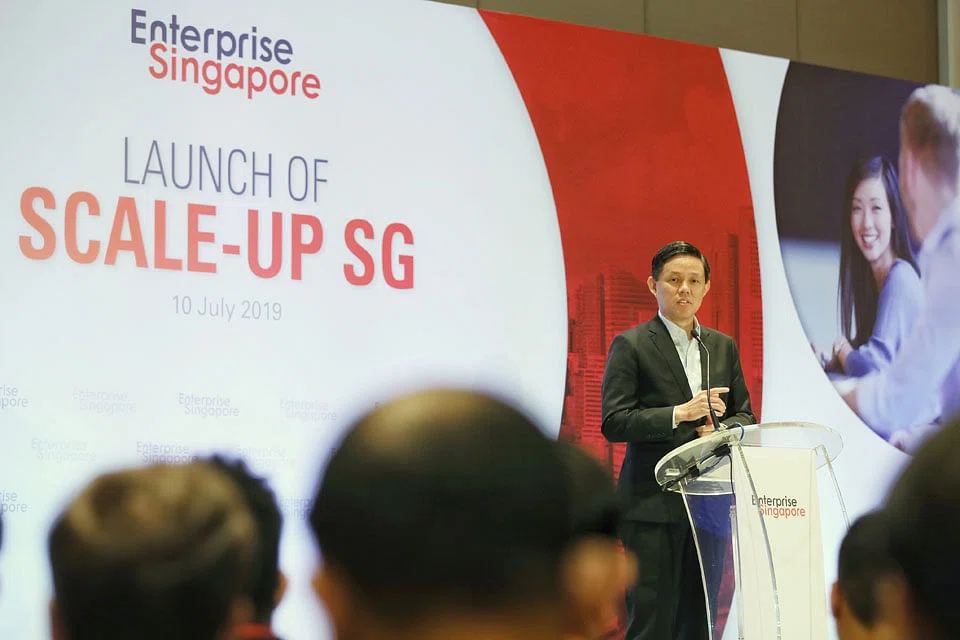
Last week's announcement of Scale-up SG, a 2.5-year programme to groom local high-growth enterprises to become global powerhouses, is a promising sign.
The invite-only programme has two main criteria that stand out - a good track record and the ambition to become big.
The government is placing its bets on high-potentials through a targeted approach, even as traditional broad-based support remains in place for smaller firms trying to get off the ground.
It might be seen as late by some in the industry, but at least we are moving in the right direction. A "spray and pray" strategy is not going to be very useful if you want to grow billion-dollar companies. For example, many business owners opined that it is often easier to grow a business from zero to S$50 million, but the additional step to grow from S$50 million to S$100 million is far more difficult. It is at this critical stage where the government - with its networks, resources and advice - can come in and guide these businesses so that they can continue their growth.
There is hope that the accelerated growth of these businesses will inspire and spur more companies to follow in their footsteps.
Another positive move took place in late 2017, with the merger of IE Singapore and Spring Singapore into a single government agency Enterprise Singapore. This is more than a cosmetic change. By having one touchpoint for businesses, this enterprise-centric approach will definitely make a difference in the long run to build companies that can compete with the best in the world. The government agency has also been ramping up its overseas offices and networks to push more companies to go international from the start.
The challenges ahead are formidable, but Singapore companies are not starting from zero. One huge advantage that companies do have overseas is the Singapore brand, which is associated with trust and reliability.
Amid the US-China trade war and as chatter about a potential recession gets louder, having a group of strong, global companies will matter more than ever as a growth engine for Singapore. The end game is not to have big companies for the sake of it, but to create good jobs and a stable economy. A strong tree with deep roots can withstand the storm far better than a small sapling.
There is a long road ahead to grow this pool of Singapore MNCs, but the wheels are now in motion to make it happen.