

Tech and beverage families go property shopping

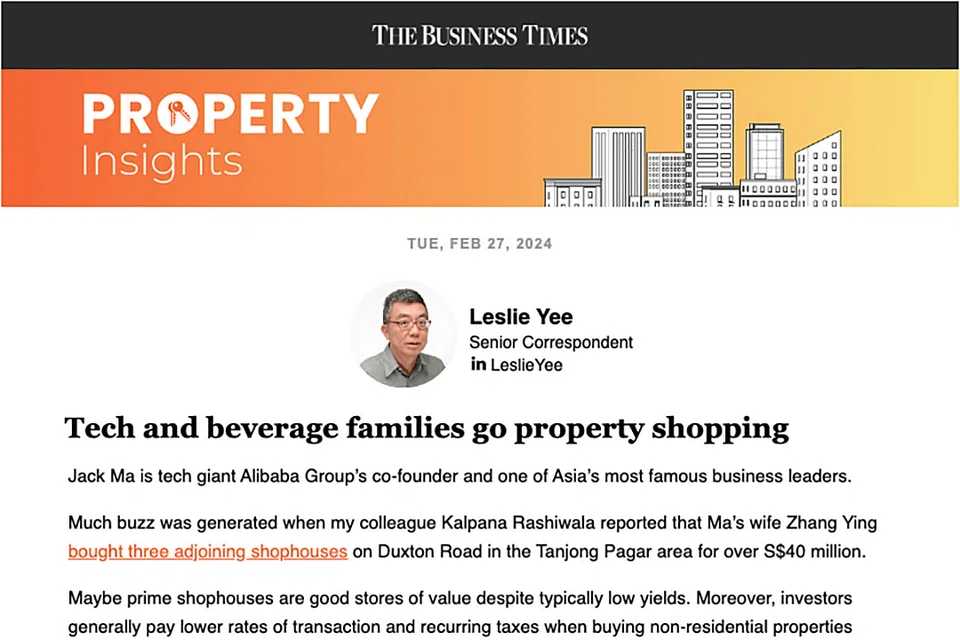
JACK Ma is tech giant Alibaba Group’s co-founder and one of Asia’s most famous business leaders.
Much buzz was generated when my colleague Kalpana Rashiwala reported that Ma’s wife Zhang Ying bought three adjoining shophouses on Duxton Road in the Tanjong Pagar area for over S$40 million.
Maybe prime shophouses are good stores of value despite typically low yields. Moreover, investors generally pay lower rates of transaction and recurring taxes when buying non-residential properties versus homes.
Other wealthy people have also been busy property shopping. Serene Centre, a prime mixed-use development at the corner of Bukit Timah Road and Farrer Road, was sold for S$105 million to the Teo family from Apricot Capital and their partners.
The family is behind Singapore’s three-in-one coffee empire Super Group, which was founded by David Teo.
Property Week
Recently, many insightful property pieces were published as part of BT Property Week 2024. For a week from Feb 21, we published expert views and insights on all sectors of Singapore property.
For many young Singaporeans, the home ownership journey starts with buying a subsidised Build-To-Order (BTO) flat from the Housing and Development Board (HDB). Starting later this year, BTO flats will be classified as Standard, Plus and Prime.
ERA Singapore’s Eugene Lim and Wong Shanting provide advice on what to consider when buying a BTO unit under the new HDB model.
Meanwhile, Ismail Gafoor and Wong Siew Ying of PropNex question if mass-market condo projects are still compelling.
Citing statistics showing a fall in the share of private landed homes bought by buyers with HDB addresses, Mogul.sg’s Nicholas Mak opines that HDB owners may be increasingly shut out of the ultimate upgrade to landed housing.
Outside the housing sector, CBRE’s David McKellar and Goh Jia Ling analyse what drives the decentralisation of office buildings beyond the Central Business District.
JLL Capital Markets’ Richard Bloxam looks at real estate capital flows and highlights the popularity of the logistics and living sectors.
Desmond Sim and Kenneth Wong of Edmund Tie & Company see a generally positive picture of Singapore retail property. Sim and Wong expect well-managed and well-located malls to maintain high levels of occupancy and positive rental reversions through strategic tenant curation and in-mall events.
When Covid-related movement restrictions were in place, many malls here became ghost towns. People wondered if they would recover.
However, visiting malls as a way of life appears to be well and alive for Singapore residents across various age groups. In The Level Ground, I argue that factors such as consumer lifestyles and the planning regime lend support to a positive outlook for strong mall owners in Singapore.
A seminar
Generally, I don’t work on a Saturday. However, last Saturday was a pleasant exception.
I hosted a panel discussion involving PropNex’s Ismail Gafoor, OrangeTee & Tie’s Justin Quek and Savills’ Alan Cheong at the BT Property Outlook 2024 Seminar.
The seminar also provided an opportunity for me to interact with our readers, among whom are people with deep knowledge of and interest in Singapore property.
The panel discussion followed by questions from the audience covered many topics. There was much energy and passion.
My key takeaway was that the housing market for 2024 will see stability.
Meanwhile, against a backdrop of rising home prices, my colleague Ry-Anne Lim reported that data crunched by Cushman & Wakefield showed the total number of deals for non-landed private homes, including executive condominiums, with a holding period of five years or less nearly quadrupled to 2,507 in 2023, from 681 in 2019.
The median profit on sale of non-landed private homes within a five-year holding period grew to S$247,000 in 2023, from S$185,000 the previous year, and S$123,241 in 2019 according to Cushman & Wakefield.
However, some of the fizz appears to be coming off Singapore’s high-flying private housing market.
Condo resale prices fell for the first time in five months in January, while volumes remained muted. Flash data from SRX and 99.co showed that condo resale prices fell 0.8 per cent from the previous month, but were 7.2 per cent higher year on year (yoy).
Mixed results
With high interest rates, the operating environment for property groups is tough.
Recent results by real estate investment trusts (Reits) and other property players show a mixed bag.
Prime US Reit’s distribution per unit (DPU) for H2 2023 fell over 90 per cent yoy, as the manager opted to preserve a substantial proportion of distributable income. In reporting its latest results, the trust’s manager proposed a one-for-10 bonus issue.
Meanwhile, BHG Retail Reit, Cromwell European Reit, IREIT Global, and United Hampshire US Reit saw DPU for H2 2023 fall yoy.
However, Sasseur Reit grew its DPU for its latest quarter while ARA US Hospitality Trust grew its distribution per stapled security for H2 2023.
Real estate services provider APAC Realty posted a 31 per cent yoy drop in net profit for H2 2023 amid a challenging year for the group’s business in Vietnam.
Ho Bee Land posted a net loss for 2023 of S$259 million, versus a net profit in 2022. The group was hit hard by decline in valuation of investment properties in London, UK.
However, Singapore Land Group reported a 7 per cent yoy rise in net profit for H2 2023. The group’s board of directors proposed a higher dividend for 2023 versus that paid for 2022.
While periodic results of property groups can fluctuate, property investment is possibly something well suited for those with long time horizons.
A young real estate leader, Emilia Teo, who co-founded TE Capital with her brother Terence, tells my colleague Jessie Lim that the group is here for the long term.
TE Capital manages or owns properties in Singapore, Japan, Australia and the US. The Teo siblings are third-generation family members of Tong Eng Group, one of Singapore’s oldest property developers.
Looking beyond Singapore, China’s key real estate sector continues to be in choppy waters. Official data showed China’s January new home prices fell for the seventh straight month, even as policymakers stepped up support to restore confidence in the debt-ridden sector.
Meanwhile, the news was mixed in the US where existing home sales rose to a five-month high in January, while sales of new US single-family homes rose less than expected in January, likely curbed by frigid weather.
TRENDING NOW
32 companies, 6 individuals bag accolades at Singapore Corporate Awards 2026

He built the Vingroup empire. Now South-east Asia’s richest man is handing some key roles to his sons
URA to review guidelines on floor space to give developers more design flexibility: Chee Hong Tat
Chagee, Mixue and Luckin won the market. Sustaining their edge is the harder part

