

BYD takes different route from Tesla by partnering for regional expansion, looking at plug-in hybrids

IN ITS South-east Asia push, China electric vehicle (EV) giant BYD is taking the opposite approach from its biggest rival Tesla, signing many franchise dealers in contrast to Tesla’s direct-sales model.
Liu Xueliang, general manager for Asia-Pacific sales for BYD Auto, said in an interview with The Business Times: “We choose dealers because with electric cars, there are still many consumers who are sceptical about the product itself. “Through dealers, we still want to be able to reassure customers face to face,” he said in Mandarin.
As it scales up in the region, BYD may also offer not just EVs, but plug-in hybrids (PHEVs) as well, although these vehicles are pricier than conventional petrol-electric hybrids and thus have not sold as widely.
BYD and Tesla are by far the top sellers of EVs. In 2023, Tesla took pole position for global EV sales with 1.8 million, closely followed by BYD’s 1.6 million. Coming in at a distant third place was Volkswagen with 771,100.
In the last quarter of 2023, BYD outpaced Tesla with a record 526,000 EVs sold, compared to Tesla’s 484,500.
Art of the deal
Tesla handles its own distribution and retail sales. This is in contrast to the traditional franchise dealership model, under which car brands appoint a distributor who sells cars to dealers, who in turn sell them to customers.
BYD doubles down on the traditional model by appointing more dealers than the industry norm, to give itself a larger retail presence than other car brands.
It is aggressively expanding its dealership network in the Asia-Pacific. In Singapore, for instance, it has three dealers for its passenger EVs: Motor-East, EightX and Vantage Automotive. By the end of March, it will add another, Harmony Auto. These four dealers will have seven retail locations among them. Most car brands only have one dealer in Singapore, and two or three retail locations at most. In Hong Kong, BYD has 11 retail outlets; its closest competitors have only around seven, said Liu.
The traditional method of automotive retail “is also the most intimate”, he said. Physical presence and good service can help win over potential customers who may be sceptical about EVs.
BYD will continue this strategy in the Asia-Pacific, with plans to increase its Japan and Thailand retail outlets to 100 and 300 respectively, by the end of 2025. In the next 18 months, it will also open another 30 outlets in Australia, adding to the existing 28.
Amping up
In another contrast to Tesla, which sets up its own Supercharger network in markets that it enters, BYD’s strategy for EV charging is also dependent on partners.
On Friday (Mar 15), BYD Singapore signed an agreement with five charge point operators (CPOs) in Singapore – Charge+, ComfortDelGro -owned CDG ENGIE, Shell Singapore, SP Group, Keppel -owned Volt Singapore – to provide preferential rates for BYD owners.
The charging networks of these CPOs are already accessible to the public. However, BYD owners whose cars are registered this year will be able to select one CPO and get a discount of up to 20 per cent when charging with that operator.
BYD is also laying the groundwork in other areas for its regional EV push.
To meet the big potential demand that it sees in South-east Asia, it has two factories in the works. One is a US$500 million factory in Thailand, set to begin production this year and produce 150,000 vehicles a year; the other, announced in January, is a US$1.3 billion factory in Indonesia with a similar output. BYD is exploring the export of models from its Thai factory to the region, but has yet to arrive at a decision, said Liu. “We believe that in the entire South-east Asia region in 2024, the growth of electric vehicles should far exceed that in 2023,” he said.
BYD has already made inroads in South-east Asia, accounting for almost a quarter of all EVs sold in the region in the second quarter of 2023.
Plugging into growth
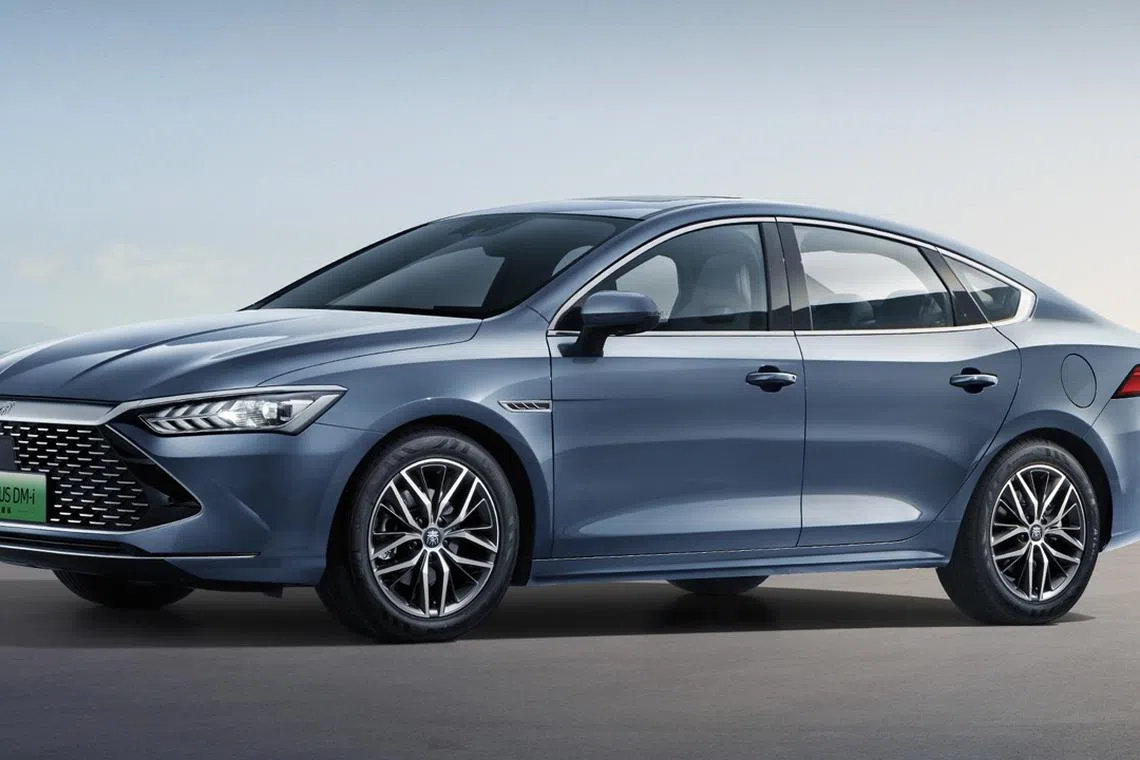
PHEVs are another card that BYD plans to play, and it is one that Tesla lacks. PHEVs are an alternative to EVs in places without extensive charging infrastructure, or for drivers who need to travel long distances.
Unlike regular petrol-electric hybrids with a limited electric range, PHEVs go further on electric power, while still running on petrol for longer distances. BYD’s claimed range for some of its PHEVs is up to 120 km on batteries and 1,000 km with petrol.
BYD is the world’s largest producer of PHEVs, which accounted for nearly half – 1.4 million – of its total car sales of 3 million in 2023. EVs have so far been the focus of its expansion in South-east Asia, but BYD is considering bringing these plug-ins to the region, including Singapore, said Liu.
Even when these PHEVs run on petrol, they are cleaner than regular cars. This is because, like conventional hybrids, they “recover” energy during braking or coasting, and store it in their batteries for future use.
They can thus meet demand for cleaner vehicles even among buyers with no access to a home charger, such as those who live in government housing or in rural areas, said Liu. He declined to mention specific targets for BYD’s plug-in sales in the region, noting that not all countries – including Singapore – have rebates or policies for this vehicle type. PHEVs, which already cost more than conventional hybrids, are ineligible for Singapore’s EV Early Adoption Incentive enjoyed by fully electric cars, so their adoption has been limited.
From 2022 to 2023, Singapore’s PHEV population rose 23.4 per cent to 1,359 from 1,101. In comparison, the EV population grew 82.8 per cent to 11,941 from 6,531.
But Liu believes such incentives will eventually be introduced – and when they are, BYD will enter overseas PHEV markets accordingly. “When talking about cars of the future, pure electric cars are only one aspect. PHEVs will certainly be another important aspect,” he said.
Analysts expect the competition among Chinese EVs to intensify in 2024, but have backed BYD’s emphasis on PHEVs and exports as a potential driver of growth in the mid-term.
DBS Group Research analysts expect sales growth of 20 to 30 per cent for the brand in 2024, supported by the expansion of its EV/PHEV portfolio. Nomura analysts predict BYD will “stay strong” amid intensified competition in China’s EV sector.
Both have a “buy” recommendation on BYD stock.
TRENDING NOW

Once staunchly pro-China, Malaysian Chinese businesses are now distancing themselves from Beijing

Looking beyond looming CEO succession, should UOB potentially pursue a transformative merger?

Could stablecoins be the future of money?

Grab CEO’s wife Chloe Tong on life with Anthony Tan and finding her purpose

