OFF TANGENT

The detectives who sniff out ‘superfake’ luxury bags

Imitators are getting more creative, but so are the sleuths

Sharanya Pillai
Published Fri, Feb 23, 2024 · 10:00 AM
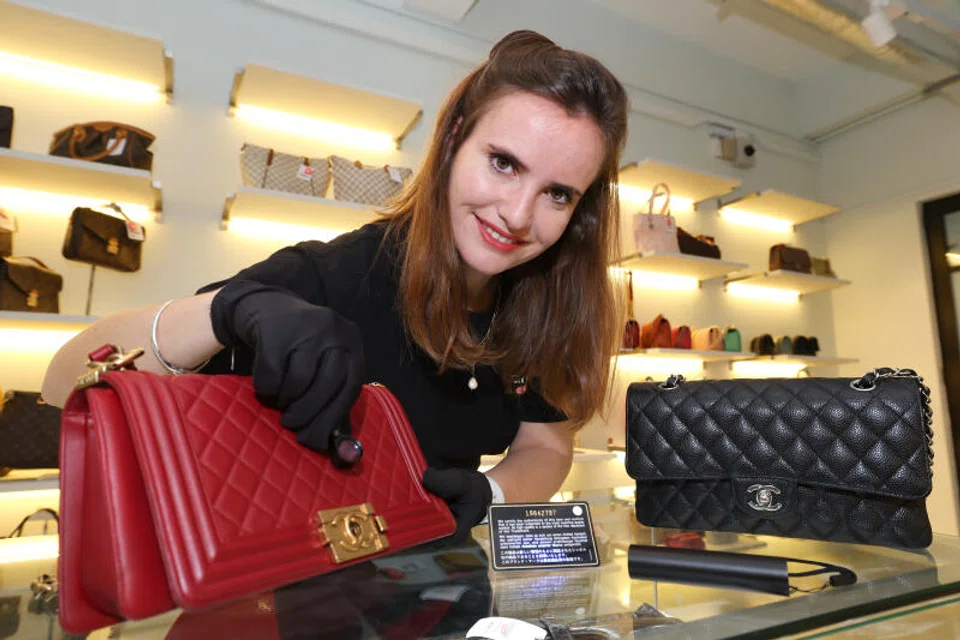
    • Luxury authenticators are like detectives gathering evidence to solve a mystery, says Carousell's Heloise Meyer.
    • Luxury authenticators are like detectives gathering evidence to solve a mystery, says Carousell's Heloise Meyer. BT PHOTO: YEN MENG JIIN

    WEARING black cloth gloves and holding a magnifying glass, Heloise Meyer gingerly examines a grey Hermès Birkin bag. No detail escapes her, as she shines a bright light from the magnifying glass onto the bag’s interior, labels, and even minute engravings.

    To my untrained eye, this Birkin looks no different from any of the others on display at the Carousell luxury showroom. But this is in fact a very convincing knock-off.

    Meyer lets me look through the magnifying glass at the zipper, where the brand name is engraved. Instead of carrying the Hermès label – with a grave accent mark – the zipper is wrongly branded Hermés, with an acute one.


    For luxury bag authenticators like Meyer, the subtlest details can be the biggest clues. It’s not too different from solving a crime or cracking a code.

    “I like to compare the authentication profession to detectives,” says Meyer, who is Carousell’s merchandising manager for luxury. “We have to gather proof and evidence to solve the mystery.”

    And like any professional sleuth, having good instincts is key. “We need a sixth sense to perform in this profession,” she says. “You have the factual product knowledge, but you also need this… intuition that will help you to know there is something wrong.”

    Asean Intelligence

    Get insights into businesses across South-east Asia

    Get the free report
    Want to test if you can spot a fake luxury bag? Play our quiz!

    That intuition muscle isn’t built overnight. Authenticators get to know the look, feel and even smell of genuine bags so well that encountering a fake produces an “immediate physical reaction”, she adds.

    Luxury is a booming business, and the sale of second-hand luxury goods is also growing. The resale luxury market was estimated to be worth US$25 billion to US$30 billion in 2020, and set to grow by 10 to 15 per cent annually over the next decade, consulting firm McKinsey & Co found.

    But fakes are also on the rise, with a new breed of knock-offs known as “superfakes” – counterfeits so well-made they are nearly indistinguishable from an authentic bag, and can easily fool customers and even artificial intelligence (AI) tools.

    “Some superfakes can pass the authentication of AI, because they’re so perfect visually. But for us, we will be able to authenticate (correctly) because we use all the other senses – touching, feeling, smelling – and tools that AI wouldn’t be using, like weighing and measuring,” says Meyer.

    Investigators at work

    The process for Meyer and the Carousell team starts from just a photo. Individuals who wish to sell their used luxury bags submit photos to the platform. And even just by studying the details, authenticators can spot tell-tale signs of a fake – a common one being the wrong font. These fakes are then swiftly rejected.

    “Unfortunately, many superfakes have very good fonts,” says Meyer. The team therefore has additional layers of checks once they receive the bags. They touch the leather to check if it has the right feel, and sniff it to suss out “wrong” smells. This can be especially tricky with used items.

    “Because these are second-hand, sometimes there are new smells, because it has been used by the person… or it was in a closed environment. But we know what the right and wrong smell are. There are some intermediary smells of usage, which are normal. But the wrong smell usually is a glue or chemical smell,” explains Meyer.

    Once, the Carousell team encountered a Chanel Classic Flap that passed the photo check and looked almost flawless.

    “The lambskin was beautiful, the stitchings were perfect… There’s a pocket at the back, and they managed to have a perfect alignment of the pocket with the body of the bag,” Meyer recounts.

    Yet the bag could not pass the smell test, because it literally had the “wrong” scent. “Maybe an untrained authenticator wouldn’t know, but actually it was through the smell that we managed to see an issue with the bag,” she says.

    Sometimes the clues lie not just in the bag itself, but even the packaging. Just some misaligned font in the logo can be solid evidence of a fake.

    In an attempt to combat superfakes, luxury houses have come up with verification tools, such as microchips embedded in each piece. But even these are being imitated by ever-ingenious superfake makers.

    Meyer’s team once came across a Louis Vuitton bag that had a microchip – typically a good sign. But upon closer inspection, it turned out that the microchip was labelled with the wrong factory name.

    “If we hadn’t checked the name properly, we could have gotten fooled by it. But it’s quite interesting that they went so deep that they even included a microchip – just that it was a fake one,” she says.

    As superfake makers get more creative, luxury houses will have to outsmart them. And in the middle of this cat-and-mouse game are the luxury authenticators, deploying their detective chops to protect consumers from the fakes.

    I point out to Meyer that with her black gloves and magnifying glass, she looks like a detective. She responds with a laugh. “Exactly, I feel like I’m Sherlock Holmes every day”.

    Ready to test if you can spot a fake luxury bag? Play our quiz!

    The art of sussing out superfakes is just one of many weird and wonderful phenomena out there. This bimonthly column goes off tangent from the news and looks into curiosities in various fields, from finance and economics to science and psychology, or even beyond.

    Decoding Asia newsletter: your guide to navigating Asia in a new global order. Sign up here to get Decoding Asia newsletter. Delivered to your inbox. Free.

    Copyright SPH Media. All rights reserved.